
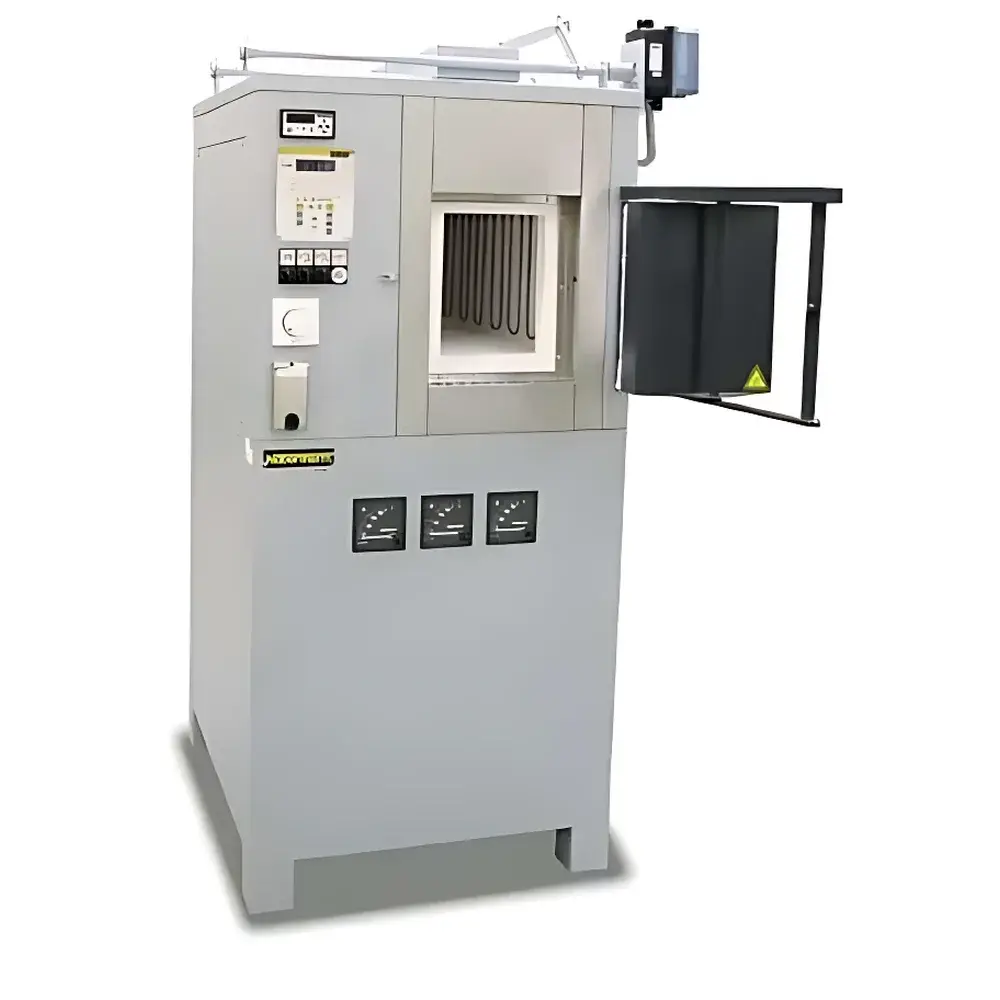
Nabertherm HT Series Vertical High-Temperature Muffle Furnace with MoSi₂ Heating Elements
| Brand | Nabertherm |
|---|---|
| Origin | Germany |
| Model | HT 04/16 – HT 16/18 |
| Furnace Type | Vertical Muffle Furnace |
| Max Temperature | 1600°C – 1800°C |
| Temperature Uniformity | ±1°C |
| Heating Element | Molybdenum Disilicide (MoSi₂) |
| Internal Dimensions | 150×150×150 mm to 260×300×200 mm |
| Chamber Volume | 4 L – 450 L |
| Max Power Input | 5.2 kW – 12.0 kW |
| Ramp Time to Max Temp | ≤60 min |
| Power Supply | 3-phase, 400 V |
| Thermal Insulation | High-purity Al₂O₃ fiber module construction |
| Safety | Dual-stage overtemperature protection (mechanical limiter + electronic controller), B-type thermocouple (PtRh30/PtRh6), chain-guided parallel door mechanism, helical locking system, reinforced hearth option, inert gas purge ports, optional forced-air cooling fan & automated venting |
Overview
The Nabertherm HT Series represents a class of precision-engineered vertical high-temperature muffle furnaces designed for demanding laboratory and R&D applications requiring thermal stability, reproducibility, and long-term operational integrity at extreme temperatures. Built upon a rigid, space-efficient vertical architecture, the HT furnace leverages molybdenum disilicide (MoSi₂) heating elements — renowned for their oxidation resistance, mechanical rigidity, and stable resistivity up to 1800°C in air — to deliver uniform radiant heating across the entire working chamber. Unlike conventional resistance wire or silicon carbide systems, MoSi₂ elements maintain structural integrity without sagging or creep under prolonged exposure to >1600°C, enabling consistent thermal profiles essential for sintering, ashing, calcination, and high-temperature material synthesis. The furnace chamber is lined with high-purity alumina fiber modules (Al₂O₃ ≥95%), offering low thermal mass, minimal outgassing, and exceptional thermal insulation — critical for minimizing energy consumption and achieving rapid ramp rates (≤60 minutes to maximum temperature) while preserving temperature homogeneity within ±1°C across the specified working zone.
Key Features
- Vertical configuration optimized for ergonomic loading/unloading and reduced floor footprint in constrained lab environments
- MoSi₂ heating elements mounted in double-wall configuration for enhanced thermal symmetry and extended service life beyond 5,000 hours at 1750°C
- Chain-guided parallel door movement ensures precise alignment during opening/closing, preventing fiber insulation compression or delamination
- Helical cam locking mechanism provides uniform sealing pressure across the full door perimeter, maintaining chamber integrity during inert gas purging
- Dual independent overtemperature protection: mechanical B-type thermocouple limiter (fail-safe cut-off) + programmable digital controller safeguard
- Reinforced hearth options available for loads exceeding 25 kg; standard hearth rated for continuous operation at full temperature with distributed mass
- Integrated purge ports (ISO-KF 16 or 25) with Viton or ceramic-sealed feedthroughs compatible with N₂, Ar, or forming gas atmospheres
- Optional forced-air cooling fan (EC motor, variable speed) and motorized vent damper enable controlled cooldown profiles per ASTM E1113 or ISO 8501-1
Sample Compatibility & Compliance
The HT furnace accommodates a wide range of sample geometries and materials, including ceramic green bodies, metal powders, catalyst precursors, refractory crucibles (Al₂O₃, ZrO₂, graphite), and semiconductor substrates. Its air-atmosphere capability — enabled by MoSi₂’s inherent passivation layer — eliminates need for vacuum or reducing gas in most oxide-processing workflows. All models comply with IEC 61000-6-3 (EMC emission), IEC 61000-6-2 (immunity), and EN 61000-3-12 (harmonic current limits). Optional configurations support GLP/GMP-aligned operation: audit-trail-enabled controllers (IEC 62304 Class B), 21 CFR Part 11-compliant data logging, and traceable calibration certificates (DAkkS-accredited where applicable). Chamber linings meet USP extractables criteria for pharmaceutical thermal validation studies.
Software & Data Management
Standard furnaces ship with Nabertherm’s THERMOCOM® 3.0 controller featuring 16-segment programmable ramp-soak profiles, real-time graphing, and USB data export (CSV/TXT). Optional THERMOCOM® LabLink software enables remote monitoring via Ethernet/Wi-Fi, synchronized multi-furnace scheduling, and automated report generation compliant with ISO/IEC 17025 clause 7.8.2. All controllers record timestamped temperature logs with resolution of 0.1°C, supporting retrospective analysis of thermal history per ASTM E220 or ISO 80601-2-80. Data integrity safeguards include write-protected memory, cyclic redundancy checksums, and configurable user access levels (operator, technician, administrator).
Applications
- High-temperature sintering of advanced ceramics (e.g., Si₃N₄, AlN, YSZ) and ultra-high-molecular-weight polyethylene (UHMWPE) composites
- Thermal gravimetric analysis (TGA) pre-conditioning and residue quantification per ISO 11358 and ASTM D6370
- Calcination of metal oxides (e.g., NiO, Co₃O₄, MnO₂) for battery cathode precursor synthesis
- Ash content determination in food, feed, and polymer matrices (AOAC 942.05, ISO 2171)
- Heat treatment of dental zirconia frameworks and orthopedic implant coatings
- Pre-firing of platinum crucibles and quartz ware prior to ICP-MS analysis
- Development and qualification of thermal barrier coatings (TBCs) under simulated service conditions
FAQ
What atmosphere options are supported without modification?
Air operation is standard; inert gas purging (N₂, Ar) is enabled via factory-installed ISO-KF ports and sealed door gaskets. Reducing atmospheres (e.g., H₂/N₂) require optional quartz or molybdenum hot-zone liners.
Can the furnace be integrated into an automated sample handling system?
Yes — all models provide dry-contact I/O signals (start/stop, door open/closed, fault status) and Modbus RTU over RS485 for PLC-level integration per IEC 61158.
Is calibration traceable to national standards?
Factory calibration uses DAkkS-accredited reference thermocouples; on-site recalibration kits (including fixed-point cells for Co-C and Pd melting points) are available upon request.
What maintenance intervals are recommended for MoSi₂ elements?
No scheduled replacement is required; lifetime exceeds 5,000 h at 1750°C in clean air. Visual inspection every 500 h is advised to detect surface pitting or localized oxidation.
Does the controller support custom PID tuning for non-standard load configurations?
Yes — advanced tuning mode allows manual adjustment of proportional band, integral time, and derivative gain to optimize response for low-mass or high-thermal-inertia samples.



