
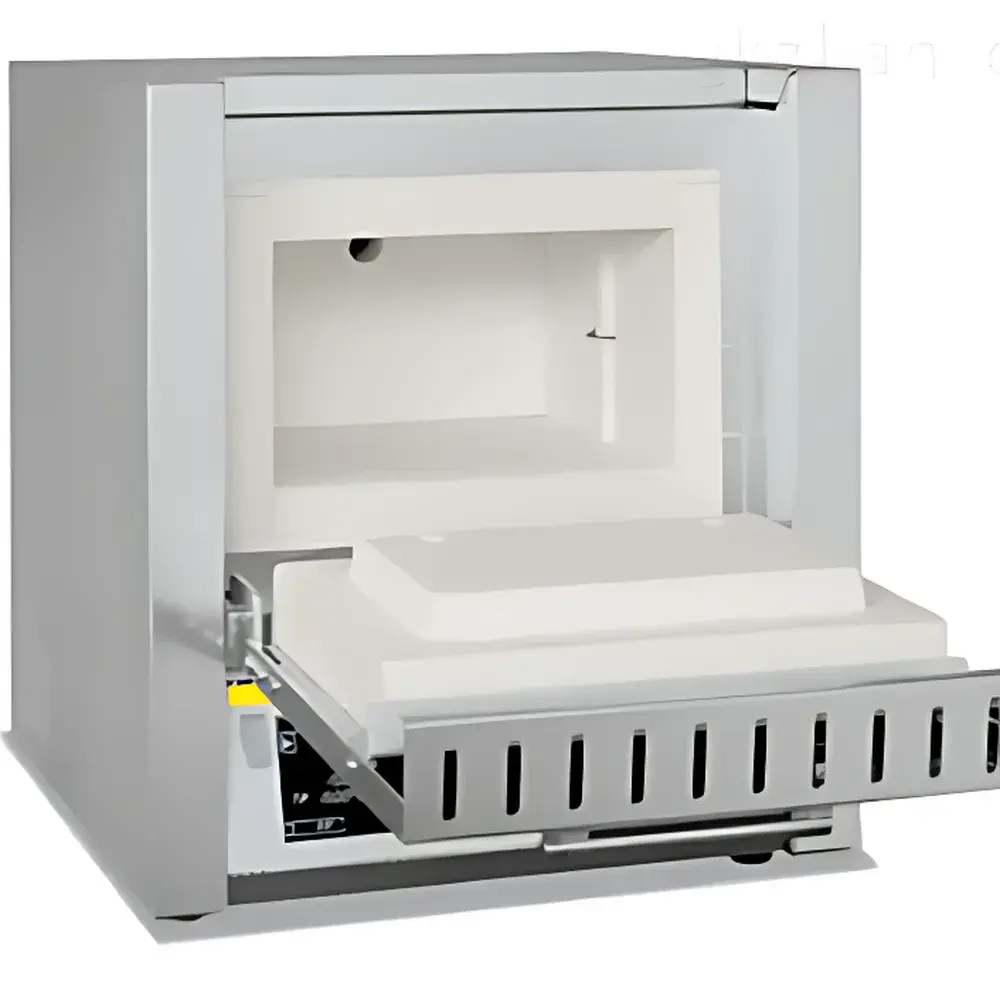
Nabertherm N/L Series High-Temperature Muffle Furnace
| Brand | Nabertherm |
|---|---|
| Origin | Germany |
| Model | N/L Series |
| Temperature Range | 30 °C to 1300 °C (standard), up to 3000 °C (custom configurations) |
| Heating Configuration | Triple-sided (N-type), Bottom-protected with SiC plates |
| Insulation | Multi-layer lightweight refractory bricks |
| Controller Options | B150, C250 (side-mounted), B170 (programmable PID), P320 (9 programs × 8 segments), C40 + dual C6Z (triple-zone, ≥750 mm length, ≤1300 °C) |
| Chamber Construction | Stainless steel housing, radiation-free heating elements wound on ceramic support tubes |
| Exhaust Port Location | Side (N31 and earlier), rear wall (N31/H onward) |
| Door Mechanism | Vertically downward-opening parallel-guided door |
| Optional Accessories | Integrated exhaust purification systems, data logging modules compliant with GLP/GMP audit trails |
Overview
The Nabertherm N/L Series High-Temperature Muffle Furnace is a rigorously engineered thermal processing system designed for precision laboratory and pilot-scale applications requiring stable, repeatable, and traceable heat treatment. Based on decades of German industrial furnace expertise, this series implements classical muffle furnace architecture—where the heating elements are physically isolated from the process chamber by refractory barriers—to eliminate contamination risks and ensure chemical inertness during sintering, calcination, ashing, annealing, and pre-firing operations. Operating on resistive heating principles via silicon carbide (SiC) or high-purity Kanthal® elements, the furnace delivers uniform thermal distribution across its working volume through triple-sided (N-type) or axial (L-type tube furnace) energy input. Its temperature capability spans 30 °C to 1300 °C as standard—with extended configurations reaching 3000 °C upon specification—making it suitable for advanced ceramics, metallurgical research, dental prosthesis firing, and ISO/ASTM-compliant thermal testing protocols.
Key Features
- Triple-zone heating architecture (optional on L-series furnaces ≥750 mm length) enables independent control of front, center, and rear zones—critical for gradient thermal profiles in sintering studies.
- Radiation-free heating elements wound on high-alumina ceramic support tubes minimize thermal drift and extend service life while improving energy efficiency by up to 18% compared to conventional coil-wound designs.
- Multi-layer lightweight refractory brick insulation ensures low surface temperatures (<55 °C at ambient +25 °C), reduced standby losses, and compliance with EN 60519-2 safety standards for laboratory equipment.
- Vertically downward-opening parallel-guided door provides stable alignment, gas-tight sealing, and unobstructed access—essential for reproducible sample loading and minimizing thermal shock during insertion/removal.
- SiC bottom shielding plates protect heating elements from mechanical abrasion and thermal cycling fatigue—particularly advantageous in metal heat-treatment and powder metallurgy workflows.
- Modular controller ecosystem supports both fixed-setpoint operation (B150/C250) and fully programmable thermal profiles (B170, P320, C40+C6Z), with optional real-time data export via RS485/USB interfaces.
Sample Compatibility & Compliance
The N/L Series accommodates a broad range of sample geometries and chemistries—including crucibles (alumina, zirconia, graphite), ceramic green bodies, metallic alloys, catalyst pellets, and biological ashing vessels—without risk of cross-contamination due to its sealed muffle design. All standard models meet CE marking requirements under Directive 2014/35/EU (Low Voltage Directive) and 2014/30/EU (EMC Directive). Optional configurations include exhaust gas recirculation units certified to DIN EN 13672 for VOC abatement and integrated thermocouple calibration ports traceable to PTB (Physikalisch-Technische Bundesanstalt). The furnace’s thermal stability (±1 °C over 8 hours at 1000 °C) and uniformity (±5 °C across 90% of working volume) satisfy ASTM E220, ISO 9001:2015 clause 7.1.5.2 (monitoring and measuring resources), and USP requirements for thermal validation in pharmaceutical excipient processing.
Software & Data Management
Nabertherm’s proprietary THERMOCOM software (v4.2+) supports bidirectional communication with all digital controllers in the N/L platform. It enables full-cycle thermal profile definition—including ramp rates (0.1–50 °C/min), dwell times (1 min–99 h 59 min), and conditional logic steps (e.g., “hold until TC#2 reaches 850 °C”). Audit trail functionality complies with FDA 21 CFR Part 11 when paired with password-protected user roles, electronic signatures, and immutable event logs stored in encrypted .CSV/.XML formats. Raw temperature data can be synchronized with external DAQ systems via Modbus TCP, facilitating integration into LIMS environments and automated quality reporting workflows aligned with ISO/IEC 17025:2017 clause 7.7.
Applications
- Materials science: Sintering of oxide/non-oxide ceramics (Al2O3, SiC, ZrO2), densification studies, phase transformation analysis.
- Metallurgy: Annealing of stainless steels and superalloys, stress-relief treatments, grain growth experiments under controlled atmospheres.
- Environmental testing: EPA Method 2540E-compliant ash content determination in soils, sludges, and wastewater solids.
- Dental laboratories: Firing of zirconia frameworks and porcelain veneers per ISO 6872:2015 specifications.
- Academic research: Kinetic modeling of solid-state reactions using multi-step thermal programs with precise dwell accuracy.
- Quality control: Thermal validation of refractory linings, catalyst supports, and battery electrode materials prior to scale-up.
FAQ
What is the maximum recommended continuous operating temperature for the standard N/L Series?
The standard configuration is rated for continuous operation up to 1300 °C; higher-temperature variants (e.g., 1600 °C or 3000 °C) require custom refractory lining, specialized heating elements, and additional cooling provisions.
Can the furnace be operated under inert or reducing atmospheres?
Yes—when equipped with gas inlet/outlet ports and optional atmosphere control kits (e.g., N2/Ar purge, H2/N2 mixtures), provided proper venting and explosion-proof accessories are installed per ATEX Directive 2014/34/EU.
Is third-party calibration documentation available?
Factory calibration certificates (traceable to national standards) are included; on-site verification and ISO/IEC 17025-accredited calibration services are available through authorized Nabertherm service partners.
How is temperature uniformity verified across the working chamber?
Uniformity mapping is performed per ASTM E220 Annex A3 using a 9-point thermocouple array; reports include deviation contours and uncertainty budgets referenced to the furnace’s master sensor.
Does the system support remote monitoring via Ethernet or Wi-Fi?
Ethernet connectivity (TCP/IP) is standard on P320 and C40 controllers; Wi-Fi requires an external industrial-grade gateway and is not natively supported due to electromagnetic interference concerns in high-temperature lab environments.
Related Products



