
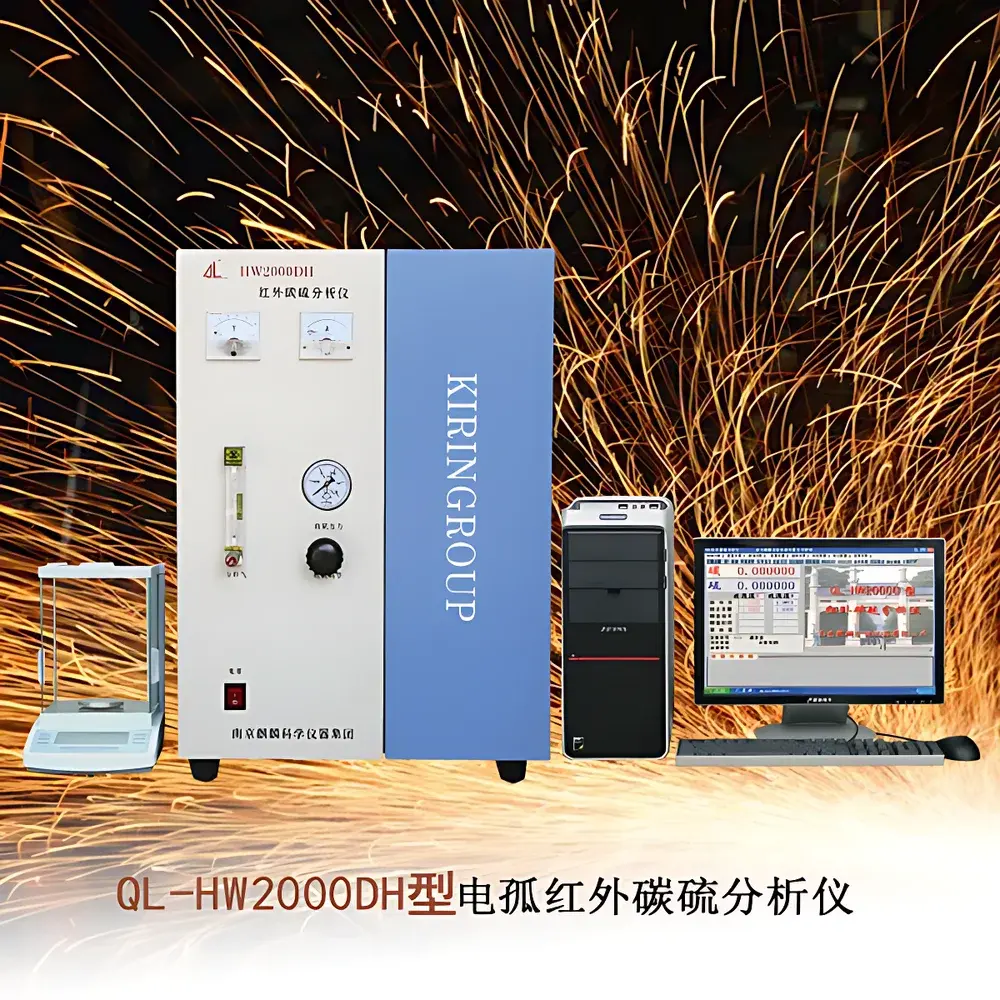
Nanjing Qilin QL-HW2000DH Arc-Combustion Infrared Carbon-Sulfur Analyzer
| Brand | Qilin/QL |
|---|---|
| Origin | Jiangsu, China |
| Manufacturer Type | Authorized Distributor |
| Regional Classification | Domestic (China) |
| Model | QL-HW2000DH |
| Measurement Principle | Infrared Absorption Spectroscopy |
| Heating System | High-Frequency Induction Furnace |
| Carbon Range | ω(C) 0.0010–10.00 wt% |
| Sulfur Range | ω(S) 0.0005–0.500 wt% |
| Sensitivity | 0.1 ppm (as displayed reading) |
| Accuracy | Compliant with GB/T 223.69–1997 (C) and GB/T 223.68–1997 (S) |
| Analysis Time | Adjustable 20–60 s (typical: 35 s) |
| Sample Weighing | Analytical Balance (0.0001 g resolution) |
| Operating Environment | 10–30 °C, RH < 75% |
Overview
The Nanjing Qilin QL-HW2000DH Arc-Combustion Infrared Carbon-Sulfur Analyzer is a robust, benchtop elemental analyzer engineered for precise quantification of total carbon (C) and sulfur (S) in ferrous and non-ferrous metallic matrices—including carbon steels, stainless steels, cast irons, nickel-based superalloys, and titanium alloys. It operates on the principle of high-frequency induction combustion coupled with dual-channel non-dispersive infrared (NDIR) detection. During analysis, a precisely weighed solid sample is combusted in an oxygen-rich atmosphere within a high-purity quartz combustion tube. The evolved CO₂ and SO₂ gases are swept through proprietary gas-handling modules—comprising dust filtration, water vapor removal via perchloric acid magnesium and anhydrous calcium sulfate traps, and CO-to-CO₂ conversion—before entering dedicated NDIR cells calibrated for each analyte. The instrument’s optical path employs thermally stabilized detectors and narrow-band interference filters to ensure high selectivity and minimal cross-sensitivity between C and S signals.
Key Features
- High-frequency induction furnace (≥2.5 kW output) enabling rapid, complete combustion of refractory and high-carbon materials without electrode erosion or arc instability
- Dual independent NDIR detection cells with temperature-compensated photodetectors and optimized optical path lengths for enhanced signal-to-noise ratio
- Automated sample introduction and ignition sequence; arc initiation time ≤ 0.4 s per analysis cycle
- Integrated analytical balance interface (0.0001 g resolution) supporting不定量称样 (non-fixed mass sampling), eliminating manual re-weighing and improving throughput
- Modular gas purification system with real-time pressure monitoring and automatic flow regulation (50–120 mL/min)
- Industrial-grade metal chassis with EMI-shielded electronics enclosure and passive thermal management for stable long-term operation in QC laboratories
Sample Compatibility & Compliance
The QL-HW2000DH accommodates solid metallic samples up to 1.0 g in mass, including drill chips, turnings, and pressed pellets. It supports direct analysis of low-alloy steels, tool steels, and high-sulfur copper alloys without pre-treatment. The instrument meets the performance requirements specified in national standards GB/T 223.69–1997 (for carbon) and GB/T 223.68–1997 (for sulfur), and its measurement traceability aligns with ISO/IEC 17025–2017 general requirements for competence of testing and calibration laboratories. While not certified to ASTM E1019 or ISO 15350 out-of-the-box, its hardware architecture and calibration protocol are fully compatible with those methods upon user-defined validation and routine verification using certified reference materials (CRMs) such as NIST SRM 662a, 663a, and 664a.
Software & Data Management
The embedded Windows-based control software provides full method configuration, real-time spectral monitoring, auto-calibration curve generation (linear and quadratic), and drift correction via internal reference gas pulses. All analytical data—including raw absorbance values, peak integration parameters, and instrument status logs—are timestamped and stored in encrypted binary files compliant with basic audit-trail requirements. Export options include CSV, TXT, and XML formats for LIMS integration. Though not natively compliant with FDA 21 CFR Part 11, the system supports optional third-party electronic signature modules and configurable user access levels (Operator, Supervisor, Administrator) to facilitate GLP/GMP-aligned workflows in regulated environments.
Applications
This analyzer serves as a primary tool in metallurgical QC labs for incoming raw material inspection, melt process control, and final product certification. Typical use cases include: verification of carbon content in austenitic stainless steel grades (e.g., 304, 316) to ensure corrosion resistance; sulfur quantification in bearing steels (e.g., GCr15) where excessive S promotes MnS inclusion formation; rapid screening of scrap metal blends prior to remelting; and R&D support for developing low-carbon high-strength steels (<0.03 wt% C). Its sub-ppm sensitivity and reproducibility (RSD < 0.8% at 0.1 wt% C level) make it suitable for both routine production testing and intermediate-level research applications.
FAQ
What types of samples can be analyzed on the QL-HW2000DH?
Solid metallic specimens only—including ferrous alloys, nickel-based superalloys, titanium, and copper alloys. Powders, ceramics, or organic matrices require alternative instrumentation.
Is the instrument compatible with ASTM E1019?
The hardware design and combustion/detection principles conform to ASTM E1019 requirements; full compliance requires user-performed method validation using approved CRMs and documented uncertainty assessment.
Does the system support automated calibration verification?
Yes—users may schedule periodic zero/gain checks using certified span gases or CRM samples, with results logged and trended in the software.
What maintenance intervals are recommended?
Quartz combustion tube replacement every 3,000–5,000 analyses; filter cartridges every 200–300 runs; annual optical alignment verification and detector baseline recalibration.
Can data be exported to a laboratory information management system (LIMS)?
Yes—via configurable CSV/XML export with field-mapping support; direct ODBC connectivity is not included but can be implemented via middleware.




