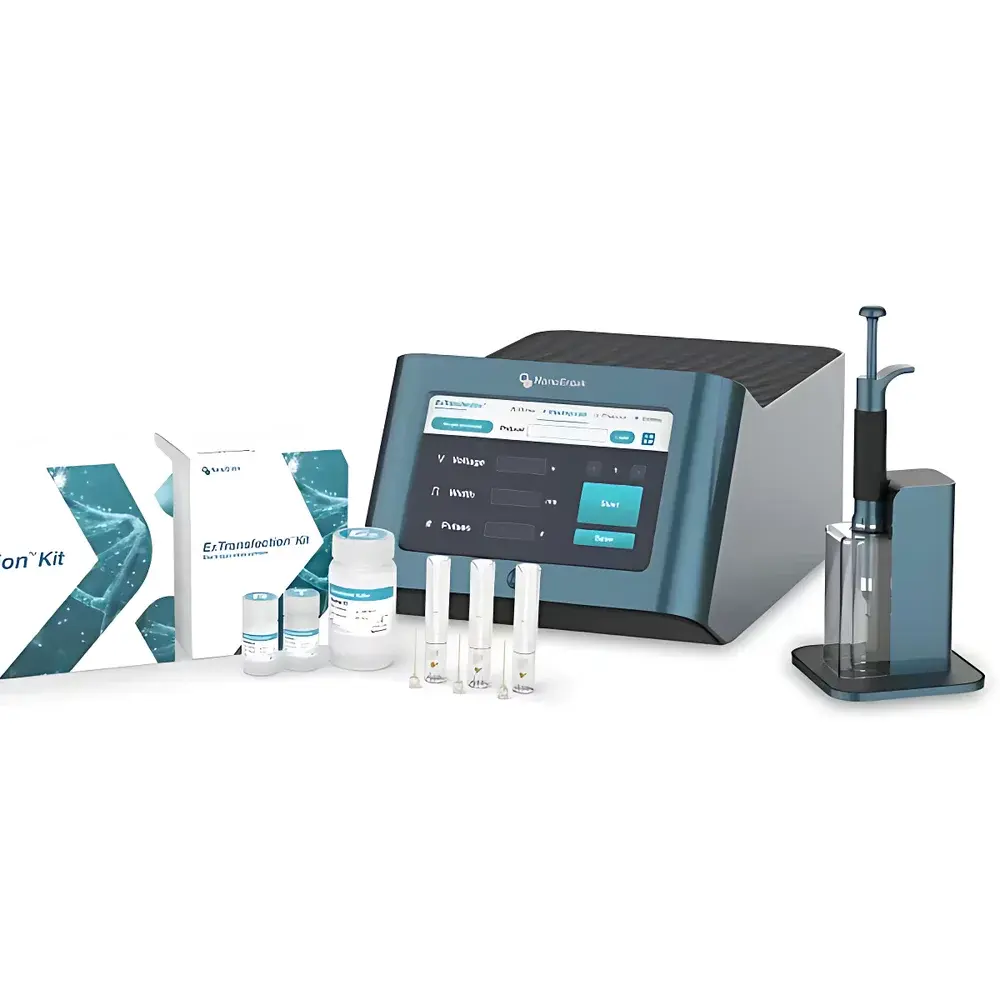
NanoEnTek ExTransfection Microchannel Electroporation System
| Brand | NanoEnTek |
|---|---|
| Origin | South Korea |
| Model | ExTransfection |
| Type | Benchtop Microchannel Electroporator |
| Application Focus | High-Efficiency Nucleic Acid and RNP Delivery to Primary Cells, Stem Cells, and Immune Cells |
Overview
The NanoEnTek ExTransfection Microchannel Electroporation System is a precision-engineered benchtop electroporator designed for high-efficiency, low-toxicity delivery of nucleic acids (plasmid DNA, siRNA, shRNA) and ribonucleoprotein complexes (RNPs), including CRISPR-Cas9, into challenging mammalian cell types. Unlike conventional cuvette-based electroporators relying on parallel-plate electrode geometry, the ExTransfection system employs proprietary microchannel electroporation technology—replacing rigid cuvettes with disposable capillary-type electroporation chambers. This architecture maximizes inter-electrode gap while minimizing electrode surface area, resulting in a highly uniform electric field distribution across the sample volume. The consequence is significantly improved transfection efficiency and markedly enhanced post-pulse cell viability—particularly critical for primary, non-dividing, and immunologically relevant cell populations where membrane recovery and functional integrity are paramount.
Key Features
- Microchannel electroporation chamber design enabling uniform field distribution and reduced joule heating
- Benchtop operation with intuitive touchscreen interface and programmable pulse parameters (voltage, pulse width, number of pulses)
- Dedicated pre-optimized protocols for CRISPR-Cas9 RNP delivery in Jurkat (1600 V, 10 ms, 3 pulses), HEK293 (1200 V, 10 ms, 3 pulses), and other hard-to-transfect lines
- Single-buffer workflow compatibility—eliminates need for multiple buffer exchanges or cell washing steps pre- or post-electroporation
- Biocompatible pipette-tip-compatible chamber loading—minimizes sample loss and enables precise handling of low-input cell numbers (10⁴–10⁷ cells per reaction)
- Robust thermal management system ensuring consistent pulse delivery across repeated runs
Sample Compatibility & Compliance
The ExTransfection system demonstrates validated performance across a broad spectrum of mammalian cell types, with particular efficacy in primary immune cells—including bone marrow-derived macrophages (BMDM), conventional dendritic cells (cDC1, cDC2, BM-cDC1), CD4⁺ and CD8⁺ T lymphocytes, natural killer (NK) cells, and hematopoietic stem/progenitor cells. Its ability to deliver Cas9 RNPs with >90% editing efficiency in these systems supports applications aligned with ISO/IEC 17025-compliant assay development and GLP-aligned functional genomics workflows. While not FDA-cleared for clinical diagnostics, the system’s design, documentation, and traceable parameter logging support audit readiness for academic, biotech, and contract research laboratory environments adhering to internal SOPs referencing ASTM F2975-22 (Standard Guide for Electroporation-Based Gene Transfer in Mammalian Cells).
Software & Data Management
The integrated control software provides full experimental traceability: each run logs timestamp, user ID, protocol name, applied voltage, pulse duration, pulse count, and chamber resistance. Exportable CSV reports include post-run viability estimates (via integrated impedance-based assessment) and optional integration with third-party analysis platforms via API. Audit trail functionality complies with ALCOA+ principles (Attributable, Legible, Contemporaneous, Original, Accurate, Complete, Consistent, Enduring, Available), supporting laboratories operating under 21 CFR Part 11–aligned data integrity frameworks. No cloud storage is enabled by default; all data resides locally unless explicitly exported by the user.
Applications
- CRISPR-Cas9 and base editor RNP delivery for knock-out, knock-in, and epigenetic modulation in primary human and murine immune cells
- High-efficiency transfection of suspension cells (e.g., Jurkat, THP-1) without centrifugation-dependent adaptation
- Functional screening of transcription factors, intracellular biosensors, and surface marker expression in rare cell subsets
- Development of ex vivo engineered immune therapies requiring minimal culture perturbation
- siRNA/shRNA-mediated gene silencing in terminally differentiated cells where viral vectors are contraindicated
- Co-delivery of multiple payloads (e.g., Cas9 RNP + donor ssDNA) with preserved stoichiometry
FAQ
What cell input range is supported per electroporation reaction?
The system accommodates 10⁴ to 10⁷ viable cells per microchannel chamber, with optimal performance observed between 1×10⁵ and 5×10⁶ cells depending on cell type and payload.
Is the microchannel chamber reusable?
No—chambers are single-use, sterile, and certified endotoxin-free to prevent cross-contamination and ensure reproducible electrical characteristics across experiments.
Can I customize pulse parameters beyond pre-set protocols?
Yes. Full manual control is available for voltage (range: 100–2000 V), pulse width (1–100 ms), and pulse number (1–10), enabling empirical optimization for novel cell-payload combinations.
Does ExTransfection require specialized buffers?
It operates with a single, serum-free, low-conductivity electroporation buffer supplied by NanoEnTek; no additional buffer exchange or recovery media are required prior to culture.
How is cell viability assessed post-electroporation?
Viability is inferred from real-time impedance monitoring during pulsing and confirmed experimentally via trypan blue exclusion, Annexin V/PI staining, or functional assays such as cytokine secretion or proliferation capacity.