
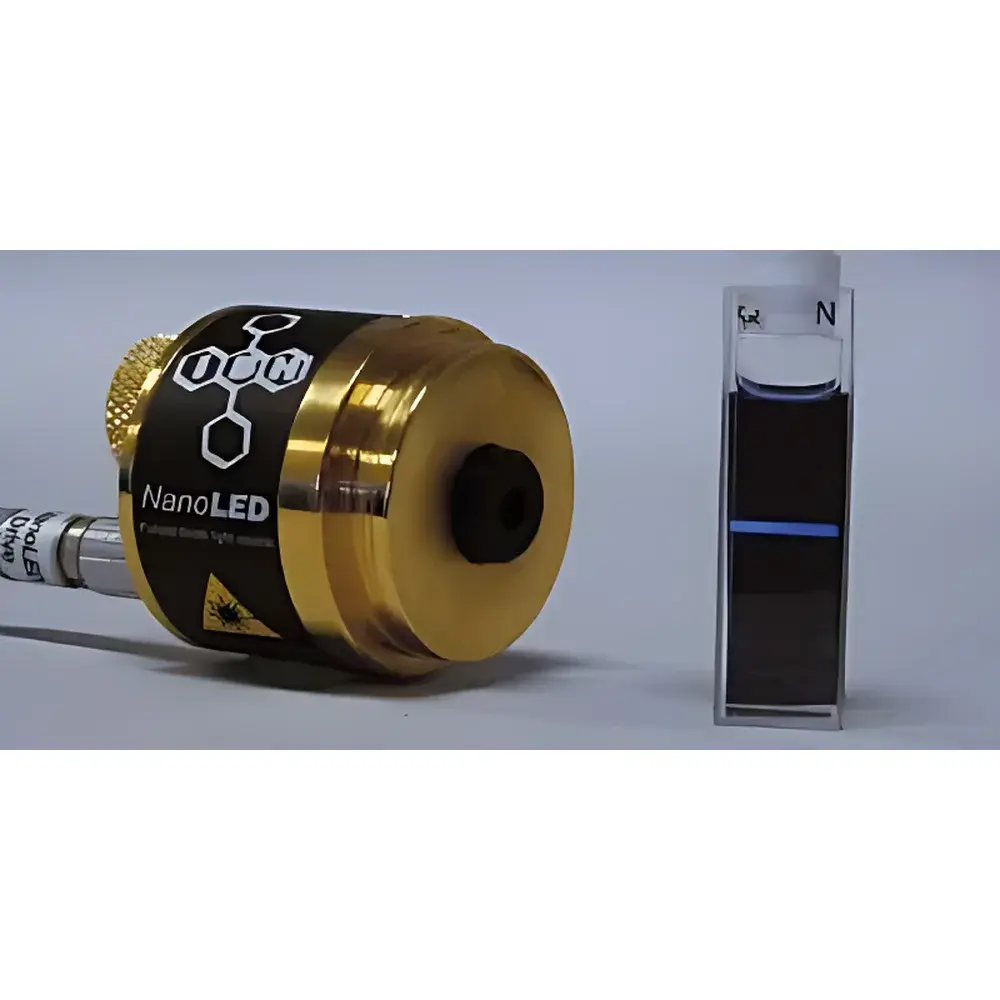
NanoLED High-Frequency Pulsed Laser Source
| Brand | HORIBA |
|---|---|
| Origin | United Kingdom |
| Manufacturer | Jobin Yvon IBH (acquired by HORIBA) |
| Model | NanoLED |
| Core Technology | Semiconductor-based pulsed diode laser |
| Wavelength Range | 250–830 nm (UV to NIR) |
| Pulse Width | <100 ps (typ. for 405 nm variant) |
| Repetition Rate | 10 kHz – 1 MHz (software-selectable in multiple discrete steps) |
| Pulse Energy | 10 pJ/pulse (at 405 nm, typical) |
| Control Interface | Single unified controller compatible with all NanoLED variants |
| Compliance | CE-marked |
Overview
The NanoLED High-Frequency Pulsed Laser Source is a precision semiconductor-based pulsed diode laser system engineered for time-resolved photoluminescence and fluorescence lifetime measurements. Developed by Jobin Yvon IBH — now part of HORIBA’s global photonics portfolio — the NanoLED platform leverages ultrafast current-driven laser diode architecture to deliver sub-200 picosecond optical pulses with exceptional temporal stability and low jitter. Unlike flashlamp-pumped or mode-locked solid-state sources, the NanoLED operates on direct electrical pulsing of high-speed laser diodes, enabling precise synchronization with detection electronics (e.g., TCSPC modules, streak cameras, or gated ICCDs) without external triggering latency. Its design prioritizes pulse fidelity, spectral purity, and long-term repeatability—critical parameters for quantitative decay analysis in complex biological, material, and chemical systems.
Key Features
- Ultrafast pulse generation: <100 ps pulse width (NanoLED-405L), <200 ps across full wavelength range
- Wide spectral coverage: 250 nm (deep UV) to 830 nm (NIR), with 29 discrete wavelength options including NanoLED-250, NanoLED-470L, NanoLED-635L, and NanoLED-785L
- Programmable repetition rate: 10 kHz to 1 MHz in user-defined steps via integrated controller firmware
- Single universal controller: Fully backward- and forward-compatible across all NanoLED models — eliminates hardware reconfiguration when upgrading or switching wavelengths
- Stable pulse energy: 10 pJ/pulse (typical at 405 nm, calibrated per unit); energy consistency maintained over >10⁶ pulses under continuous operation
- Low timing jitter: <25 ps RMS (measured against sync output), ensuring high-resolution decay fitting in TCSPC applications
- Compact OEM-ready form factor: Designed for seamless integration into commercial and custom-built fluorescence lifetime spectrometers
Sample Compatibility & Compliance
The NanoLED series supports a broad range of sample types—including aqueous protein solutions, quantum dot suspensions, organic thin films, perovskite crystals, and single-molecule immobilized surfaces—without requiring optical parametric amplification or harmonic generation. Its narrow spectral bandwidth (<2 nm FWHM for most variants) minimizes excitation-induced photobleaching while maximizing signal-to-noise in lifetime-resolved detection. All units comply with IEC 61000-6-3 (EMC emission standards) and IEC 60825-1:2014 (laser safety Class 1 or Class 3R depending on wavelength and output configuration). Devices are CE-marked and RoHS-compliant. For regulated environments, the NanoLED controller firmware supports audit-trail-enabled operation when paired with HORIBA’s FluoroLog®-3 or DeltaFlex™ software platforms compliant with FDA 21 CFR Part 11 requirements.
Software & Data Management
NanoLED instruments interface natively with HORIBA’s industry-standard fluorescence lifetime analysis software suites, including DAS6 and DecayFit, which implement iterative reconvolution, multi-exponential decay modeling, and χ²-based goodness-of-fit assessment. The controller provides TTL-sync output, analog modulation input, and USB 2.0 communication for real-time parameter adjustment (pulse frequency, delay, intensity scaling). All configuration settings, calibration logs, and usage history are timestamped and exportable in CSV or HDF5 format. When deployed within GLP/GMP workflows, full electronic records—including operator ID, instrument serial number, and environmental metadata (ambient temperature, humidity)—are embedded automatically in measurement files.
Applications
- Time-correlated single-photon counting (TCSPC) for protein conformational dynamics and Förster resonance energy transfer (FRET)
- Fluorescence lifetime imaging microscopy (FLIM) in confocal and multiphoton systems
- Characterization of phosphorescent OLED materials and triplet-state lifetimes
- Decay kinetics analysis of photocatalytic intermediates and charge-transfer states in perovskites
- Quality control of fluorescent nanoprobes in diagnostic assay development
- Validation of ultrafast photophysical models in molecular photophysics research
FAQ
Is the NanoLED compatible with third-party TCSPC hardware?
Yes — the NanoLED provides standardized TTL sync and gate signals, and its timing specifications meet the input requirements of Becker & Hickl, PicoQuant, and Horiba’s own detectors.
Can pulse energy be adjusted without changing the wavelength module?
Yes — attenuation is achieved via internal current-limiting circuitry; output energy is digitally adjustable from 1% to 100% of nominal value while preserving pulse width and jitter performance.
What calibration documentation is provided with each unit?
Each NanoLED ships with a factory calibration certificate detailing measured pulse width (FWHM), center wavelength (±0.5 nm), spectral bandwidth, average power, and timing jitter — traceable to NPL (UK) standards.
Does HORIBA offer wavelength-specific service contracts for NanoLED systems?
Yes — extended warranty and preventive maintenance plans include wavelength verification, pulse profile validation, and controller firmware updates aligned with ISO/IEC 17025-accredited procedures.




