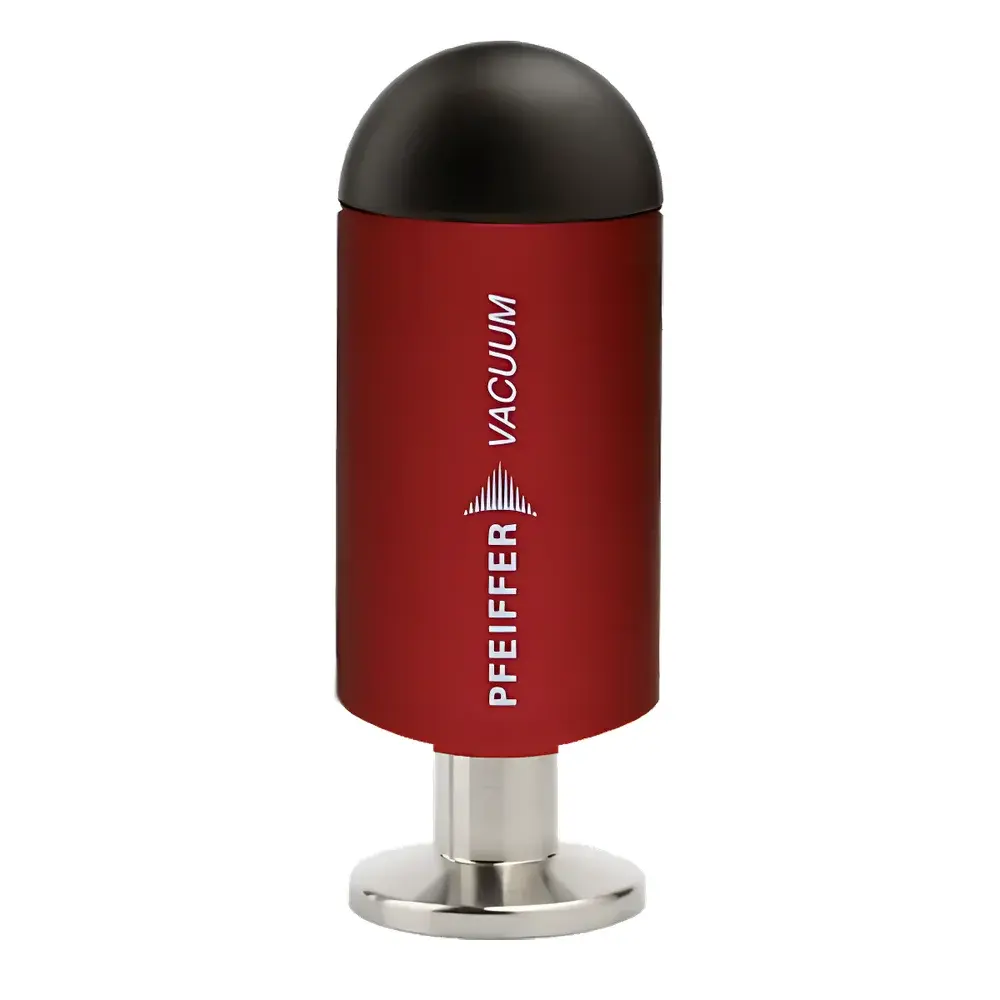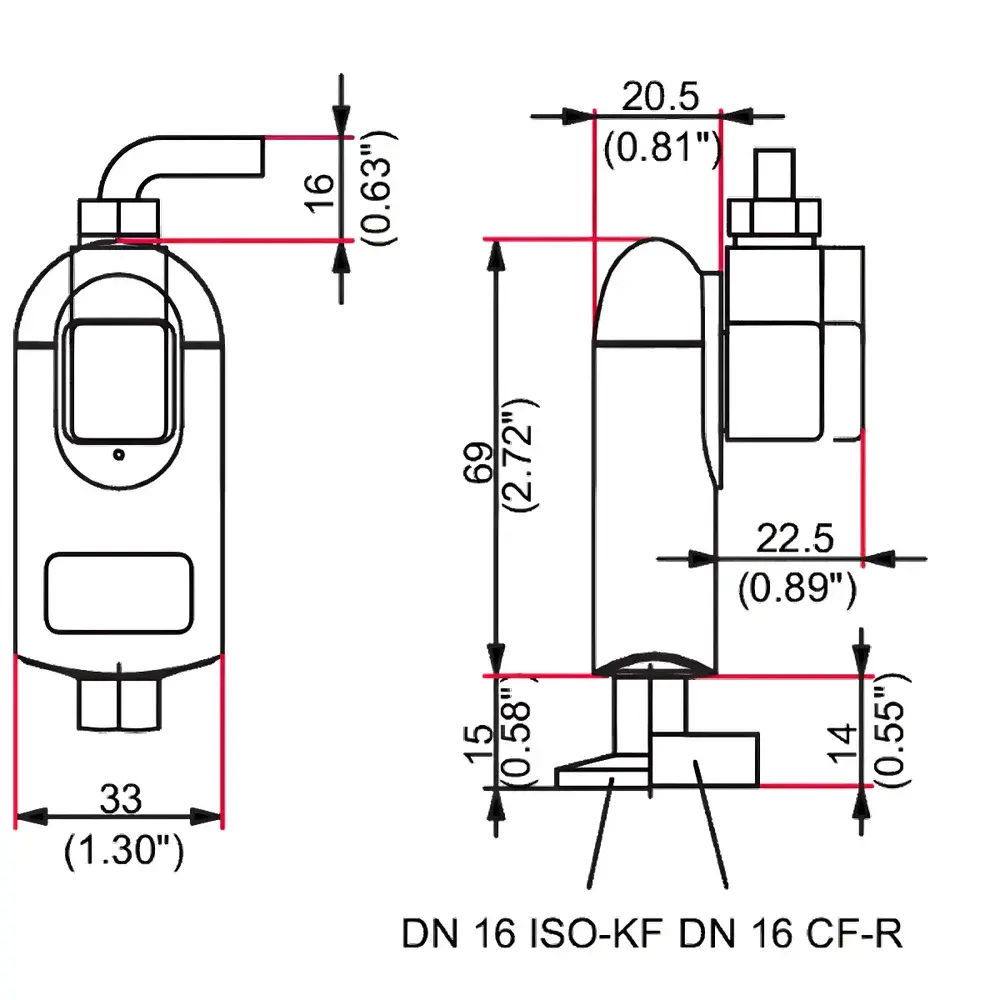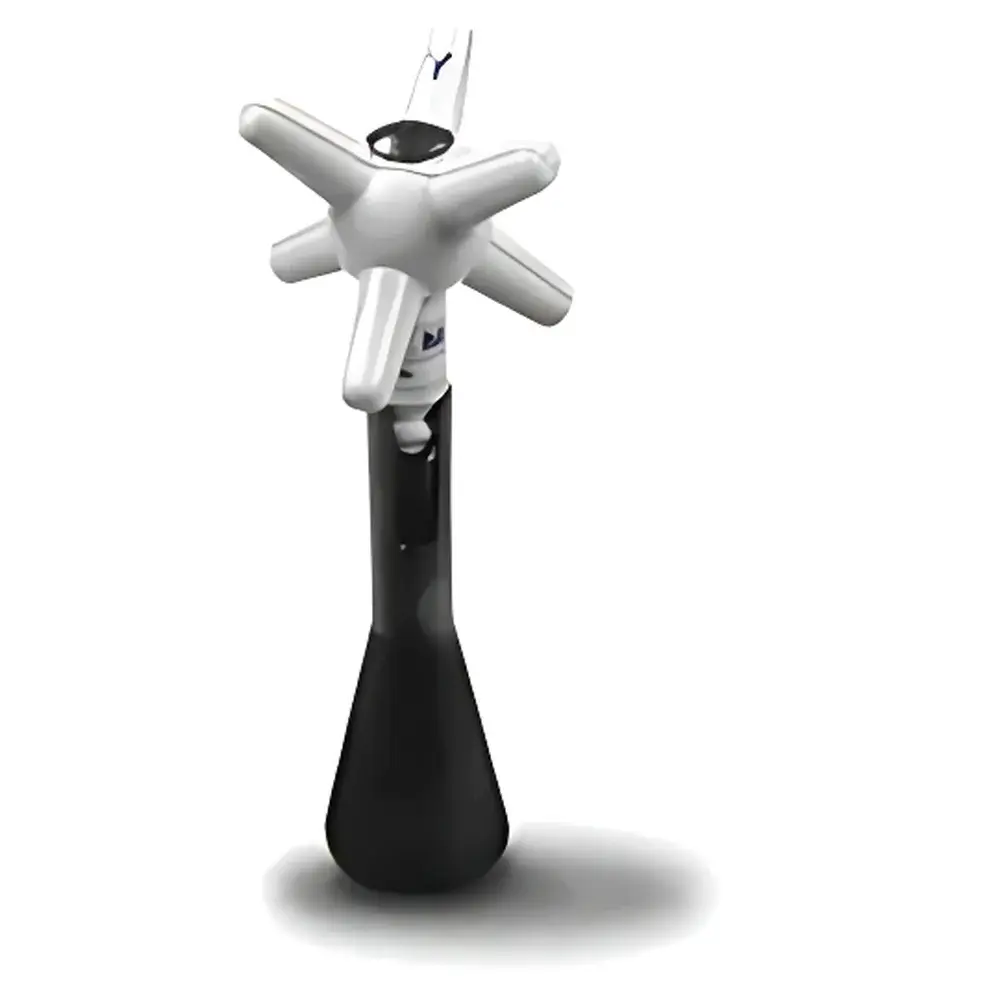
Narda EP602 Electric Field Probe
| Brand | Narda |
|---|---|
| Origin | Germany |
| Model | EP602 |
| Frequency Range | 5 kHz to 9.25 GHz |
| Dynamic Range | 1.5–1500 V/m |
| Overload Limit | 3000 V/m |
| Sampling Rate | 22 samples/sec |
| Output Interface | Fiber-optic direct connection to PC |
| Calibration Data Storage | Embedded memory with traceable calibration factors |
| Temperature Monitoring | Integrated sensor for real-time thermal compensation |
| Physical Size | Smallest in Narda’s EP-series field probe lineup |
| Compliance | Designed for IEC 61000-4-3, MIL-STD-461G RS103, DO-160 Section 20, and other RF immunity test standards |
Overview
The Narda EP602 Electric Field Probe is a high-performance, fiber-optically coupled broadband electric field sensor engineered for precision radiated immunity testing in electromagnetic compatibility (EMC) laboratories. Operating on the principle of electro-optic field sensing—where incident RF energy modulates light intensity in a dielectric crystal—the EP602 eliminates metallic signal paths and associated perturbation effects, enabling true non-intrusive field measurement. Its ultra-compact physical footprint (diameter < 8 mm, length < 45 mm) minimizes field distortion during scanning, making it uniquely suited for uniform field area (UFA) mapping, antenna pattern verification, and near-field characterization in constrained test volumes. The probe is optimized for use in standardized RF immunity test setups per IEC 61000-4-3 (radiated immunity), MIL-STD-461G RS103 (radiated susceptibility), RTCA DO-160 Section 20 (airborne equipment), and NATO AEP-55. Unlike conventional probes requiring intermediate field meters or analog coaxial links, the EP602 transmits digitized field data directly via optical fiber to a host PC—removing cable-induced loading, ground-loop interference, and bandwidth limitations inherent in RF coaxial systems.
Key Features
- Fiber-optic interface ensures galvanic isolation, eliminating grounding artifacts and enabling operation in high-potential or ESD-sensitive environments.
- Ultra-wide frequency coverage from 5 kHz to 9.25 GHz supports low-frequency magnetic coupling assessment and millimeter-wave immunity validation in 5G and radar bands.
- Dynamic range of 1.5–1500 V/m with overload tolerance up to 3000 V/m enables single-probe operation across both pre-compliance screening and full-level military/aerospace immunity stress testing.
- 22 Hz sampling rate allows rapid spatial field mapping—reducing UFA calibration time by >60% compared to legacy 1–5 Hz probes—without sacrificing amplitude resolution or phase fidelity.
- Onboard non-volatile memory stores NIST-traceable calibration coefficients, temperature compensation curves, and serial-specific correction factors; no manual coefficient entry required.
- Integrated temperature sensor enables real-time thermal drift correction, maintaining amplitude accuracy within ±0.3 dB over –10 °C to +50 °C ambient conditions.
Sample Compatibility & Compliance
The EP602 is compatible with standard EMC test configurations including TEM/GTEM cells, anechoic chambers, and open-area test sites (OATS). Its dielectric construction and absence of metallic components ensure minimal interaction with test fields—critical for validating field uniformity per IEC 61000-4-3 Annex A and MIL-STD-461G Figure RS103-1. The probe meets mechanical and environmental requirements outlined in IEC 61000-4-3:2020 Clause 6.3.2 (probe size, isotropy, linearity), and its calibration traceability complies with ISO/IEC 17025:2017 through Narda’s accredited calibration laboratory (DAkkS Certificate No. D-K-19227-01-00). It is routinely deployed in GLP- and GMP-aligned automotive EMC labs (e.g., OEM Tier-1 validation centers) where audit-ready calibration records and firmware version logging are mandatory.
Software & Data Management
The EP602 operates exclusively with Narda’s SB10 System Builder software suite (v5.2+), which provides synchronized multi-probe control, automated UFA grid scanning, real-time field vector visualization, and compliance reporting templates aligned with IEC 61000-4-3 and MIL-STD-461G. All measurements include embedded metadata: timestamp, probe ID, firmware revision, ambient temperature, and calibration expiration date. Raw data exports support IEEE Std 1159-compliant CSV and HDF5 formats, ensuring interoperability with MATLAB, Python (SciPy), and LabVIEW-based post-processing pipelines. Audit trails—including user login, parameter changes, and calibration updates—are logged in accordance with FDA 21 CFR Part 11 requirements when configured with SB10’s optional electronic signature module.
Applications
- Radiated immunity test system validation and periodic field uniformity verification in automotive EMC labs (ISO 11452-2, ISO 11452-8).
- High-field RF exposure assessment in military platform integration (e.g., avionics bays, radar front-ends, EW system co-location studies).
- Fast-scanning field mapping for antenna chamber qualification and absorber performance evaluation.
- Multi-point field monitoring using SB10’s distributed probe network—enabling simultaneous spatial profiling across up to 16 EP602 units without multiplexing latency.
- Research-grade near-field E-field characterization of PCB-level emissions and shielding effectiveness of conformal coatings.
FAQ
Does the EP602 require an external field meter or signal conditioner?
No. The probe integrates a fiber-coupled optoelectronic converter and ADC; only a USB-powered SB10 interface unit and host PC are required.
Can the EP602 be used in pulsed RF environments such as radar or IEC 61000-4-4 EFT testing?
Yes. Its 22 Hz continuous sampling supports pulse envelope capture for repetitive waveforms; for single-shot transient analysis, consult Narda’s EP602-Pulse firmware option.
Is calibration traceable to national metrology institutes?
Yes. Each probe ships with DAkkS-accredited calibration certificate (D-K-19227-01-00), valid for 12 months, with uncertainty budgets reported per ISO/IEC 17025 Annex C.
How is temperature drift compensated during long-duration tests?
The onboard thermistor feeds real-time corrections to the SB10 software, applying polynomial-based amplitude compensation derived from Narda’s thermal characterization database.
What accessories are needed for multi-probe deployment?
SB10 Multi-Channel Interface Unit (MCU-4), optical splitters, and Narda-certified single-mode fiber cables (SMF-28e+, 2 m or 5 m lengths).