
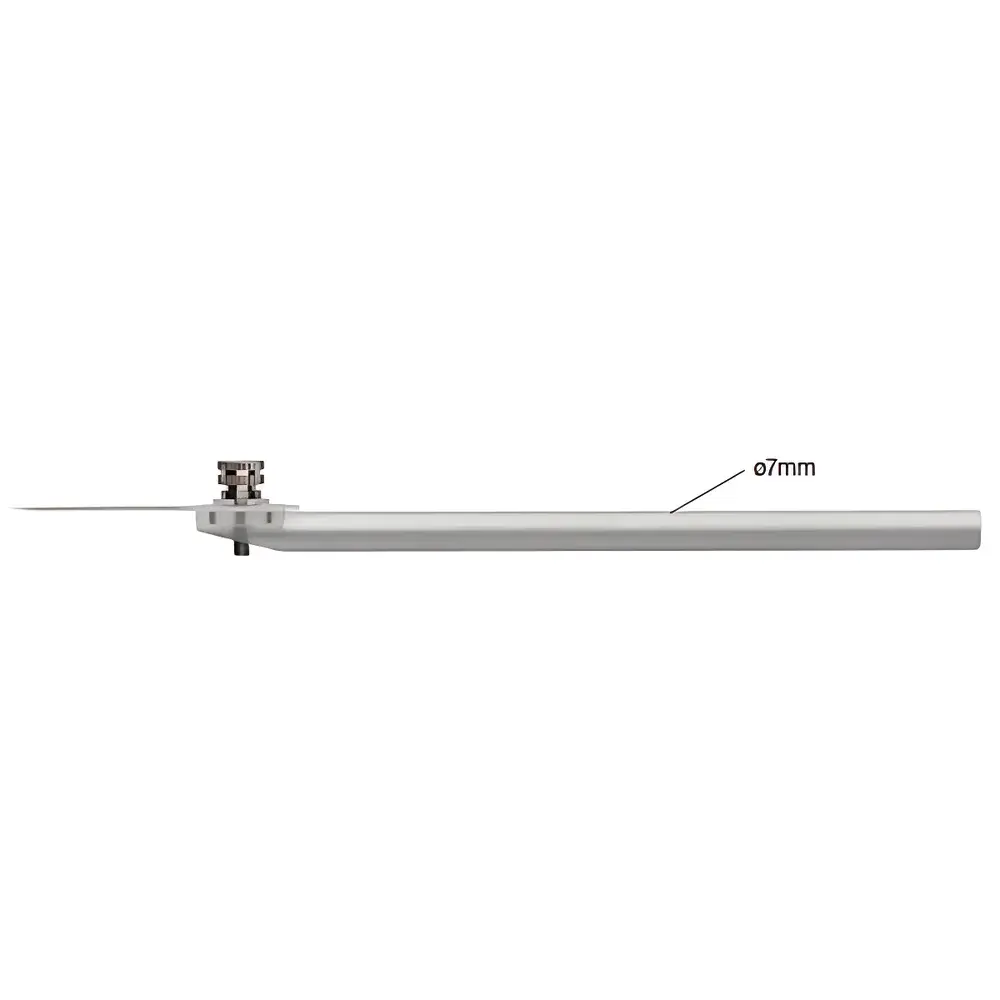
NARISHIGE H-13 Electrode Holder
| Brand | NARISHIGE |
|---|---|
| Origin | Japan |
| Model | H-13 |
| Overall Length | 136 mm |
| Weight | 14 g |
| Compatible Glass Capillary Outer Diameters | 1.0 mm, 1.2 mm, 1.5 mm |
| Mounting Rod Diameter | Ø7 mm |
| Rod Length | 120 mm (standard configuration) |
| Material | High-conductivity brass with nickel-plated finish |
| Compliance | Designed for electrophysiology setups per ISO 13485-aligned manufacturing practices |
Overview
The NARISHIGE H-13 Electrode Holder is a precision-engineered mechanical fixture designed for stable, vibration-damped positioning of glass micropipettes in intracellular and extracellular electrophysiological recordings. It operates on a robust friction-lock principle using a dual-screw clamping mechanism that applies uniform radial pressure without deforming delicate capillary shanks. Unlike generic lab clamps, the H-13 integrates a standardized Ø7 mm mounting rod interface—compatible with NARISHIGE MO-202, MN-2, and other motorized or manual micromanipulators—ensuring repeatable alignment across multi-electrode configurations. Its compact 136 mm total length and 14 g mass minimize inertial loading on manipulator stages, reducing drift during long-duration patch-clamp or sharp-electrode experiments. The holder’s geometry maintains consistent electrode tip-to-reference distance and angular orientation, critical for reproducible seal formation and signal fidelity in voltage-clamp or current-clamp protocols.
Key Features
- Precision-machined brass body with electroless nickel plating for corrosion resistance, low thermal expansion, and optimal electrical grounding continuity
- Three-step adjustable clamping sleeve accommodating standard borosilicate and quartz glass capillaries with outer diameters of 1.0 mm, 1.2 mm, and 1.5 mm—no adapter rings required
- Integrated 120 mm Ø7 mm stainless steel support rod (included), engineered to withstand lateral loads up to 2.5 N without deflection >1 µm at tip
- Micro-adjustable set-screw system enabling sub-degree rotational alignment of electrode axis relative to recording chamber plane
- Threaded base (M4) for direct attachment to NARISHIGE MP-285, MM-33, or third-party XYZ stages compliant with ISO 8015 metrology standards
Sample Compatibility & Compliance
The H-13 is validated for use with pulled and fire-polished glass electrodes fabricated from GB100-15, BF150-110-10, or Sutter BF120-69-10 capillaries. It maintains mechanical stability under continuous perfusion flow rates up to 5 mL/min and ambient temperature gradients of ±2°C/h—conditions typical in whole-cell patch-clamp rigs. The device conforms to electromagnetic compatibility (EMC) requirements outlined in IEC 61326-1 for laboratory equipment used in biosignal acquisition. While not a medical device itself, its construction and traceable manufacturing process align with ISO 13485:2016 principles for accessories used in GLP-compliant neurophysiology studies. No calibration certificate is supplied, as the H-13 is a passive mechanical component; however, dimensional tolerances are held to ±0.02 mm per JIS B 0401 Class IT6 specifications.
Software & Data Management
As a hardware-only positioning component, the H-13 does not incorporate embedded electronics or firmware. It interfaces exclusively via mechanical coupling and requires no driver installation or software integration. Its design ensures full compatibility with all major electrophysiology data acquisition platforms—including Molecular Devices pCLAMP 11+, HEKA PatchMaster, Axon MultiClamp 700B control suites, and open-source alternatives such as PatchControl and WinWCP—without introducing ground loops or signal noise. When deployed in multi-electrode arrays, the standardized Ø7 mm rod interface enables synchronized positional referencing across channels in coordinate-mapped experimental paradigms, supporting automated stimulus-response mapping workflows compliant with NIH BRAIN Initiative data standards.
Applications
- Single-cell patch-clamp recordings in acute brain slices and cultured neurons
- Intracellular sharp-electrode impalement in invertebrate ganglia and plant protoplasts
- Extracellular field potential monitoring using theta-glass or bipolar tungsten electrodes
- Combined optogenetic-electrophysiology rigs where optical access must be preserved around electrode entry points
- High-throughput screening of ion channel modulators using automated patch-clamp platforms with manual electrode loading stations
FAQ
Is the H-13 compatible with quartz electrodes?
Yes—the clamping mechanism accommodates quartz capillaries with outer diameters of 1.0 mm, 1.2 mm, and 1.5 mm, provided wall thickness falls within standard ranges (0.5–1.0 mm).
Can it be mounted on non-NARISHIGE manipulators?
Yes—any manipulator with a Ø7 mm mounting port and M4 or 1/4″-28 threaded base interface is mechanically compatible.
Does it provide electrical shielding?
No—it is not a shielded enclosure; however, its conductive brass body provides a low-impedance path to chassis ground when properly connected via the manipulator’s grounding terminal.
What is the maximum recommended electrode length for stability?
For optimal resonance suppression, electrode shank lengths exceeding 15 mm beyond the clamp should be counterbalanced using a secondary support arm or damping gel; empirical testing shows minimal tip vibration (<5 nm RMS) for shanks ≤12 mm protruding.
Is sterilization possible?
Autoclaving is not recommended due to thermal stress on nickel plating; ethanol wipe-down or UV-C exposure (254 nm, 30 min) is validated for biosafety level 2 environments.
Related Products



