
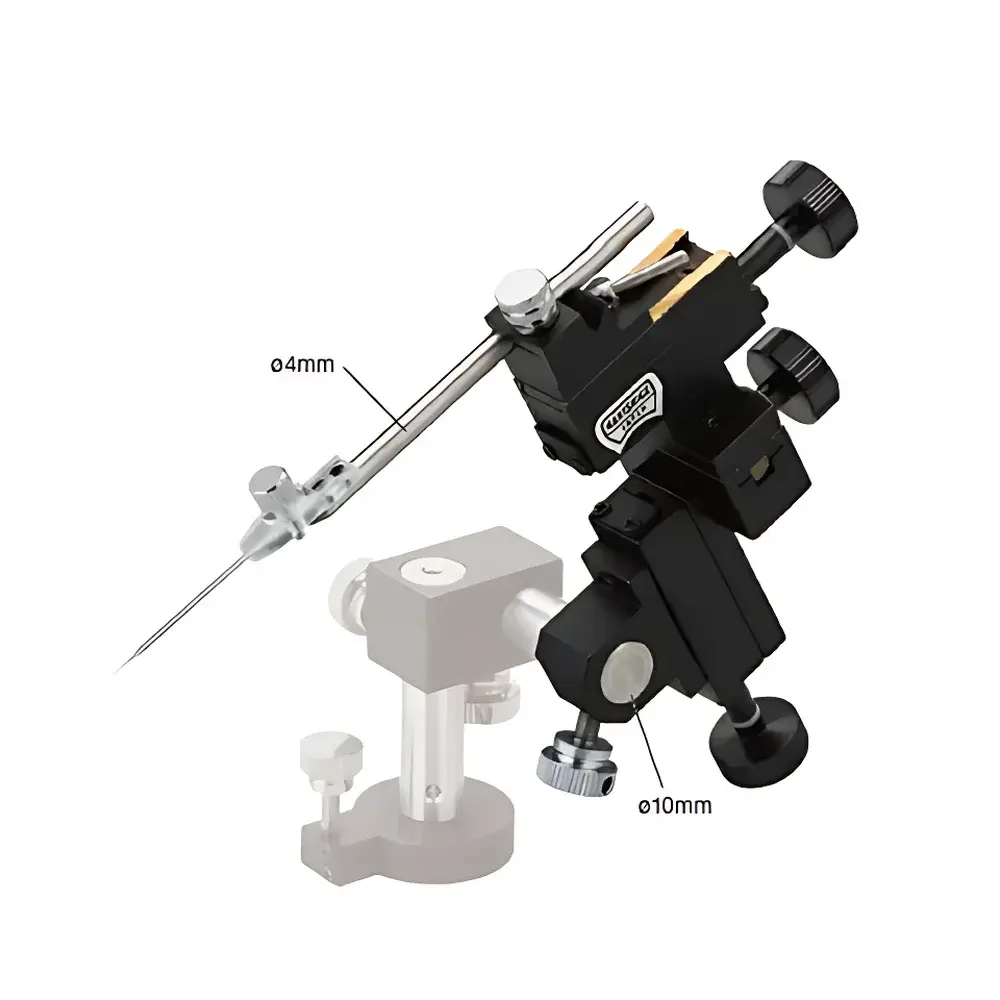
Narishige M-40B Precision Micro-Manipulator
| Brand | Narishige |
|---|---|
| Origin | Japan |
| Model | M-40B |
| Gross Travel (Coarse) | X: 22 mm, Y: 20 mm, Z: 22 mm |
| Dimensions (W × D × H) | 80 × 30 × 105 mm |
| Weight | 230 g |
| Accessories | UPN-1 Capillary Holder, Universal Wrench |
| Type | Manual Mechanical Micromanipulator |
Overview
The Narishige M-40B is a compact, manually operated mechanical micromanipulator engineered for high-precision positioning of microtools, capillaries, electrodes, or probes in life science and materials research applications. Based on a robust three-axis orthogonal kinematic architecture, it employs precision-machined brass and stainless-steel components with fine-pitch lead screws to deliver smooth, backlash-minimized coarse motion. Unlike motorized or hydraulic systems, the M-40B relies on direct manual actuation—ideal for applications requiring tactile feedback, rapid iterative repositioning, and integration into vibration-sensitive or electromagnetic-noise-constrained environments such as patch-clamp rigs, intracellular injection setups, microinjection platforms, and optical microscopy workstations. Its design prioritizes mechanical stability, repeatability, and spatial efficiency without compromising adjustability.
Key Features
- Compact footprint (80 × 30 × 105 mm) and ultra-lightweight construction (230 g), enabling seamless integration onto inverted microscopes, stereomicroscopes, or confined-stage configurations.
- Three-axis coarse translation with calibrated gross travel: X-axis ±11 mm (22 mm total), Y-axis ±10 mm (20 mm total), Z-axis ±11 mm (22 mm total), facilitating rapid macro-positioning prior to fine adjustment via complementary fine-adjustment stages.
- Modular mounting interface compatible with standard 3/8″-16 UNC threaded posts and optical table breadboards, supporting both vertical and horizontal orientation.
- Included UPN-1 universal capillary holder accepts glass micropipettes with outer diameters ranging from 1.0 to 1.5 mm, secured via dual-screw clamping with non-marring brass jaws.
- Integrated universal wrench allows tool-free tightening of all adjustment knobs and holder set screws—eliminating the need for external tools during routine operation.
- Corrosion-resistant surface finish and low-outgassing materials ensure compatibility with cleanroom environments and long-term use in humid or solvent-exposed laboratories.
Sample Compatibility & Compliance
The M-40B is designed for use with standard borosilicate or quartz micropipettes, tungsten or platinum microelectrodes, fiber optic probes, and microinjection needles. It imposes no electrical or thermal constraints, making it suitable for electrophysiology, single-cell manipulation, microdissection, and microfluidic device alignment. While the manipulator itself carries no active electronic components, its mechanical compliance supports adherence to GLP-aligned experimental workflows when paired with validated fine-positioning stages. The UPN-1 holder meets ISO 8549-1:2021 dimensional tolerances for micropipette handling interfaces. No regulatory certification (e.g., CE, FDA 510(k)) applies, as the device is classified as a Class I laboratory mechanical accessory under IEC 61010-1:2010 safety standards for electrical equipment for measurement, control, and laboratory use.
Software & Data Management
As a purely mechanical, non-electronic instrument, the M-40B does not incorporate embedded firmware, digital readouts, or software connectivity. Position data is recorded manually or synchronized externally via calibrated stage encoders or video-based tracking systems (e.g., using ImageJ plugins or MATLAB-based centroid analysis). When integrated into automated workflows—such as those governed by NIH-funded core facility SOPs—the M-40B serves as a stable, deterministic positioning backbone; its lack of electronic dependencies ensures immunity to firmware version drift, cybersecurity vulnerabilities, or timestamp synchronization errors common in networked instruments. Audit trails for positional adjustments are maintained through lab notebook entries or LIMS-integrated procedural logs.
Applications
- Manual patch-clamp electrode positioning in acute brain slice or cultured neuron preparations.
- Microinjection of zebrafish embryos, Drosophila oocytes, or C. elegans gonads using glass capillaries.
- Alignment of optical fibers or photonic probes in near-field scanning optical microscopy (NSOM).
- Positioning of AFM cantilevers or nanoindentation tips during in situ SEM experiments.
- Handling of microscale biological specimens (e.g., pollen grains, diatoms) under high-magnification stereo imaging.
- Teaching laboratories where student familiarity with fundamental micromanipulation mechanics is emphasized over automation.
FAQ
Is the M-40B compatible with inverted microscopes?
Yes—the low-profile design and optional vertical-mounting configuration allow unobstructed access to objective lenses and stage ports.
Can it be used in a CO₂ incubator environment?
Yes, provided ambient humidity remains below 70% RH and temperature stays within 15–35°C; avoid condensation-prone conditions due to absence of sealed mechanisms.
Does Narishige provide calibration certificates for the M-40B?
No—calibration is not applicable, as the device has no encoded position feedback; users may verify travel range using certified gauge blocks or laser interferometry per internal QA protocols.
What is the maximum recommended load capacity?
200 g static load at the tip of a standard 1.2 mm OD micropipette mounted in the UPN-1 holder; exceeding this may compromise positional stability and repeatability.
Are replacement parts available for long-term maintenance?
Yes—Narishige offers genuine spare knobs, lead screws, UPN-1 jaw inserts, and mounting adapters under part numbers M-40B-KNOB, M-40B-SCREW, UPN-1-JAW, and M-POST-ADAPT, respectively.



