
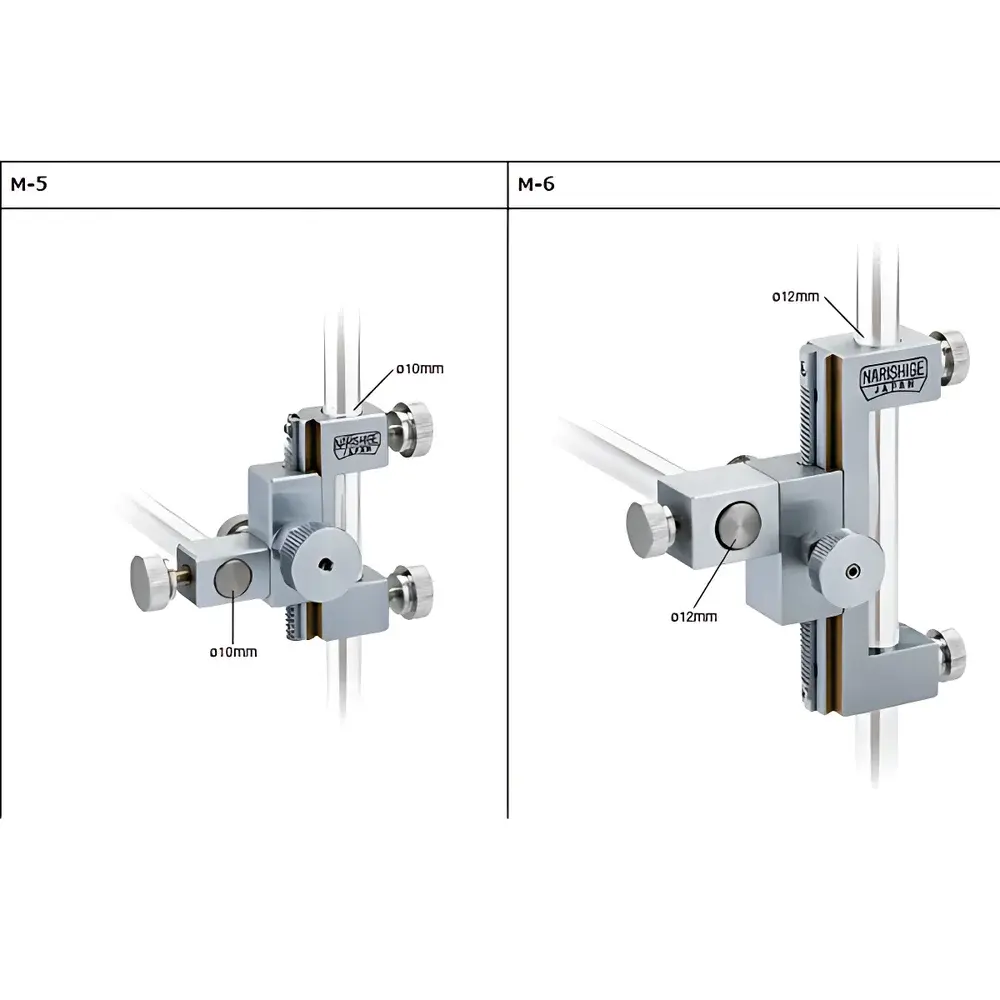
NARISHIGE M-5/6 Precision X-Type Micromanipulator Block
| Brand | NARISHIGE |
|---|---|
| Origin | Japan |
| Model | M-5/6 |
| Z-Axis Coarse Travel | M-5: 45 mm, M-6: 80 mm |
| Dimensions (M-5) | 60 × 46 × 55 mm |
| Weight (M-5) | 220 g |
| Dimensions (M-6) | 100 × 52 × 74 mm |
| Weight (M-6) | 500 g |
| Compatible Rod Diameter | Ø10 mm or Ø12 mm |
| Included Accessory | Hex Wrench |
Overview
The NARISHIGE M-5/6 Precision X-Type Micromanipulator Block is a compact, mechanically actuated positioning module engineered for high-stability, repeatable alignment of linear motion components in microscale experimental and industrial assembly setups. Unlike motorized or piezoelectric stages, the M-5/6 relies on a robust manual coarse-adjustment mechanism based on precision-machined brass and stainless-steel components, delivering deterministic positional control without electronic dependency. Its defining structural feature—the X-shaped dual-bar mounting interface—enables rigid coupling of two parallel support rods while permitting independent vertical (Z-axis) translation via an integrated micrometer-style drive screw. This architecture is optimized for applications requiring sub-millimeter repeatability under static load, such as optical path alignment in confocal microscopy, electrode positioning in patch-clamp rigs, or fixture calibration in semiconductor probe station environments. Designed and manufactured in Japan to NARISHIGE’s long-standing tolerancing standards, the M-5/6 conforms to ISO 2768-mK general tolerances for machined parts and meets material compatibility requirements for cleanroom-adjacent use (non-outgassing metals, no adhesives or plastics in load-bearing paths).
Key Features
- Modular X-type configuration allows secure mechanical integration of two parallel Ø10 mm or Ø12 mm support rods—enabling compound rigidity and torsional stability across multi-axis manipulator assemblies.
- Dual-model design: M-5 provides 45 mm of Z-axis coarse travel in a compact footprint (60 × 46 × 55 mm); M-6 extends vertical range to 80 mm with increased structural mass (100 × 52 × 74 mm, 500 g), suited for heavier payloads or extended reach requirements.
- Manual micrometer-driven Z-axis actuation ensures tactile feedback, zero power consumption, and immunity to electromagnetic interference—critical in electrophysiology, MRI-adjacent instrumentation, or Faraday cage environments.
- Machined from corrosion-resistant brass and hardened stainless steel; all sliding interfaces feature precision-ground contact surfaces with controlled surface roughness (Ra ≤ 0.8 µm) to minimize stiction and hysteresis.
- Includes a dedicated hex wrench (2.5 mm) for secure tightening of rod clamping screws—designed to maintain clamping force within 12–15 N·m without deformation of Ø10/Ø12 mm rods.
Sample Compatibility & Compliance
The M-5/6 is not a sample-handling device but a mechanical positioning infrastructure component. It supports standard NARISHIGE-compatible rod systems (e.g., MO-103, MN-151 series) and interoperates with third-party Ø10 mm / Ø12 mm stainless-steel or ceramic support rods meeting ISO 1101 geometric tolerance class h6. No regulatory certification (e.g., CE, UL) applies, as it is a passive mechanical element—not an electrically powered or safety-critical subsystem. However, its material composition complies with RoHS Directive 2011/65/EU and REACH Annex XVII restrictions on cadmium, lead, and hexavalent chromium. For GLP/GMP-aligned laboratories, the absence of firmware, batteries, or data logging ensures full auditability of mechanical setup configurations without software validation overhead.
Software & Data Management
The M-5/6 operates entirely without software, firmware, or digital interfaces. Positional settings are recorded manually via engraved scale markings on the Z-axis drive collar (graduated in 0.5 mm increments) and verified using external metrology tools (e.g., dial indicators or laser displacement sensors). This analog operation eliminates cybersecurity concerns, avoids 21 CFR Part 11 compliance obligations, and guarantees deterministic behavior across decades of service life—consistent with legacy instrument maintenance protocols in national metrology institutes and university core facilities.
Applications
- Patch-clamp electrophysiology: Precise vertical positioning of glass micropipettes relative to cell cultures on inverted microscopes.
- Nanopositioning subassemblies: Integration into custom-built AFM or STM scanner frames where thermal drift mitigation requires non-electronic Z-axis adjustment.
- Optical alignment jigs: Stabilizing fiber collimators, dichroic mirrors, or objective lens mounts in laser cavity construction.
- Microfabrication tooling: Securing MEMS probe cards or wafer-level test fixtures during mask alignment procedures.
- Educational laboratory kits: Teaching mechanical degrees of freedom, kinematic coupling, and tolerance stack-up analysis in undergraduate mechatronics courses.
FAQ
Is the M-5/6 compatible with non-NARISHIGE support rods?
Yes—provided the rod diameter is precisely Ø10 mm or Ø12 mm and meets h6 dimensional tolerance per ISO 286-1, with surface finish suitable for metal-to-metal clamping.
Does the M-5/6 offer fine (micrometer-scale) adjustment?
No—it is a coarse-positioning block only. Fine Z-axis control requires pairing with a separate fine-adjustment stage (e.g., NARISHIGE MO-203 or equivalent).
Can multiple M-5/6 blocks be stacked vertically?
Not recommended. The design does not include standardized stacking interfaces or load-rated base plates; stacking may compromise Z-axis linearity and introduce angular deviation beyond ±0.05°.
What torque should be applied when tightening the rod clamping screws?
Use the included 2.5 mm hex wrench and apply 12–15 N·m—exceeding this risks thread damage or permanent deformation of the brass housing.



