
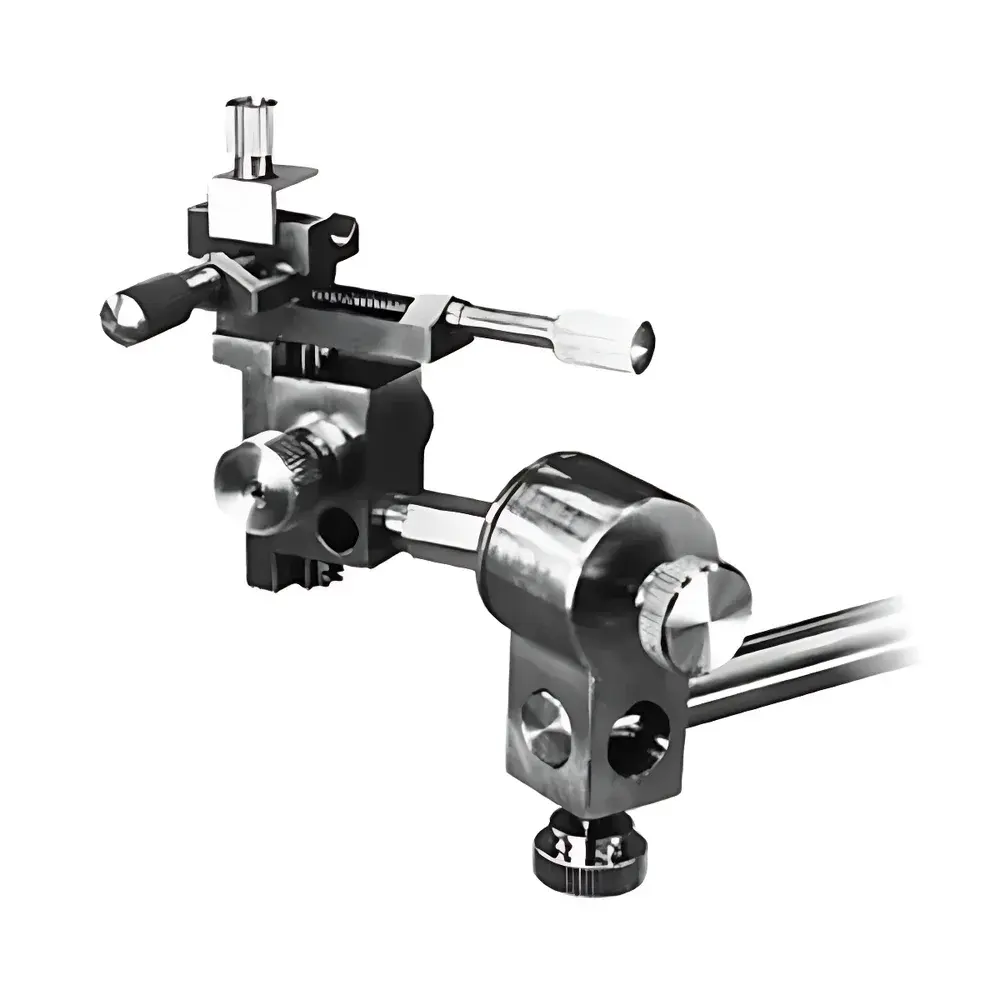
Narishige BC-3 Adjustable Micromanipulator Clamp
| Brand | Narishige |
|---|---|
| Origin | Japan |
| Model | BC-3 |
| Dimensions (W×D×H) | 80 × 46 × 96 mm |
| Weight | 250 g |
| Coarse Z-axis Travel | 19 mm |
| Fine X-axis Travel | 15 mm |
| Fine Y-axis Travel | 6 mm |
| Mounting Compatibility | ∅10 mm Rod (e.g., GJ-1) |
| Ball Joint Articulation | Full 360° Rotation with Tilt Adjustment |
| Included Accessories | XY Control Knobs, Hex Key |
Overview
The Narishige BC-3 Adjustable Micromanipulator Clamp is a precision mechanical positioning device engineered for stable, repeatable, and ergonomic sample manipulation in life science, materials research, and microelectronics laboratories. Designed around a rigid yet compact C-frame architecture, the BC-3 integrates a high-stiffness ball-and-socket joint that enables continuous angular reorientation—allowing users to position the clamp head at any orientation within ±90° tilt and full 360° azimuthal rotation. This articulation is mechanically locked via a knurled friction collar, ensuring positional stability during extended imaging or micromanipulation tasks. The device operates on a dual-stage motion principle: coarse vertical (Z-axis) positioning provides rapid gross alignment over 19 mm, while independent fine-adjustment mechanisms deliver precise orthogonal displacement—15 mm along the X-axis and 6 mm along the Y-axis—via calibrated micrometer-style knobs. Its modular design supports direct mounting onto standard ∅10 mm support rods (e.g., Narishige GJ-1), facilitating seamless integration into multi-component micromanipulation setups including patch-clamp rigs, optical tweezers platforms, and confocal microscopy stages.
Key Features
- Compact footprint (80 × 46 × 96 mm) and lightweight construction (250 g) enable flexible placement on crowded optical tables or inside environmental chambers.
- Ball-joint mounting interface permits unrestricted angular positioning without compromising mechanical rigidity or introducing play under load.
- Dual-range motion control: coarse Z-axis adjustment (19 mm travel) for rapid height setting; fine X/Y translation (15 mm / 6 mm) with tactile feedback and consistent resolution.
- Direct compatibility with Narishige’s standardized ∅10 mm rod system (e.g., GJ-1, SG-1 series), enabling stackable configurations with other manipulators, electrode holders, or vibration-isolated bases.
- Ergonomic XY control knobs located on the clamp body allow intuitive, one-handed operation without requiring tool access during routine adjustments.
- Included hex key facilitates secure tightening of all locking interfaces, ensuring long-term repeatability across experimental sessions.
Sample Compatibility & Compliance
The BC-3 is optimized for handling delicate biological specimens—including pipettes, glass capillaries, microelectrodes, tissue explants, and MEMS devices—without inducing slippage or deformation. Its C-1 style clamp jaw features smooth, non-marring contact surfaces suitable for both metallic and polymer-coated tools. While the BC-3 itself is a mechanical positioning aid (not an electronic instrument), its design conforms to general laboratory safety and ergonomics guidelines referenced in ISO 7250-1 (anthropometric data) and IEC 61000-6-2 (immunity to electromagnetic interference in lab environments). As a Japanese-manufactured component from Narishige—a vendor widely adopted in GLP-compliant neuroscience and pharmacology labs—the BC-3 supports traceable setup documentation when integrated into validated workflows involving electrophysiology or single-cell injection protocols.
Software & Data Management
The BC-3 is a purely manual, analog positioning device and does not incorporate embedded electronics, sensors, or digital connectivity. Consequently, it requires no firmware, drivers, or software installation. All positional settings are recorded manually in lab notebooks or experimental logs. For laboratories operating under FDA 21 CFR Part 11 or ISO/IEC 17025 requirements, users may document BC-3 configuration parameters (e.g., knob positions, angular orientation, rod mounting height) as part of equipment setup records. Its mechanical simplicity ensures zero risk of electromagnetic interference with sensitive measurement systems such as patch-clamp amplifiers or low-noise photodetectors.
Applications
- Electrophysiology: Precise alignment of patch pipettes relative to cultured neurons or brain slices mounted on upright or inverted microscopes.
- Microinjection: Stabilization and angular adjustment of injection needles during zebrafish embryo or oocyte microinjection procedures.
- Materials Characterization: Positioning of AFM probes, nanoindenters, or fiber-optic sensors over thin-film samples in controlled-atmosphere gloveboxes.
- Microassembly: Hand-guided placement of SMD components, flex circuits, or optical fibers during prototyping of hybrid optoelectronic modules.
- Education & Training: Used in undergraduate biophysics labs to teach principles of mechanical degrees of freedom, lever mechanics, and ergonomic workstation design.
FAQ
Is the BC-3 compatible with non-Narishige support rods?
Yes—any rigid, smooth-surface ∅10 mm rod meeting ISO tolerance class h6 can be used, though optimal clamping force and longevity are guaranteed only with Narishige-certified rods (e.g., GJ-1).
Does the BC-3 include a locking mechanism for the ball joint?
Yes—a circumferential friction-lock collar allows secure fixation at any angular orientation without tools.
Can the BC-3 be mounted vertically or upside-down?
Yes—the C-frame structure and symmetric load path permit stable mounting in any orientation, provided the base rod is rigidly secured.
What is the maximum recommended load for the clamp jaws?
For sustained positional accuracy and jaw integrity, loads should remain below 500 g; transient loads up to 1 kg are tolerable during brief manual adjustments.
Are replacement C-1 clamp jaws available separately?
Yes—Narishige offers spare C-1 jaws (Part No. C-1-SP) with interchangeable tip geometries (flat, V-groove, or concave) for specialized gripping requirements.



