
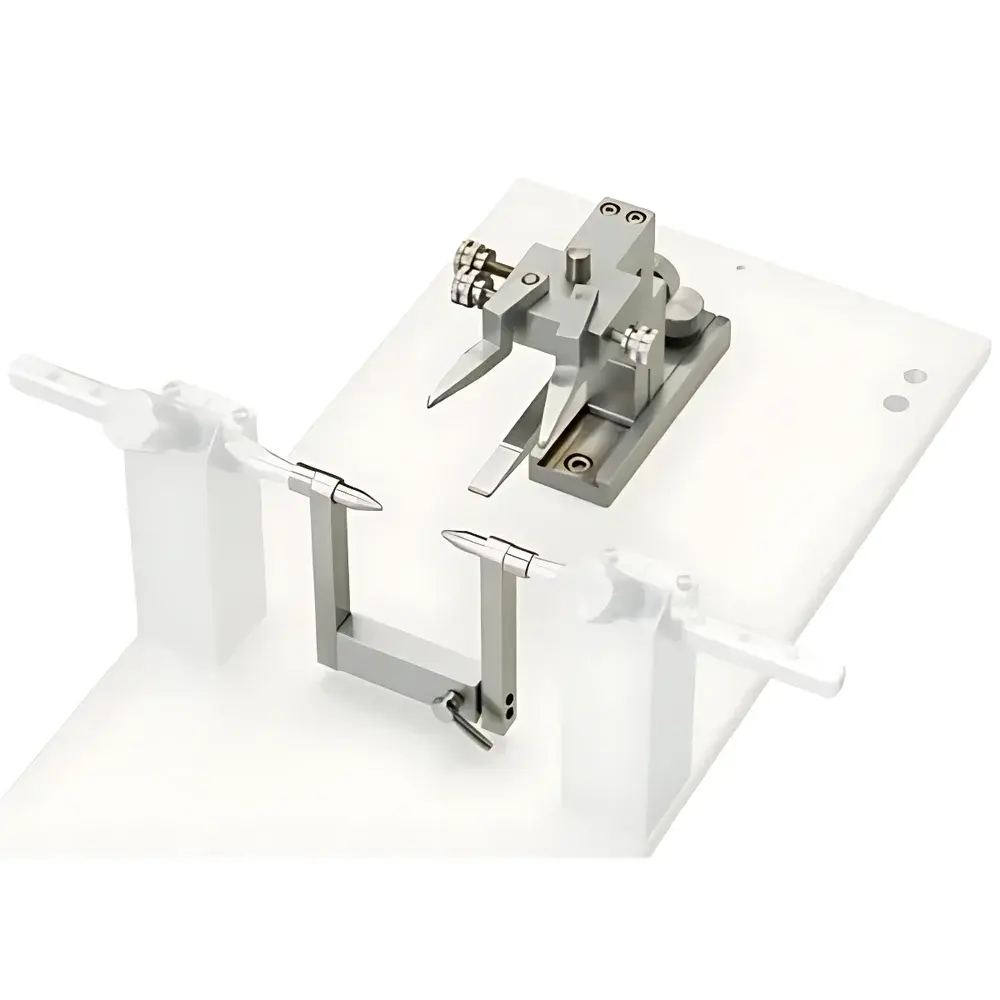
Narishige CA-6 Common Marmoset Head Holder for SR Series Stereotactic Instruments
| Brand | Narishige |
|---|---|
| Origin | Japan |
| Model | CA-6 |
| Compatibility | SR-series stereotactic frames |
| Mounting Interface | Dual dovetail rail system |
| Adjustment Axes | Vertical (up/down) and Anteroposterior (front/back) |
| Material | Anodized aluminum alloy and medical-grade polymer |
| Weight | 220 g |
| Dimensions (Accessory Ear Bars) | 125 × 52 × 67 mm (W × D × H) |
| Biocompatibility | ISO 10993-compliant contact surfaces |
| Regulatory Status | CE-marked for laboratory research use only |
Overview
The Narishige CA-6 Common Marmoset Head Holder is a precision-engineered accessory designed exclusively for integration with Narishige SR-series stereotactic instruments. It enables stable, reproducible head fixation of Callithrix jacchus during neurophysiological recording, intracerebral microinjection, and craniotomy-based surgical interventions. The device operates on a dual-axis mechanical adjustment principle—leveraging a high-tolerance dovetail rail interface to provide smooth, backlash-free vertical (up/down) and anteroposterior (front/back) positioning. Unlike generic rodent holders, the CA-6 incorporates anatomically scaled geometry derived from morphometric analysis of adult marmoset skull morphology, ensuring minimal cranial pressure while maintaining rigidity under micromanipulator loads up to 500 g. Its low-profile architecture minimizes interference with optical access paths in two-photon microscopy or fiber photometry setups, making it compatible with multimodal in vivo imaging workflows.
Key Features
- Anatomically optimized clamping geometry for Callithrix jacchus, accommodating inter-individual variation in frontal bone curvature and zygomatic arch width
- Dual dovetail mounting interface ensures repeatable alignment and zero-slip engagement with SR-series base plates and lateral arms
- Single-handed coarse/fine adjustment mechanism with tactile feedback—no tools required for intra-session repositioning
- Medical-grade polymer contact surfaces compliant with ISO 10993-5 (cytotoxicity) and ISO 10993-10 (irritation/sensitization)
- Corrosion-resistant anodized aluminum frame (6061-T6) with surface roughness Ra ≤ 0.8 µm to prevent tissue abrasion during prolonged fixation
- Integrated ear bar support system (W125 × D52 × H67 mm, 220 g) featuring non-rotating, low-friction bushings for consistent auditory canal alignment
Sample Compatibility & Compliance
The CA-6 is validated for use with healthy adult common marmosets (body weight 300–450 g, skull length 28–34 mm). It is not intended for neonatal, juvenile, or pathological specimens exhibiting cranial deformity. All load-bearing components undergo 100% dimensional inspection per JIS B 0401-1 (Geometrical Product Specifications) and are traceable to NMIJ/AIST calibration standards. The device conforms to ISO 13485:2016 requirements for design control documentation and is supplied with a Declaration of Conformity for research-use-only (RUO) applications under EU Directive 2017/745 (MDR) Annex XVI. It is not certified for clinical or diagnostic use and carries no FDA clearance.
Software & Data Management
As a purely mechanical stereotactic accessory, the CA-6 requires no embedded firmware, drivers, or software integration. Its positional repeatability (±12 µm over 100 cycles at 25 °C) eliminates dependency on digital coordinate mapping—enabling direct correlation between atlas-based coordinates (e.g., Paxinos & Watson marmoset brain atlas, 2nd ed.) and physical electrode placement. When used with Narishige’s MO-10 micromanipulators and associated digital readout systems (e.g., MN-401 encoder), the CA-6 supports GLP-aligned experimental documentation through manual logbook entries or LIMS-integrated metadata tagging (e.g., subject ID, fixation timestamp, dorsoventral depth). Audit trails remain independent of proprietary platforms, satisfying institutional animal care and use committee (IACUC) requirements for method transparency.
Applications
- In vivo extracellular single-unit and local field potential (LFP) recordings using silicon probes or tungsten microelectrodes
- Stereotactic delivery of viral vectors (AAV, lentivirus) or pharmacological agents into nucleus accumbens, prefrontal cortex, or amygdala
- Chronic cranial window implantation for longitudinal two-photon calcium imaging
- Optogenetic fiber optic cannula placement with sub-millimeter targeting accuracy
- Combined electrophysiology-fMRI validation studies requiring motion artifact suppression below 5 µm RMS displacement
FAQ
Is the CA-6 compatible with non-Narishige stereotactic frames?
No. The dovetail interface dimensions and rail pitch are proprietary to Narishige SR-series systems. Adapters for third-party frames are not available and are not recommended due to loss of positional fidelity.
Can the CA-6 be autoclaved?
No. The polymer components are rated for ethylene oxide (EtO) sterilization or 70% ethanol immersion only. Autoclaving exceeds thermal limits and compromises structural integrity.
What is the maximum recommended fixation duration?
Based on IACUC-reviewed protocols, continuous fixation should not exceed 4 hours without interim neurological assessment. For chronic preparations, removable ear bar configurations must be validated separately.
Does the CA-6 include ear bars?
Yes—the standard configuration includes a matched pair of auxiliary ear bars (W125 × D52 × H67 mm, 220 g total) with adjustable depth stops calibrated to marmoset external auditory meatus anatomy.
Is technical support available outside Japan?
Yes. Narishige maintains authorized service centers in the US (Narishige America, NJ), Germany (Narishige Europe GmbH), and China (Narishige Shanghai). Remote troubleshooting and calibration verification are supported via secure video consultation.



