
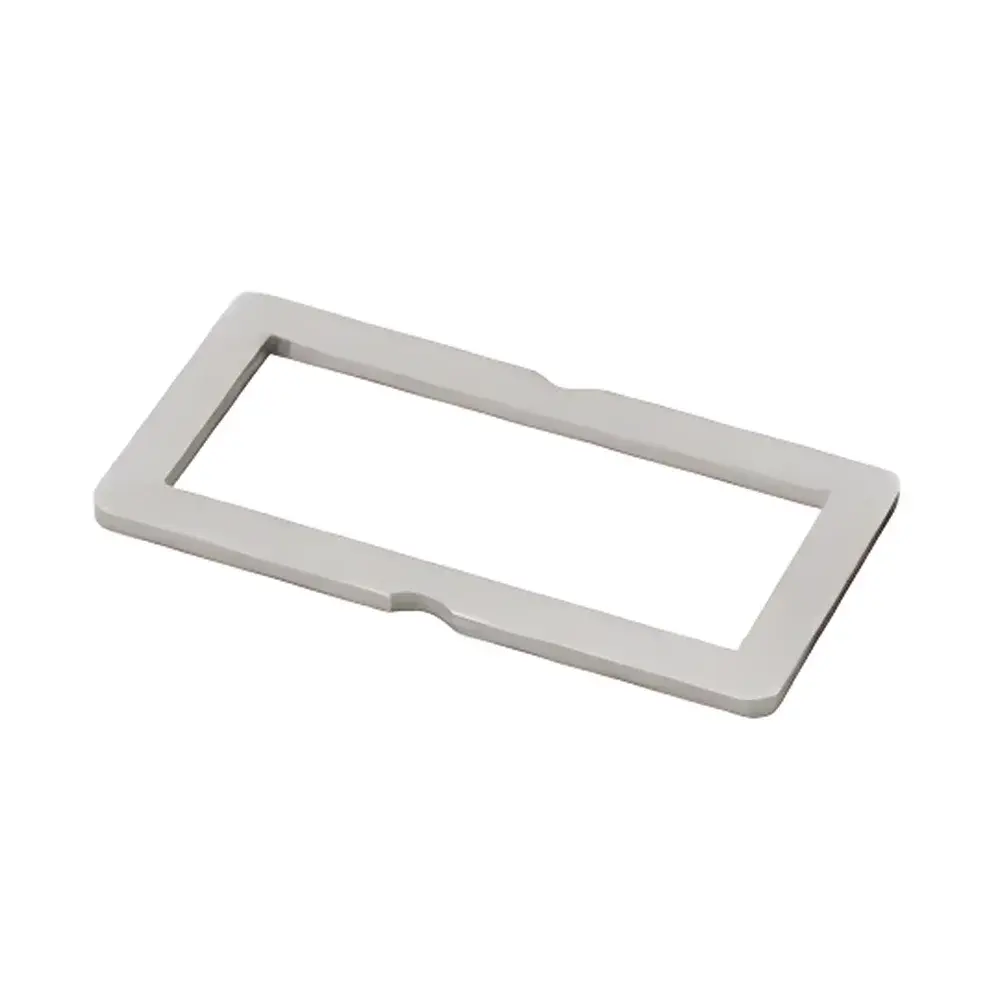
NARISHIGE CFR-1 Chamber Frame for Mouse Stereotactic Surgery
| Brand | NARISHIGE |
|---|---|
| Origin | Japan |
| Model | CFR-1 |
| Dimensions (W×D×H) | 50 × 25 × 2 mm |
| Weight | 8 g per unit |
| Package Quantity | 10 units |
| Compatibility | Designed for chronic mouse neurophysiology and stereotactic experiments |
| Intended Use | Non-anesthetized head fixation with stereotactic repeatability |
| Complementary Devices | Compatible with SR-10R-HT, SR-1, and other NARISHIGE stereotactic systems |
Overview
The NARISHIGE CFR-1 Chamber Frame is a precision-engineered, lightweight titanium-alloy (or medical-grade stainless steel) mounting platform designed specifically for chronic cranial window and intracranial electrode implantation studies in adult mice. It operates on the principle of rigid, non-invasive cranial anchoring—enabling stable, repeatable head fixation without systemic anesthesia during longitudinal behavioral or electrophysiological recording sessions. Unlike temporary clamping solutions, the CFR-1 integrates seamlessly with NARISHIGE’s stereotactic instrumentation (e.g., SR-10R-HT manipulator and SR-1 base) to provide sub-millimeter positional reproducibility across multiple experimental sessions. Its ultra-low profile (2 mm height) and minimal mass (8 g) reduce mechanical load on the skull while maintaining structural integrity under repeated torque application during micromanipulator docking. The frame is intended for permanent or semi-permanent cement-based attachment to the bregma-exposed calvarium following standard craniotomy protocols.
Key Features
- Optimized geometry for mouse-scale neurosurgery: 50 mm width × 25 mm depth × 2 mm height ensures full coverage of frontal-parietal bone surface while avoiding orbital and occipital constraints.
- Surface-treated for biocompatibility and cement adhesion: Electropolished finish enhances bonding strength with dental acrylic (e.g., C&B Metabond or Super-Bond C&B) and minimizes tissue reactivity during chronic implantation.
- Integrated alignment grooves and reference notches: Facilitate rapid, operator-independent registration with NARISHIGE stereotactic arms via mechanical indexing—eliminating reliance on visual landmark estimation.
- Modular compatibility: Interchangeable with CFR-2 (50 × 30 × 2 mm) for larger cohorts or extended cortical coverage; both share identical screw-thread interface and manipulator coupling geometry.
- Autoclavable and reusable: Withstands standard laboratory sterilization cycles (121°C, 15 psi, 20 min), supporting GLP-compliant reuse across animal cohorts when validated per institutional IACUC protocols.
Sample Compatibility & Compliance
The CFR-1 is validated for use in C57BL/6, BALB/c, CD-1, and other common inbred/outbred mouse strains (20–35 g body weight). It conforms to ISO 10993-5 (biological evaluation of medical devices — cytotoxicity) and ASTM F2129 (electrochemical corrosion testing of metallic implant materials). While not a regulated medical device, its design adheres to NIH Guide for the Care and Use of Laboratory Animals standards for chronic cranial implant stability and minimal surgical burden. Institutional Animal Care and Use Committees (IACUC) commonly approve CFR-1–based protocols for awake-behaving electrophysiology, two-photon imaging, optogenetic stimulation, and microdialysis applications requiring ≥7-day post-surgical recovery and multi-session repeatability.
Software & Data Management
The CFR-1 itself is a passive mechanical interface and does not incorporate embedded electronics or firmware. However, its geometric consistency directly supports digital workflow integration: coordinate offsets derived from initial stereotactic mapping (e.g., using NARISHIGE’s optional digital readout adapters or third-party systems like Neuropixels Baseplate Alignment Software) can be saved and recalled across sessions. When used with FDA-cleared or CE-marked recording platforms (e.g., Intan RHD2000, Tucker-Davis Technologies System 3), the CFR-1 contributes to ALCOA+ (Attributable, Legible, Contemporaneous, Original, Accurate, Complete, Consistent, Enduring, Available) data integrity by enabling identical electrode trajectory replication—critical for longitudinal LFP, single-unit, or calcium signal comparison. Audit trails for surgical placement and session-level fixation verification are maintained manually in lab notebooks or ELN systems compliant with 21 CFR Part 11 requirements.
Applications
- Chronic awake-head-fixed electrophysiology: Stable recording from silicon probes, tetrodes, or Neuropixels arrays across days to weeks.
- Repeated two-photon calcium imaging through cranial windows: Minimizes motion artifact and enables precise ROI re-localization.
- Optogenetic fiber photometry and closed-loop stimulation: Ensures consistent optical fiber tip positioning relative to target nuclei (e.g., VTA, mPFC, hippocampus).
- Microdialysis probe implantation for neurotransmitter monitoring: Maintains probe orientation and depth stability during ambulatory sampling.
- Behavioral assays requiring head restraint: Tactile discrimination, auditory oddball, or visual tracking tasks where anesthesia confounds neural dynamics.
FAQ
Is the CFR-1 suitable for rats?
No—the CFR-1 is dimensionally optimized for mouse skull anatomy. For rats, NARISHIGE recommends the CFR-2 (50 × 30 × 2 mm) or dedicated rat-sized frames such as the CMA-1 series.
Can the CFR-1 be reused across animals?
Yes, provided it undergoes full autoclave sterilization and visual inspection for deformation or surface pitting between uses. Reuse must be pre-approved by the local IACUC and documented per institutional biosafety policy.
What adhesive is recommended for cranial attachment?
Dental acrylic cements with high compressive strength and low exotherm—such as C&B Metabond or Super-Bond C&B—are empirically validated for optimal bond durability and minimal thermal damage to underlying tissue.
Does the CFR-1 interfere with MRI or CT imaging?
Titanium-alloy versions produce negligible susceptibility artifacts in 7T and lower MRI systems; stainless steel variants may cause localized distortion and are not recommended for concurrent MRI use.
How is angular alignment verified during installation?
Using the SR-10R-HT’s built-in vernier scale and laser alignment guide, coupled with the CFR-1’s bilateral notches—allowing ±0.1° rotational tolerance verification prior to cement curing.
Related Products



