
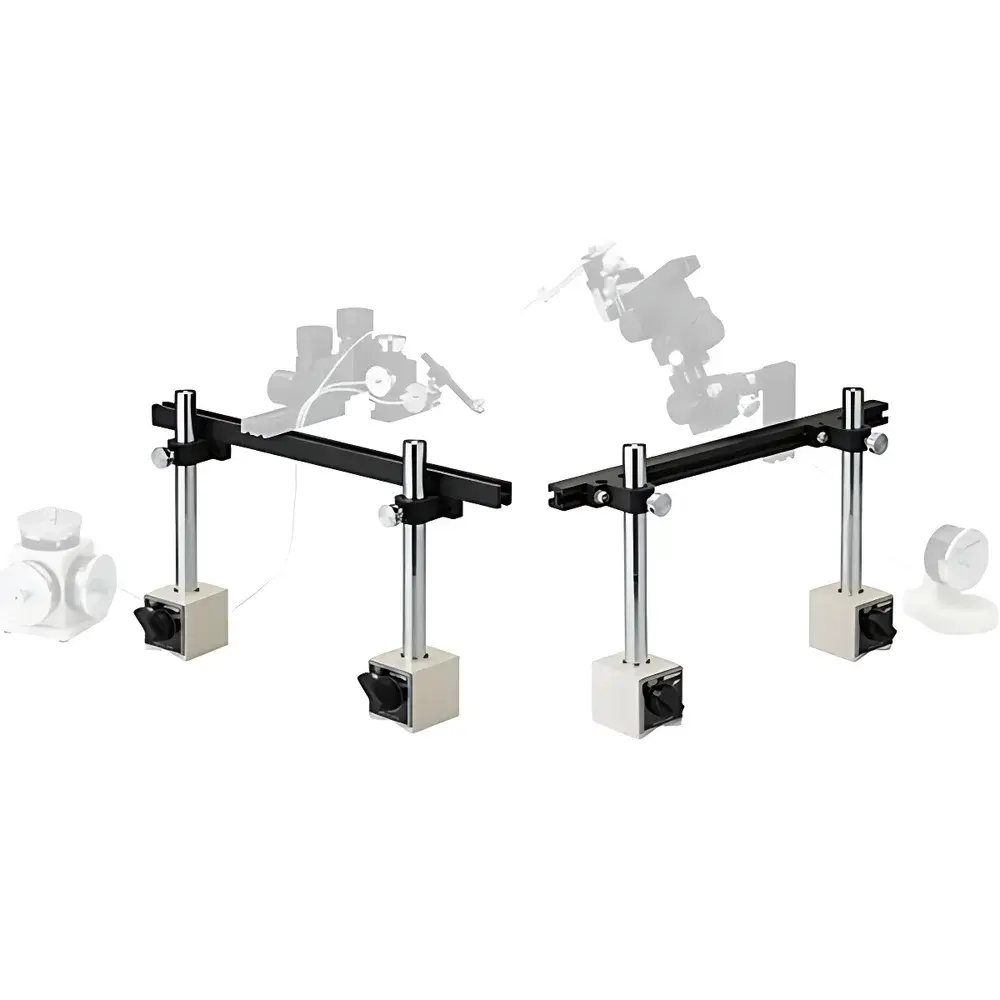
Narishige GJD-1 Magnetic “Bridge” Rod
| Brand | Narishige |
|---|---|
| Origin | Japan |
| Model | GJD-1 |
| Magnet Pull Force | ≥50 N |
| Material | Aerospace-grade Aluminum Body, Medical-grade POM Clamping Surfaces |
| Weight | 3.5 kg |
| Dimensions (W×D×H) | 400 × 90 × 250 mm |
| Mounting Interface | M6 Threaded Top Port, 10 mm Diameter Rod Compatibility |
| X/Y Coarse Travel | ±25 mm |
| Z Coarse Travel | ±30 mm |
| Z Fine Adjustment Resolution | 0.1 µm |
| Tilt Range | ±45° |
| Compliance | ISO 10993 (Biocompatibility), RoHS |
Overview
The Narishige GJD-1 Magnetic “Bridge” Rod is a precision mechanical positioning platform engineered for high-stability, low-interference integration within optical and electrophysiological workstations. It operates on the principle of permanent magnetic adhesion—utilizing sintered neodymium-iron-boron (NdFeB) magnets rated at ≥50 N pull force—to achieve tool-free, repeatable mounting onto ferromagnetic surfaces such as microscope stages, steel optical tables, or custom-built rig frames. Its structural topology—a rigid, cantilevered bridge architecture with dual lateral support arms—enables simultaneous suspension and independent alignment of up to three rod-mounted micromanipulators (e.g., electrode holders, microinjection pipette holders, or patch-clamp manipulators). This configuration eliminates mechanical coupling between devices while preserving nanoscale positional fidelity across all axes. Designed specifically for environments where electromagnetic noise, thermal drift, or mechanical vibration must be minimized—including whole-cell patch-clamp recording, intracytoplasmic sperm injection (ICSI), and live-tissue microinjection—the GJD-1 delivers passive stability without active electronics or power requirements.
Key Features
- High-fidelity magnetic base: NdFeB magnet array ensures secure, repositionable attachment to steel surfaces without drilling, clamping, or adhesive residues.
- Modular bridge geometry: Supports concurrent mounting of two to three 10 mm diameter manipulator rods (e.g., Narishige MMO-202ND, WR-6, or third-party equivalents) with independent azimuthal and tilt adjustment.
- Three-axis mechanical positioning system: Coarse X/Y translation (±25 mm), coarse Z lift (±30 mm), and fine Z adjustment via calibrated micrometer drive (0.1 µm resolution per division).
- Angular flexibility: Integrated clamp permits ±45° rotational tilt around the vertical axis, enabling oblique access to samples in inverted or upright configurations.
- Electromagnetically silent operation: Fully passive mechanical construction—no sensors, motors, or circuitry—ensuring zero EMI/RFI emission during extracellular or intracellular electrophysiological measurements.
- Biocompatible interface surfaces: All sample-facing components (clamping jaws, contact pads) fabricated from medical-grade polyoxymethylene (POM), certified per ISO 10993-5 (cytotoxicity) and ISO 10993-10 (irritation/sensitization).
Sample Compatibility & Compliance
The GJD-1 is compatible with standard 10 mm outer-diameter micromanipulator rods used across major life science instrumentation platforms. Its M6 threaded top port accepts commercially available accessories including objective lens brackets, fluorescence filter cubes, LED excitation mounts, and custom-machined adapters. The device conforms to RoHS Directive 2011/65/EU for hazardous substance restriction and meets mechanical safety requirements under ISO 14120:2015 (guards—general requirements for the design and construction of fixed and movable guards). While not an active medical device, its biocompatible POM components are validated for direct contact with primary neuronal cultures, oocytes, and retinal explants under GLP-aligned cell handling protocols.
Software & Data Management
As a purely mechanical positioning aid, the GJD-1 requires no firmware, drivers, or software integration. It functions independently of digital control systems and introduces no latency, calibration dependencies, or data logging overhead. This makes it particularly suitable for use in FDA 21 CFR Part 11–compliant electrophysiology suites where audit trails must remain unambiguous and hardware-induced variability must be excluded from signal acquisition pipelines. Positional repeatability is verified manually using calibrated stage micrometers or laser interferometry; no software-based homing or coordinate mapping is necessary or supported.
Applications
- Reproductive biology: Stabilization of oocyte and injection needle during ICSI procedures, enabling submicron alignment under time-lapse DIC imaging.
- Neurophysiology: Synchronized deployment of multi-electrode arrays (e.g., H-13 holders) for dual-patch recordings in acute brain slices or cultured neurons.
- Ophthalmic microsurgery: Rigid fixation of ex vivo porcine or primate eyes during subretinal vector delivery experiments.
- Materials science: Precise angular orientation of semiconductor wafers or MEMS devices during focused ion beam (FIB) milling or thin-film deposition.
- Gene therapy development: Controlled positioning of viral vector-loaded glass capillaries for spatially resolved transduction of organoid tissues.
FAQ
Is the GJD-1 compatible with non-Narishige manipulators?
Yes—it accepts any 10 mm OD cylindrical rod mount, including models from Scientifica, Sutter Instrument, and Luigs & Neumann.
Can the magnetic base damage sensitive equipment?
No—the field is highly localized and decays rapidly with distance; it poses no risk to CCD cameras, PMTs, or piezoelectric positioners when mounted >30 mm away.
What maintenance is required?
None beyond periodic cleaning of the magnet face with isopropyl alcohol to remove ferrous debris; no lubrication or recalibration is needed.
Does the GJD-1 meet cleanroom Class 100 requirements?
Its anodized aluminum body and POM components are non-shedding and compatible with ISO 14644-1 Class 5 (Class 100) environments when handled with appropriate gowning protocols.
Can it be used on non-ferromagnetic optical tables?
Only if a steel adapter plate (e.g., 3 mm thick SS304) is affixed to the table surface; the magnet does not adhere to aluminum, granite, or carbon fiber substrates.



