
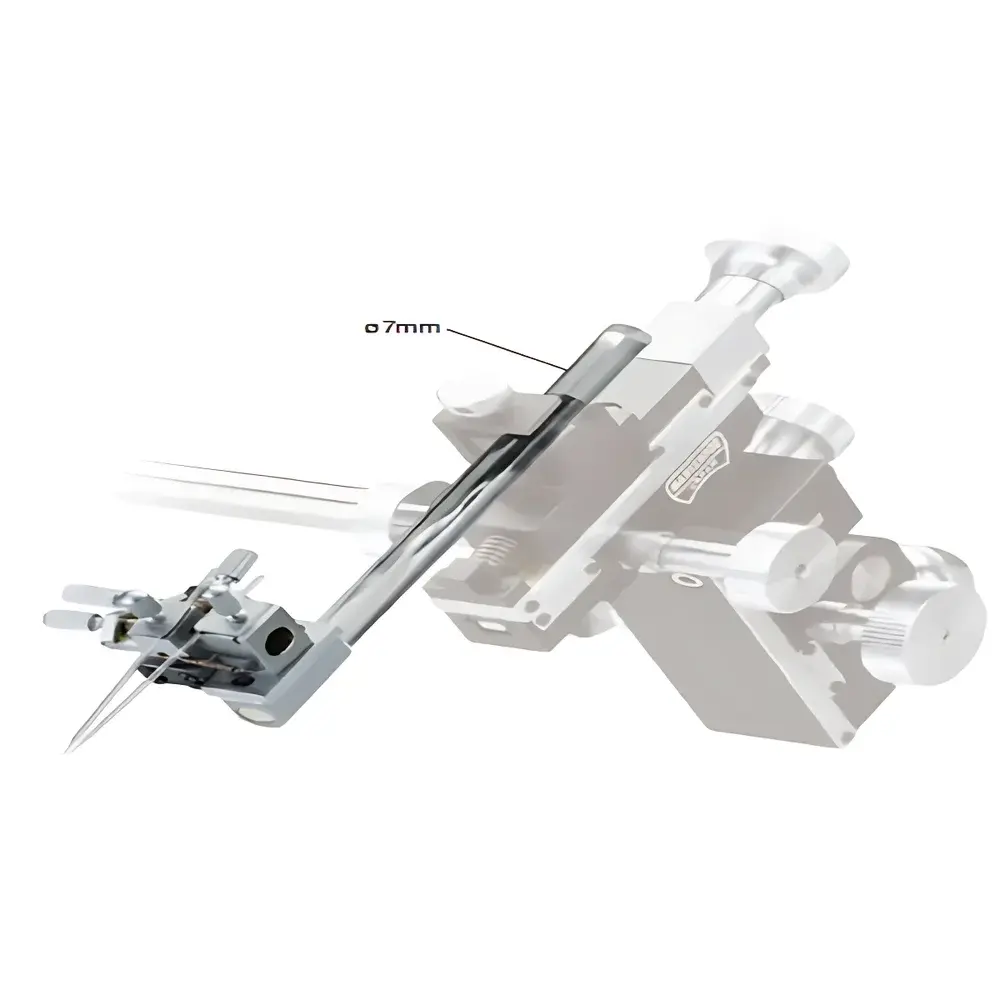
NARISHIGE HMD-2 Dual-Electrode Micromanipulator Holder
| Brand | NARISHIGE |
|---|---|
| Origin | Japan |
| Model | HMD-2 |
| Dimensions | 110 × 40 × 40 mm (W × D × H) |
| Weight | 60 g |
| Electrode Mounting | Dual Ø7 mm acrylic rods |
| Actuation | Manual (mechanical micromanipulator-coupled) |
| Adjustment Axes | X, Y, rotation, tilt |
| Compliance | Compatible with standard micromanipulator arms (e.g., MO-202, MN-401) |
Overview
The NARISHIGE HMD-2 Dual-Electrode Micromanipulator Holder is a precision passive positioning device engineered for electrophysiological, microinjection, and intracellular recording applications requiring simultaneous, independent, and highly stable placement of two fine electrodes. Unlike motorized or piezoelectric holders, the HMD-2 operates without active drive components—relying instead on rigid mechanical coupling to high-resolution manual micromanipulators (e.g., NARISHIGE MO-202, MN-401, or equivalent third-party arms). Its core architecture centers on a low-mass acrylic support rod (Ø7 mm) that directly interfaces both electrode shafts, minimizing cantilever deflection and thermal drift while preserving sub-micrometer positional reproducibility during long-duration experiments. The absence of integrated actuators eliminates electromagnetic interference, power supply dependencies, and thermal noise—critical for low-noise voltage-clamp recordings or sensitive impedance measurements.
Key Features
- Rigid dual-electrode mounting via parallel Ø7 mm acrylic rods—ensures coaxial alignment and minimizes relative drift between electrodes.
- Four-degree-of-freedom manual adjustment: independent X-axis translation, Y-axis translation, rotational orientation (azimuth), and tilt (pitch) — each controlled via knurled, backlash-minimized brass knobs with tactile feedback.
- Ultra-compact footprint (110 × 40 × 40 mm) and lightweight construction (60 g) enable seamless integration into crowded rig configurations—including inverted microscopes, patch-clamp workstations, and multi-probe electrophysiology setups.
- Passive design eliminates electrical noise sources, making it suitable for high-gain DC-coupled amplifiers and low-current (<1 pA) measurement environments.
- Chemically resistant acrylic body withstands repeated exposure to ethanol, chloroform, and common electrophysiology saline solutions without dimensional creep or hazing.
- Standardized mounting interface compatible with NARISHIGE’s universal manipulator clamps and industry-standard 3/8″-16 UNC threaded bases.
Sample Compatibility & Compliance
The HMD-2 is optimized for glass micropipettes (1.0–1.5 mm OD), metal microelectrodes (e.g., tungsten, platinum-iridium), and borosilicate or quartz shank probes used in sharp-electrode intracellular recording, extracellular field potential mapping, and dual-patch clamp configurations. It supports electrode lengths up to 100 mm when mounted on manipulators with ≥50 mm vertical travel. While the holder itself carries no intrinsic certification, its passive mechanical design conforms to GLP-aligned laboratory practices by eliminating software-controlled variables—facilitating audit-ready documentation of experimental setup geometry. When deployed within FDA-regulated preclinical neurophysiology workflows, the HMD-2 contributes to traceable, operator-documented positioning protocols compliant with 21 CFR Part 11 requirements for manual instrument logs.
Software & Data Management
As a purely mechanical positioning aid, the HMD-2 does not incorporate embedded firmware, digital interfaces, or data logging capabilities. Positional parameters (X/Y coordinates, rotation angle, tilt) are recorded manually in lab notebooks or experiment metadata files (e.g., NWB, HDF5) alongside electrophysiological traces. Its design intentionally avoids digital dependency—ensuring uninterrupted operation during software crashes, OS updates, or network outages. For labs implementing electronic lab notebooks (ELNs) such as LabArchives or Benchling, standardized templates can be configured to capture knob settings and electrode spacing at setup time, supporting full experimental reproducibility and cross-lab protocol harmonization.
Applications
- Dual intracellular recording from coupled neurons or syncytial tissues (e.g., cardiac myocyte pairs, cortical slice networks).
- Simultaneous stimulation and recording using one electrode for current injection and another for voltage sensing.
- Microelectrode array (MEA) calibration and reference electrode positioning in hybrid in vitro platforms.
- Controlled proximity experiments—e.g., measuring inter-electrode capacitance or electric field coupling in defined geometries.
- Training platforms for novice electrophysiologists, where deterministic, non-software-mediated control builds fundamental spatial intuition.
FAQ
Can the HMD-2 be used with motorized micromanipulators?
Yes—provided the manipulator features a standard mechanical clamp interface (e.g., NARISHIGE’s MHW-1 or equivalent); however, all positioning remains manual via the HMD-2’s dedicated knobs.
What is the minimum center-to-center electrode spacing achievable?
Approximately 0.8 mm, constrained by electrode shank diameter and clearance between the two Ø7 mm acrylic rods.
Is the HMD-2 autoclavable?
No—acrylic softens above 70 °C; cleaning is recommended with 70% ethanol and lint-free wipes.
Does it support vibration isolation mounting?
Yes—the low mass and rigid geometry allow direct attachment to optical tables, pneumatic isolators, or custom damping stages without resonance amplification.
Are replacement acrylic rods available separately?
Yes—NARISHIGE supplies spare Ø7 mm acrylic rods (Part No. HMD-2-RD) and M3×0.5 locking screws (Part No. HMD-2-SC) through authorized distributors.
Related Products



