
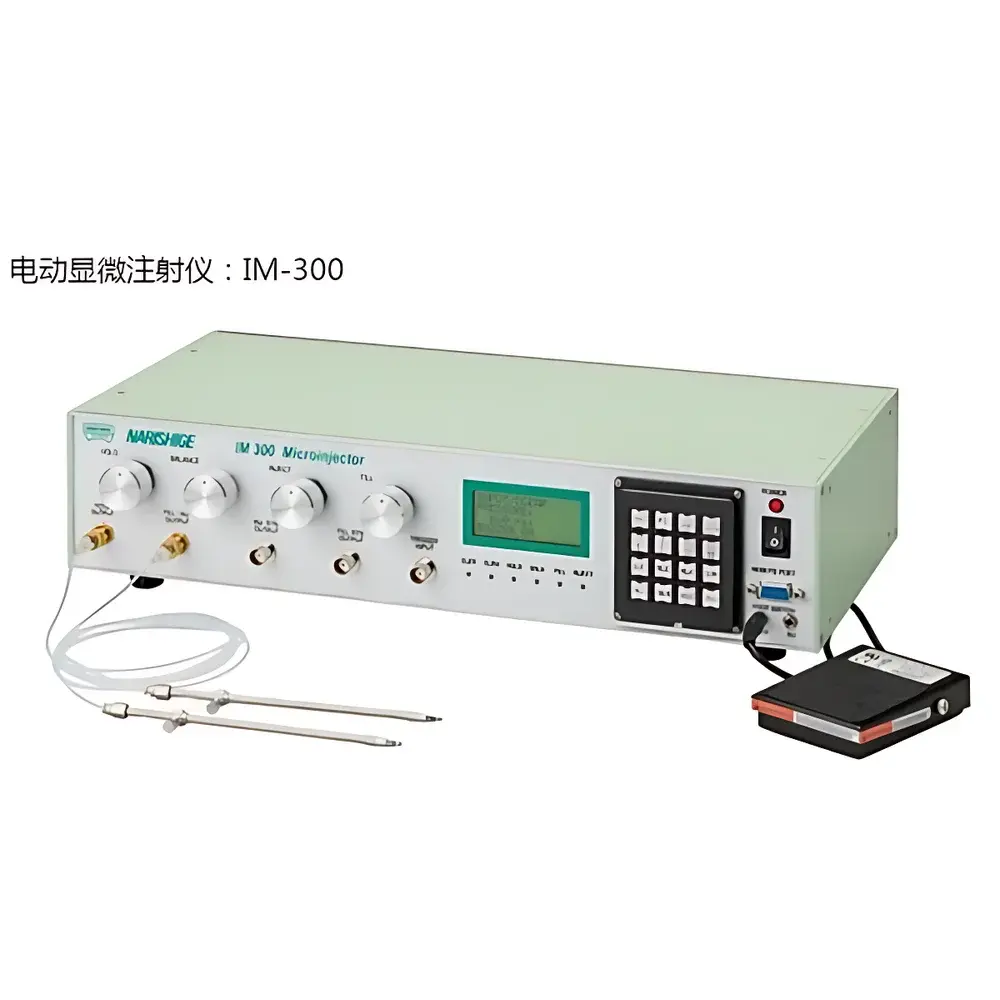
Narishige IM-300 Programmable Electric Microinjector for Zebrafish
| Origin | Japan |
|---|---|
| Manufacturer Type | Authorized Distributor |
| Origin Category | Imported Instrument |
| Model | IM-300 |
| Pricing | Available Upon Request |
| Input Pressure | 400–700 kPa (60–100 psi) |
| Injection Pressure Range | 0.7–400 kPa (0.1–60 psi) |
| Balance Pressure Range | 0–70 kPa (0–10 psi) |
| Time Setting Resolution | 10 ms – 327.66 s |
| Count Setting Range | 1–255 |
| Power Supply | AC 100–120 V ±5% / 220–240 V ±5%, 50/60 Hz |
| Power Consumption | ~25 W |
| Dimensions (W×D×H) | 425 × 205 × 90 mm |
| Weight | 3.7 kg |
Overview
The Narishige IM-300 is a precision-engineered, programmable electric microinjector designed specifically for reproducible, low-volume liquid delivery in developmental biology and genetic manipulation workflows—particularly in zebrafish (Danio rerio) embryo microinjection. Operating on a digitally controlled pneumatic actuation principle, the IM-300 delivers calibrated pressure pulses to glass capillary needles mounted on standard micromanipulators. Its core architecture integrates three independently adjustable pressure channels—Injection, Withdrawal (aspiration), and Balance—enabling fine-grained control over fluid dynamics at the microscale. Unlike manual or analog systems, the IM-300 eliminates operator-dependent variability by replacing hand-triggered injection with deterministic, repeatable timing and pressure profiles. This ensures high intra- and inter-experimental consistency—critical for CRISPR/Cas9 gene editing, mRNA or morpholino oligonucleotide delivery, lineage tracing dyes, and transgenic construct integration where dosage fidelity directly impacts phenotypic penetrance and statistical validity.
Key Features
- Triple-pressure channel architecture: Independent digital regulation of injection pressure (0.7–400 kPa), withdrawal pressure (aspiration), and balance pressure (0–70 kPa) for precise control of meniscus stability and backflow prevention.
- Programmable timing resolution: Adjustable pulse duration from 10 milliseconds to 327.66 seconds in 10-ms increments, supporting both single-pulse and multi-cycle injection protocols.
- Dual-mode operation: Local footswitch activation for real-time manual control, plus TTL-compatible external trigger input (5 V logic level) for synchronization with imaging systems, motorized stages, or automated embryo positioning platforms.
- Batch injection capability: User-defined count setting (1–255 injections per sequence) with automatic cycle termination and audible/visual completion feedback.
- Robust pneumatic design: Stainless-steel solenoid valves and sealed pressure regulators ensure long-term stability and minimal drift across extended operational sessions.
- Universal power compatibility: Auto-switching dual-voltage input (100–120 V / 220–240 V, 50/60 Hz) enables deployment in global laboratory environments without voltage converters.
Sample Compatibility & Compliance
The IM-300 is optimized for use with standard borosilicate or quartz glass capillaries (inner diameters 0.5–5.0 µm), commonly pulled using laser or gravity-based micropipette pullers. It supports injection into zebrafish embryos at 1–4 cell stages, as well as other small model organisms including Xenopus laevis oocytes, Drosophila embryos, and C. elegans gonads. All wetted components comply with ISO 10993-5 biocompatibility standards for short-term non-implantable contact. The instrument meets IEC 61010-1:2010 safety requirements for laboratory electrical equipment and conforms to EMC Directive 2014/30/EU. While not certified for GMP production environments, its deterministic parameter logging and repeatable output support GLP-aligned experimental documentation when integrated into validated lab workflows.
Software & Data Management
The IM-300 operates as a standalone hardware controller with no proprietary software dependency. All parameters—including pressure values, time settings, and injection counts—are configured via an intuitive front-panel membrane keypad with LED status indicators. Each parameter change is immediately saved to non-volatile memory, ensuring retention after power cycling. For traceability, users are advised to record configuration snapshots manually or integrate the device into custom LabVIEW, Python (PySerial), or MATLAB automation scripts via the TTL trigger interface. Though the unit does not generate native audit trails or electronic signatures, its deterministic behavior and stable calibration make it suitable for FDA 21 CFR Part 11-compliant environments when paired with validated third-party data acquisition systems that capture timestamped trigger events and operator metadata.
Applications
- Zebrafish transgenesis: Delivery of Tol2 transposase mRNA + plasmid DNA constructs into 1-cell embryos with sub-nanoliter volume accuracy.
- Functional genomics: Co-injection of Cas9 protein, sgRNA, and repair templates for targeted knock-in or base editing studies.
- Morpholino antisense oligonucleotide (MO) knockdown: Quantitative suppression of maternal or zygotic gene expression with minimized off-target toxicity.
- Cell labeling and lineage tracing: Precise intracellular or perivitelline space injection of fluorescent dextrans, calcium indicators, or photoactivatable probes.
- Pharmacological perturbation: Controlled delivery of small-molecule inhibitors or activators into specific embryonic compartments during gastrulation or organogenesis.
FAQ
What types of micropipettes are compatible with the IM-300?
Standard filamented or non-filamented borosilicate glass capillaries (e.g., Sutter BF150-86-10, World Precision Instruments TW100F-4) pulled to tip inner diameters between 0.5 µm and 5.0 µm.
Can the IM-300 be integrated into automated embryo handling systems?
Yes—its TTL trigger input accepts 5 V logic signals, enabling synchronization with robotic embryo aligners, high-speed cameras, or motorized XYZ stages via custom or commercial control interfaces.
Is calibration required before each use?
No routine recalibration is needed; however, users should verify pressure output annually using a NIST-traceable digital pressure gauge connected to the output port.
Does the IM-300 support continuous infusion or only pulsed injection?
It is designed exclusively for discrete, time-gated pressure pulses—not continuous flow. For sustained perfusion applications, a separate syringe pump system is recommended.
What maintenance is recommended for long-term reliability?
Monthly cleaning of the input filter, quarterly inspection of O-rings and tubing for microcracks, and annual replacement of the internal desiccant cartridge (part no. DS-1) to prevent moisture-induced valve corrosion.





