
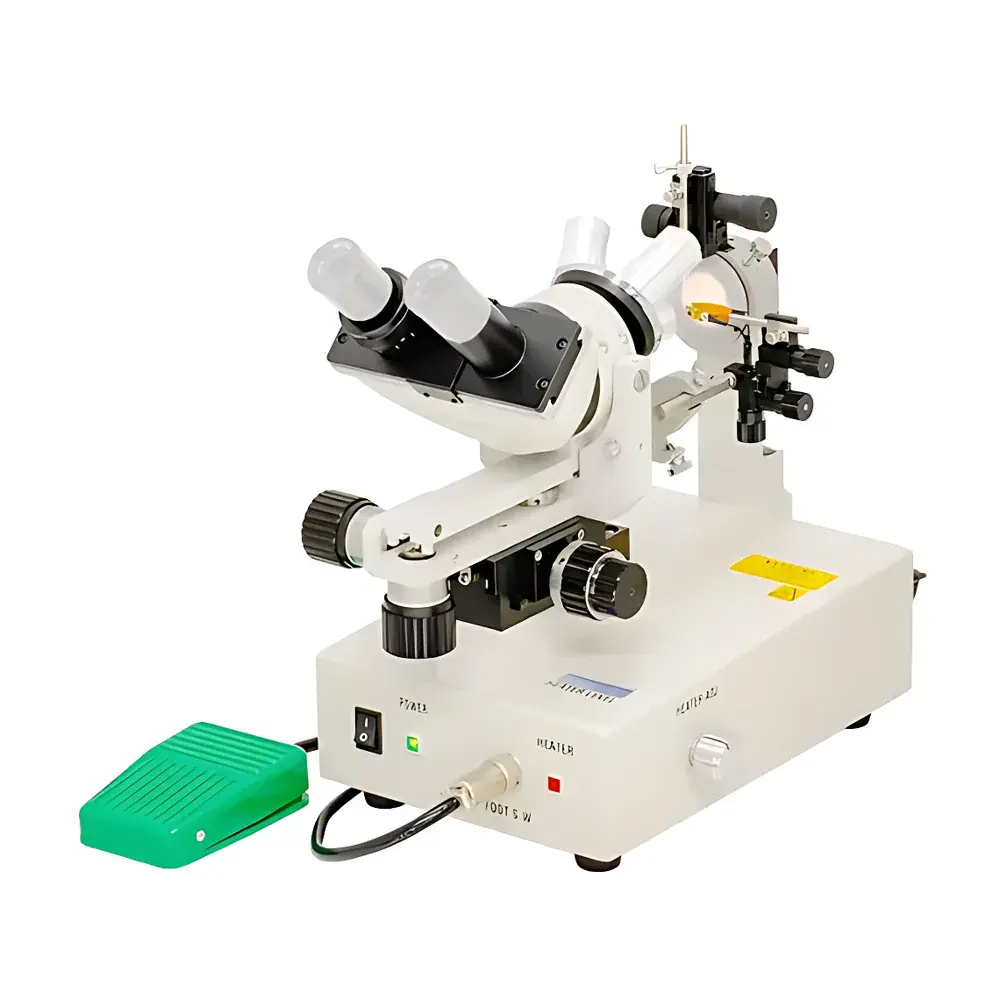
NARISHIGE MF2 Microforge
| Brand | NARISHIGE |
|---|---|
| Origin | Japan |
| Model | MF2 |
| Input Voltage | AC 100–240 V, 50/60 Hz |
| Power Consumption | 13 W |
| Dimensions (W×D×H) | 210 × 300 × 280 mm |
| Weight | 5.8 kg |
| Heating Element Travel Range (X/Y/Z) | 14 mm each |
| Capillary Manipulator Travel Range (X/Z) | 12 mm / 28 mm |
| Microscope Focus Travel (Y) | 30 mm |
| Swing Angle (X) | ≈5° |
| Tilt Adjustment (Z) | ≈3° |
| Magnification Options | 50×/100× (MF2-LS1), 400× (with MF2-LO40), 600× (MF2-LO40 + MF2-LE15) |
| Capillary Compatibility | Ø1.0, Ø1.2, Ø1.5 mm borosilicate glass |
| Included Accessories | Foot switch, power cord, capillary holder, hex key, spare heater (PT-B), silicone rubber gasket (HI01PK01) |
| Optional Lenses | MF2-LS1 (5×/10× objectives + 10× eyepieces), MF2-LE15 (15× eyepieces), MF2-LO40 (40× objective) |
| Micrometer Calibration | 20 µm/div (5×), 10 µm/div (10×), 2.5 µm/div (40×) |
| LED Illumination | Adjustable brightness, low-eye-fatigue design |
| Safety Features | Heater status display, open-circuit warning for heater failure |
Overview
The NARISHIGE MF2 Microforge is a precision microfabrication instrument engineered for the controlled thermal modification of glass capillaries under optical observation. Operating on the principle of localized resistive heating—where a fine tungsten or platinum wire heater delivers calibrated thermal energy to the tip of a pulled or cut capillary—the MF2 enables reproducible fabrication of micropipettes, patch-clamp electrodes, microinjection needles, and electrophysiological probes. Its integrated high-stability stereo microscope provides real-time visual feedback during fire-polishing, bending, bevelling, and tip sharpening operations. Designed for use in neuroscience, developmental biology, single-cell electrophysiology, and microinjection laboratories, the MF2 meets the stringent mechanical and thermal stability requirements necessary for sub-micron tip geometry control. The system’s compact footprint and rigid X-Y-Z manipulator architecture minimize vibration-induced drift and capillary fracture risk during delicate thermal processing.
Key Features
- Integrated coaxial focus microscope with 30 mm vertical travel, coarse/fine dual-stage focusing, and optional magnification up to 600× (using MF2-LO40 40× objective and MF2-LE15 15× eyepieces)
- Digital heater level display with real-time feedback and open-circuit fault detection—provides immediate visual alert if heater continuity is lost
- Dual-axis (X/Z) capillary manipulator with 12 mm horizontal and 28 mm vertical travel, enabling precise positioning relative to the heating zone
- Three-axis (X/Y/Z) heating element manipulator (14 mm per axis) with re-engineered stiffened control mechanisms for enhanced positional repeatability
- Adjustable LED illumination system with continuous brightness control—optimized for extended operator comfort and reduced ocular fatigue
- Foot-switch operation for hands-free heater activation/deactivation, supporting ergonomic workflow during prolonged fabrication sessions
- Backward compatibility with legacy optics: MF-830 and MF-900 objective lenses and eyepieces are fully interoperable
- Modular accessory support including silicone rubber gaskets (HI01PK01), spare heaters (PT-B), and dedicated capillary holders for Ø1.0, Ø1.2, and Ø1.5 mm tubing
Sample Compatibility & Compliance
The MF2 is validated for use with standard borosilicate glass capillaries (e.g., HIC-1.2, HIC-1.5, H-7 series), accommodating outer diameters from 1.0 mm to 1.5 mm. Its thermal profile and mechanical positioning accuracy ensure consistent tip geometry across batch-manufactured pipettes used in GLP-compliant electrophysiology studies and FDA-regulated preclinical injection protocols. While the MF2 itself is not a medical device, its output—micropipettes fabricated to defined tip opening diameters (<1 µm), taper angles, and wall thicknesses—supports experimental reproducibility required under ISO/IEC 17025-accredited laboratory practices. The instrument’s electrical safety complies with IEC 61010-1 for laboratory equipment; CE marking applies to the EU market. No software-based audit trail is embedded, but manual logbook documentation of heater settings, capillary type, and fabrication parameters satisfies basic GMP traceability needs for non-automated electrode production.
Software & Data Management
The MF2 operates as a hardware-only platform with no embedded firmware, network interface, or proprietary software dependency. All operational parameters—including heater intensity (displayed digitally in arbitrary units), focus position, and manipulator coordinates—are set manually via calibrated mechanical controls. This analog-first architecture eliminates cybersecurity risks, ensures long-term operational continuity without OS updates or driver dependencies, and aligns with institutions maintaining air-gapped electrophysiology core facilities. For laboratories requiring digital recordkeeping, integration with external lab information management systems (LIMS) is achieved through standardized operator-entered metadata (e.g., capillary lot number, date/time, heater setting, final tip geometry measured post-fabrication using SEM or optical profilometry). Optional micrometer-equipped eyepieces (e.g., MF2-LS1) provide traceable scale calibration per ISO 10110-5 for quantitative tip diameter estimation under optical microscopy.
Applications
- Electrophysiology: Fabrication of low-resistance patch-clamp pipettes with polished tips for whole-cell and perforated-patch configurations
- Microinjection: Production of tapered, bevelled needles for pronuclear or cytoplasmic injection in transgenic mouse, zebrafish, and C. elegans models
- Single-cell analysis: Generation of ultrafine aspiration pipettes for subcellular organelle isolation or nuclear transfer
- Neuroscience research: Custom shaping of recording electrodes for in vivo tetrode or silicon probe assembly
- Developmental biology: Creation of blunt-ended transfer pipettes for embryo handling and blastomere separation
- Materials science: Thermal conditioning of glass microcapillaries prior to coating or functionalization
FAQ
What capillary diameters are supported by the MF2?
The MF2 accommodates standard borosilicate glass capillaries with outer diameters of 1.0 mm, 1.2 mm, and 1.5 mm—compatible with commercially available HIC-series and H-7 tubing.
Is the microscope magnification fixed or configurable?
Magnification is fully modular: base configuration offers 50×/100× (with MF2-LS1 lens set); optional upgrades enable 400× (MF2-LS1 + MF2-LO40) or 600× (MF2-LO40 + MF2-LE15), verified via calibrated micrometer reticles.
Does the MF2 support automated tip-diameter feedback control?
No—the MF2 is a manual microforge. Tip geometry assessment relies on operator visual inspection under the microscope and optional post-fabrication metrology (e.g., scanning electron microscopy or optical interferometry).
Can the heater orientation be changed between horizontal and vertical setups?
Yes. The heating element mount permits reconfiguration for either horizontal or vertical alignment relative to the capillary axis, facilitating optimal heat distribution for different tip-shaping protocols.
What maintenance is required for long-term reliability?
Routine cleaning of optical surfaces, periodic verification of heater wire integrity, and replacement of consumables (e.g., PT-B spare heaters, HI01PK01 gaskets) per manufacturer guidelines—no scheduled calibration is mandated due to the purely mechanical control architecture.
Related Products



