
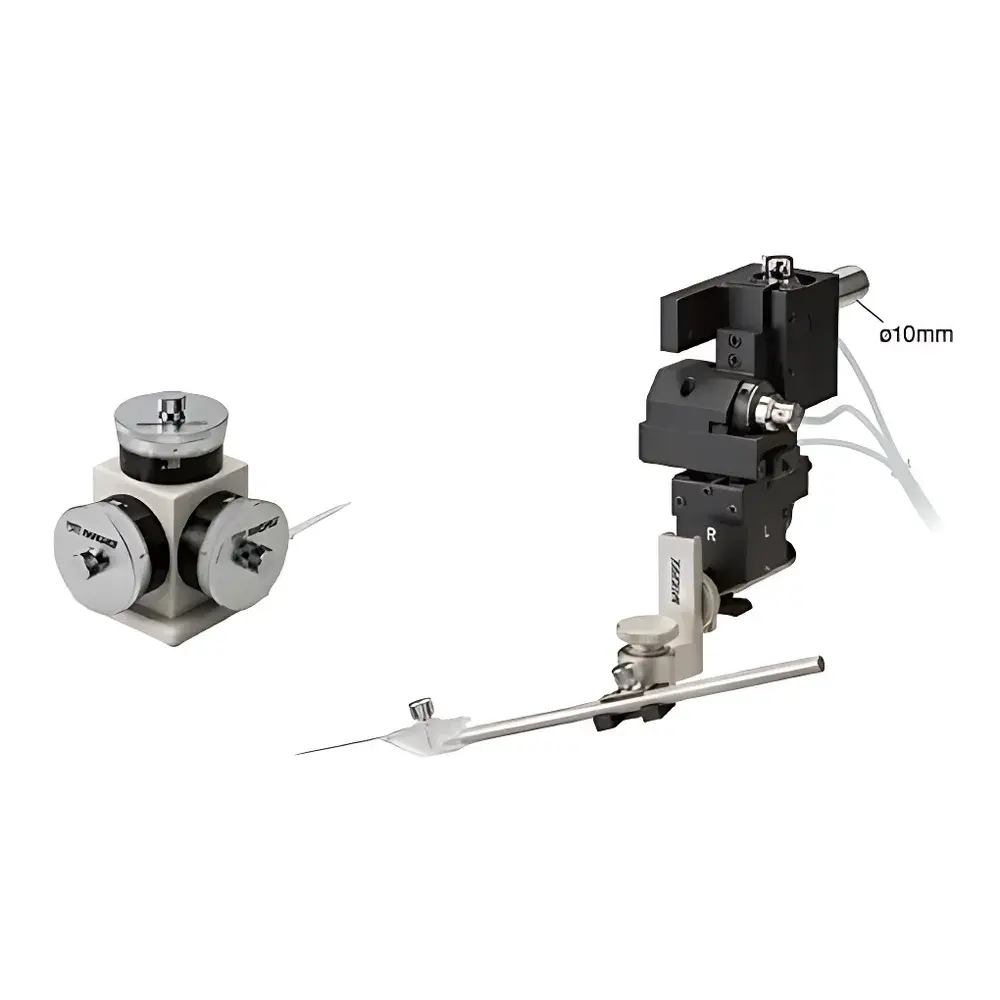
NARISHIGE MHW-103 Three-Axis Water-Hydraulic Micromanipulator
| Brand | NARISHIGE |
|---|---|
| Origin | Japan |
| Model | MHW-103 |
| Travel Range (X/Y/Z) | 10 mm each axis |
| Minimum Increment | 1 µm |
| Fine Adjustment per Full Turn | 250 µm |
| Control Unit Dimensions | 115 × 115 × 132 mm, 1.6 kg |
| Actuator Dimensions | 40 × 50 × 51 mm, 180 g |
| Hydraulic Tubing Length | 0.9 m |
| Accessories | B-8C Spherical Joint, H-7 Pipette Holder, CF-3 Universal Clamp, CF-3 Wrench |
Overview
The NARISHIGE MHW-103 is a precision-engineered three-axis water-hydraulic micromanipulator designed for high-stability, low-drift positioning in demanding life science and electrophysiology applications. Unlike mechanical or piezoelectric alternatives, the MHW-103 employs a closed-loop hydraulic transmission system using deaired, non-compressible water as the actuation medium—enabling smooth, backlash-free motion with exceptional force transmission fidelity and negligible hysteresis. Its core architecture integrates a compact, modular actuator unit with a separate ergonomic control console, connected via a 0.9 m reinforced hydraulic line. This physical decoupling minimizes thermal and vibrational coupling between operator input and tip movement—a critical advantage during prolonged patch-clamp recordings, intracellular microinjection, or live-cell imaging where nanometer-scale positional stability directly impacts experimental success rate.
Key Features
- Three independent linear axes (X, Y, Z) with 10 mm total travel per axis, engineered for orthogonal alignment and minimal crosstalk under load.
- Micrometer-style full-turn adjustment mechanism delivering 250 µm of linear displacement per revolution, calibrated to a resolution of 1 µm—achievable through fine-threaded stainless-steel leadscrews and hardened brass bushings.
- B-8C spherical joint provides ±15° angular freedom for rapid coarse reorientation without compromising axial rigidity; compatible with standard 3/8″–24 threaded microscope stages and manipulator arms.
- H-7 pipette holder features dual-set-screw clamping with integrated torque-limiting design, ensuring secure retention of glass micropipettes (OD 1.0–1.5 mm) while preventing fracture during lateral loading.
- CF-3 universal clamp enables rigid mounting on vertical posts (diameter 12–25 mm) or horizontal rails, supporting both upright and inverted configurations without adapter modification.
- Hydraulic circuit includes integrated air-bleed ports and pressure-relief valves, facilitating rapid system priming and long-term fluid integrity—critical for maintaining consistent response time and eliminating stepwise “jump” artifacts during slow ramping.
Sample Compatibility & Compliance
The MHW-103 is routinely deployed in GLP- and GMP-aligned electrophysiology labs, neuroscience core facilities, and developmental biology platforms where reproducibility and traceable calibration are mandated. Its all-metal construction (anodized aluminum housing, stainless-steel drive components) ensures compatibility with standard laboratory sterilization protocols (e.g., 70% ethanol wipe-down), and its sealed hydraulic system prevents leakage in humidified CO₂ incubator environments. While the device itself carries no CE or FDA clearance as a medical device, it conforms to IEC 61000-6-2 (EMC immunity) and IEC 61000-6-4 (EMC emission) standards when operated within specified ambient temperature (15–30°C) and humidity (30–70% RH, non-condensing) ranges. Calibration certificates for positional accuracy (±2 µm over full range, verified per ISO 230-2 Annex A) are available upon request for audit-ready documentation.
Software & Data Management
The MHW-103 operates as a manual, analog-positioning instrument—requiring no firmware, drivers, or software integration. This architecture eliminates dependency on operating systems, USB handshaking latency, or driver conflicts, thereby ensuring deterministic response times and zero risk of digital failure modes during extended recording sessions (>12 h). All adjustments are fully tactile and visually indexed via engraved vernier scales on each control knob, supporting blind operation under microscope eyepieces. For laboratories implementing electronic lab notebooks (ELN) or LIMS, positional settings can be manually logged alongside experimental metadata; optional third-party motorized upgrade kits (e.g., MHW-103M with stepper-motor retrofit) support ASCII command protocol (RS-232) for basic external triggering—though such modifications void original hydraulic warranty and are not endorsed by NARISHIGE for routine use.
Applications
- Whole-cell and cell-attached patch-clamp electrophysiology on primary neurons, HEK293 cells, and organotypic brain slices.
- Intracytoplasmic sperm injection (ICSI) and oocyte microinjection in reproductive biology and transgenic model generation.
- Targeted microelectrode placement for in vivo extracellular recordings in rodent stereotaxic surgery setups.
- High-magnification micromanipulation of subcellular organelles using laser-capture-compatible glass probes.
- Alignment and positioning of microfluidic devices relative to optical traps or confocal excitation volumes.
FAQ
Is the MHW-103 compatible with vibration-isolation tables?
Yes—the low-mass actuator (180 g) and decoupled hydraulic design minimize dynamic coupling; mounting via CF-3 clamp on a passive pneumatic isolator yields sub-µm drift over 60-minute intervals.
Can the hydraulic fluid be replaced or refilled by the user?
No—system priming and fluid maintenance must be performed by authorized NARISHIGE service technicians using certified deaeration procedures; unauthorized intervention risks air entrapment and loss of positional repeatability.
Does the MHW-103 support motorized or computer-controlled operation?
Not natively—the base model is strictly manual. Motorized variants (e.g., MHW-103M) exist but require separate controller hardware, introduce mechanical compliance, and forfeit the inherent stability advantages of pure hydraulic actuation.
What is the maximum recommended load capacity per axis?
150 g static load per axis at full extension; exceeding this threshold may accelerate seal wear and reduce minimum increment fidelity over time.
How often does the system require recalibration?
Under typical usage (≤4 hrs/day, ambient lab conditions), annual verification against traceable gauge blocks per ISO 230-2 is sufficient; no routine recalibration is required if vernier scales remain undamaged and knobs retain consistent torque profile.



