
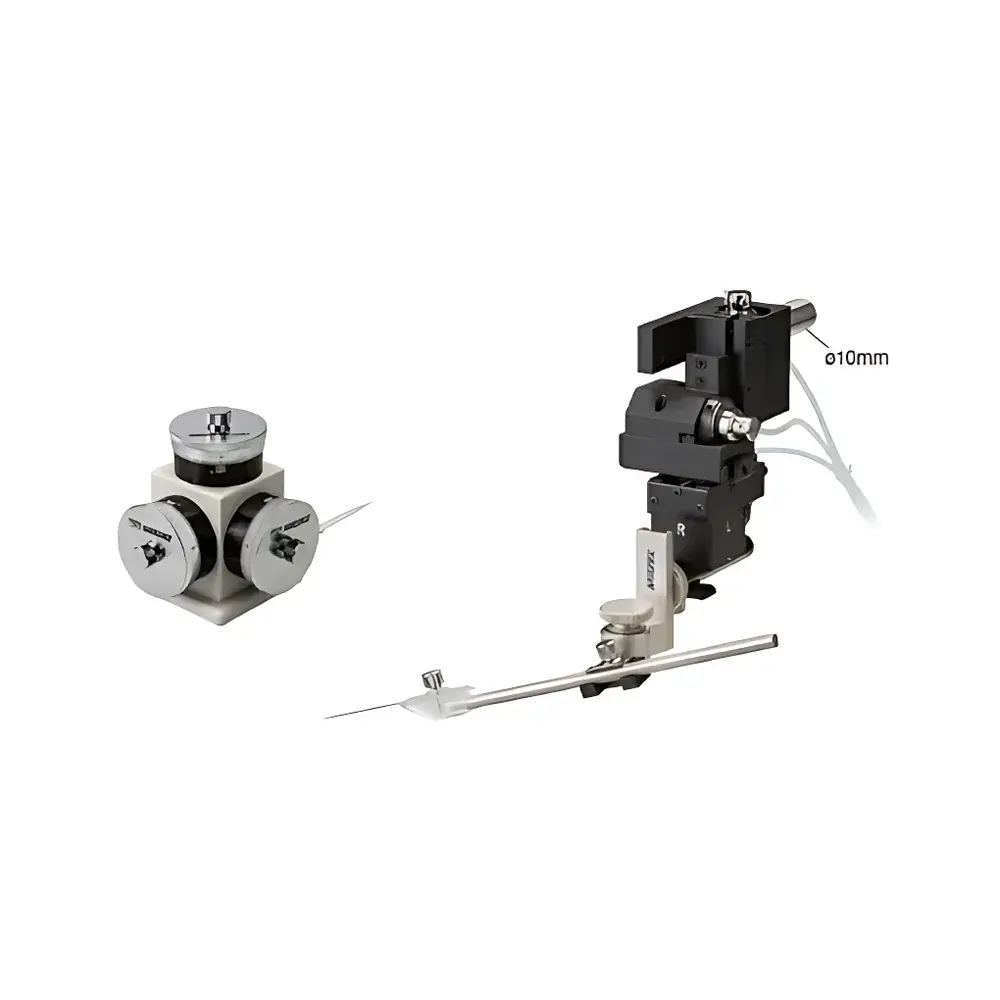
NARISHIGE MHW-4 One-Axis Water-Hydraulic Micromanipulator
| Brand | NARISHIGE |
|---|---|
| Origin | Japan |
| Model | MHW-4 |
| Travel Range | 2 mm |
| Minimum Increment | 50 µm |
| Resolution (Scale Reading) | 0.2 µm |
| Control Unit Dimensions | 65 × 88 × 93 mm, 630 g |
| Drive Unit Dimensions | 42 × 28 × 41 mm, 60 g |
Overview
The NARISHIGE MHW-4 is a single-axis, water-hydraulic micromanipulator engineered for high-precision manual positioning in life science and electrophysiology applications. Unlike mechanical or piezoelectric actuators, the MHW-4 employs a sealed hydraulic transmission system—using deionized water as the incompressible working fluid—to deliver smooth, backlash-free motion with exceptional force transmission and thermal stability. Its 2 mm total travel range is achieved via a calibrated rotary knob that translates angular displacement into linear actuation through a precision-machined piston-cylinder assembly. The device operates on the principle of Pascal’s law, ensuring consistent mechanical advantage and minimal hysteresis across repeated positioning cycles. Designed for integration into upright or inverted microscopes, patch-clamp rigs, and microinjection stations, the MHW-4 serves as a reliable manual positioning stage where sub-micron repeatability and tactile feedback are critical—particularly during electrode approach, cell targeting, or glass capillary alignment.
Key Features
- Water-hydraulic actuation ensures zero mechanical backlash, no gear wear, and immunity to electromagnetic interference—ideal for sensitive electrophysiological recordings.
- Coarse/fine dual-mode control: Full-turn knob provides 50 µm per revolution for rapid coarse positioning; vernier scale enables visual readout down to 0.2 µm for fine adjustments.
- Modular architecture separates the compact drive unit (mounted directly on the microscope stage or manipulator arm) from the ergonomic control unit—minimizing vibration coupling and optimizing workspace ergonomics.
- All wetted components are constructed from corrosion-resistant stainless steel and chemically inert elastomers, compatible with standard laboratory buffers, saline solutions, and low-conductivity water.
- No external power supply or compressed air required—operation is purely manual and self-contained, supporting use in shielded Faraday cages or laminar flow hoods without utility dependencies.
Sample Compatibility & Compliance
The MHW-4 is routinely deployed in GLP-compliant electrophysiology labs, developmental biology imaging suites, and neurophysiology core facilities. Its design conforms to ISO 9001 manufacturing standards at NARISHIGE’s Yokohama facility. While the device itself is not a medical device or diagnostic instrument, its mechanical performance supports experimental protocols aligned with key methodological references including ASTM F2943 (Standard Guide for Electrophysiology Instrumentation), USP (Performance Assessment of Micromanipulators), and IEC 61000-4-3 (EMC immunity for laboratory equipment). No regulatory submission (e.g., FDA 510(k), CE-IVD) applies, as it functions solely as a passive mechanical positioning aid—not a data-acquiring or therapeutic system.
Software & Data Management
The MHW-4 is a fully analog, hardware-only manipulator with no embedded electronics, firmware, or digital interface. Consequently, it does not generate, store, or transmit data—and requires no software drivers, calibration certificates, or audit trails. This absence of digital components eliminates concerns related to cybersecurity, firmware validation, or 21 CFR Part 11 compliance—making it suitable for environments where regulatory traceability of electronic records is either unnecessary or deliberately avoided. Users maintain full manual control integrity without dependency on proprietary platforms, third-party APIs, or periodic software updates. Documentation includes a bilingual (English/Japanese) printed user manual with torque specifications, maintenance intervals (recommended annual seal inspection), and dimensional mounting templates for standard microscope dovetail and cage-system adapters.
Applications
- Manual patch-clamp electrode positioning under visual guidance, especially during blind patching or when optical access is constrained.
- Microinjection of zebrafish embryos, Xenopus oocytes, or C. elegans gonads using glass micropipettes mounted on the drive unit.
- Alignment of fiber-optic probes, optogenetic cannulas, or thermocouples in chronic implantation studies requiring repeatable depth registration.
- Positioning of microelectrode arrays (MEAs) or silicon probes during ex vivo brain slice recordings.
- Calibration reference stage for validating closed-loop motorized manipulators—leveraging its known mechanical resolution and lack of encoder drift.
FAQ
Is the MHW-4 compatible with vibration isolation tables?
Yes—the low-mass drive unit (60 g) and rigid hydraulic linkage minimize dynamic coupling; mounting via optional M6-threaded base plate ensures stable integration on active or passive damping platforms.
Can the hydraulic fluid be refilled or replaced by the user?
No—units are factory-sealed and non-serviceable. Attempting disassembly voids warranty and risks contamination-induced seal failure. NARISHIGE recommends replacement after 5 years of continuous lab use or upon visible leakage.
Does the 0.2 µm scale resolution reflect actual positional accuracy?
The 0.2 µm刻度 (vernier scale graduation) indicates the smallest readable increment under ideal lighting and magnification; actual positional repeatability under typical load conditions is ±1.5 µm (3σ), as verified per NARISHIGE’s internal test protocol MHW-4-TP-2022.
What mounting interfaces are supported?
Standard configuration includes a 3/8″-16 UNC threaded base compatible with Thorlabs, Sutter, and Leica manipulator arms; custom dovetail (e.g., Nikon Eclipse, Zeiss Axio) and cage-system (30 mm or 60 mm) adapters are available as optional accessories.
Is temperature compensation provided for thermal drift?
No active compensation is integrated; however, the water-hydraulic system exhibits 30 min, ambient temperature control (<±0.5 °C) is recommended.



