
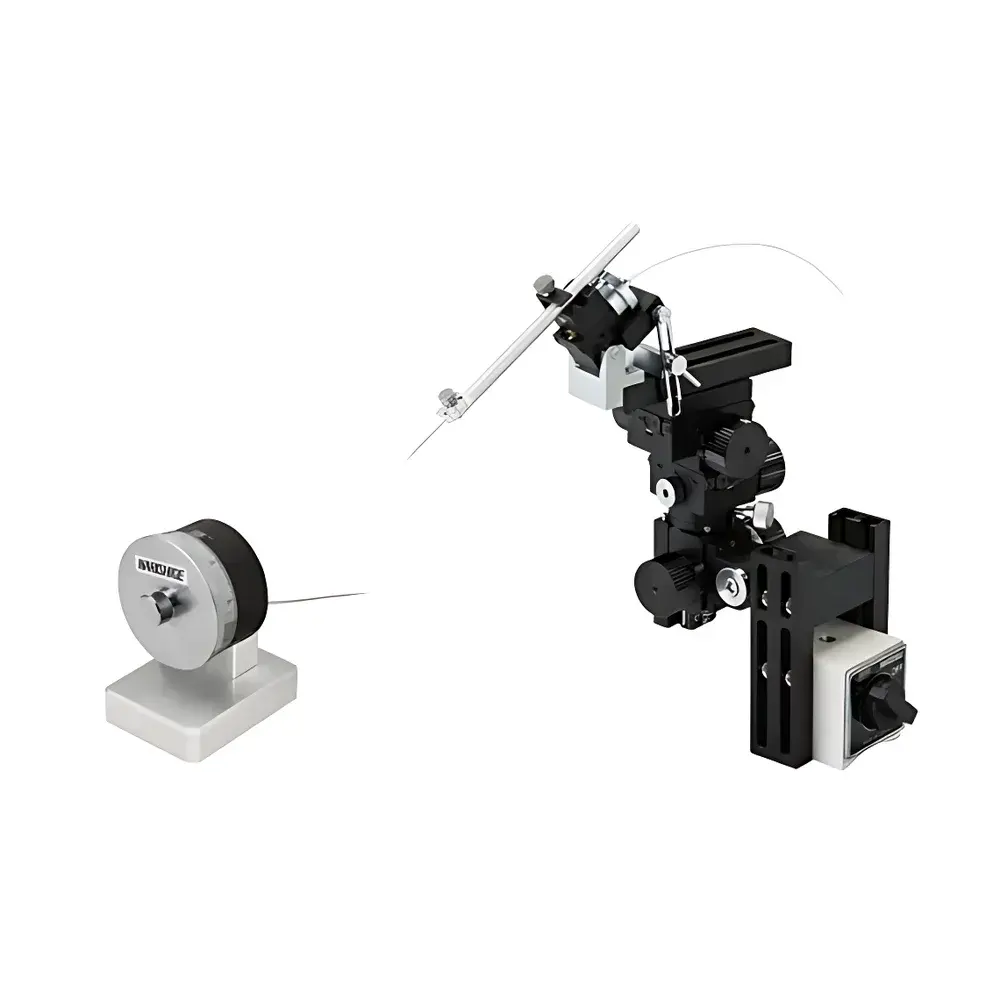
NARISHIGE MWS-32 One-Axis Water-Hydraulic Micromanipulator
| Brand | NARISHIGE |
|---|---|
| Origin | Japan |
| Model | MWS-32 |
| Axis Configuration | Single-axis (Z-axis primary motion with X/Y coarse positioning) |
| Coarse Travel | 30 mm (X, Y, Z) |
| Fine Adjustment Range | 2 mm (Z-axis only) |
| Minimum Graduation | 0.2 µm |
| Control Unit Dimensions | 65 × 88 × 93 mm, 630 g |
| Drive Unit Dimensions | 200 × 100 × 240 mm, 2.45 kg |
| Included Accessories | H-13 Electrode Holder, CF-3 Clamp, Universal Wrench |
| Mounting Type | Magnetic base |
| Actuation Principle | Water-hydraulic pressure transmission with mechanical fine-thread adjustment |
Overview
The NARISHIGE MWS-32 is a precision-engineered, single-axis water-hydraulic micromanipulator designed for stable, low-drift positioning in electrophysiology, patch-clamp recording, microinjection, and other life science applications requiring sub-micrometer repeatability under static or quasi-static conditions. Unlike motorized or piezoelectric systems, the MWS-32 employs a sealed water-hydraulic actuation mechanism coupled with a high-resolution mechanical fine-adjustment screw—providing inherent damping, minimal thermal drift, and immunity to electromagnetic interference. Its primary axis of motion is Z-directional, enabling precise vertical approach control of electrodes, pipettes, or probes toward biological specimens. Coarse X- and Y-axis adjustments (each 30 mm) allow rapid repositioning within the working field, while the dedicated Z-axis fine adjustment (2 mm range, 0.2 µm graduation) delivers tactile, analog control ideal for delicate contact initiation and depth modulation. The magnetic base ensures rapid, non-permanent mounting on standard ferromagnetic microscope stages without drilling or clamping hardware.
Key Features
- Water-hydraulic transmission system for smooth, backlash-free motion with high mechanical stability and negligible hysteresis
- Z-axis fine adjustment via calibrated 50 µm/rev micrometer screw with engraved 0.2 µm scale divisions for visual positional verification
- Integrated magnetic base (permanent NdFeB) supporting secure attachment to steel optical tables or inverted microscope stages (minimum thickness ≥3 mm)
- Modular accessory interface compatible with NARISHIGE’s standardized 3/8″–24 UNC mounting threads
- Control unit optimized for ergonomic thumb-wheel operation; compact footprint (65 × 88 × 93 mm) minimizes workspace intrusion
- Drive unit housing constructed from anodized aluminum alloy for dimensional stability across ambient temperature fluctuations (15–30 °C)
- No external power supply or controller required—fully manual, self-contained operation
Sample Compatibility & Compliance
The MWS-32 is routinely deployed in ISO 13485-aligned electrophysiology labs and GLP-compliant neurophysiology facilities. Its passive, non-electronic architecture eliminates RF noise coupling into low-voltage signal paths (<100 µV), making it suitable for intracellular recording per ASTM E2917-21 guidelines on instrumentation validation for biomedical measurements. The H-13 electrode holder accepts glass capillaries with outer diameters from 1.0 to 1.5 mm and features dual-set-screw fixation for torsional rigidity. The CF-3 universal clamp provides adjustable jaw opening (up to 35 mm) and rubber-coated gripping surfaces to prevent slippage during prolonged experiments. All metallic components comply with RoHS Directive 2011/65/EU and are passivated per ISO 8502-3 for corrosion resistance in humid laboratory environments.
Software & Data Management
As a fully manual, analog positioning device, the MWS-32 does not incorporate embedded electronics, firmware, or digital interfaces. Consequently, it requires no software installation, driver configuration, or cybersecurity validation. Positional data is recorded manually by users via scale reading or integrated into third-party acquisition systems (e.g., Axon pCLAMP, HEKA PatchMaster) using external encoders or laser displacement sensors—where traceability is maintained through lab notebook entries or electronic lab notebook (ELN) annotations compliant with 21 CFR Part 11 when paired with validated documentation workflows. Calibration verification is performed semi-annually using NIST-traceable gauge blocks and optical interferometry per ISO/IEC 17025:2017 clause 6.5.
Applications
- Patch-clamp electrode positioning for whole-cell, cell-attached, and perforated-patch configurations
- Microinjection of zebrafish embryos, oocytes, or cultured neurons using glass micropipettes
- Single-cell aspiration and manipulation in combination with upright or inverted fixed-stage microscopes
- Alignment of optical fibers or cantilevers in AFM/SECM hybrid setups
- Manual calibration of reference probes in metrology-grade biosensor characterization rigs
- Teaching laboratories where intuitive, failure-resistant instrumentation supports student learning of spatial coordination fundamentals
FAQ
Is the MWS-32 compatible with vibration-isolated optical tables?
Yes—the magnetic base maintains firm adhesion on ferromagnetic table surfaces; however, for ultra-low-vibration applications (e.g., single-molecule imaging), supplemental vacuum chucks or mechanical clamps are recommended to suppress resonant coupling.
Can the fine adjustment be locked during long-duration recordings?
The Z-axis micrometer includes a knurled locking ring that mechanically immobilizes the fine-thread carriage without inducing creep or backlash upon release.
What is the maximum load capacity for the H-13 holder when used with borosilicate pipettes?
Rated for static loads up to 150 g at the tip; dynamic loading (e.g., pipette penetration) should remain below 50 g to preserve graduation accuracy and hydraulic seal integrity.
Does NARISHIGE provide calibration certificates for the MWS-32?
Factory calibration is performed using interferometric verification of the micrometer scale; optional ISO/IEC 17025-accredited calibration reports are available upon request through authorized distributors.
How often should the hydraulic fluid be replaced?
Under normal laboratory use (≤4 hrs/day), the sealed water-glycerol mixture requires no maintenance or replacement over a 10-year service interval, as confirmed by accelerated aging tests per JIS Z 8703.



