
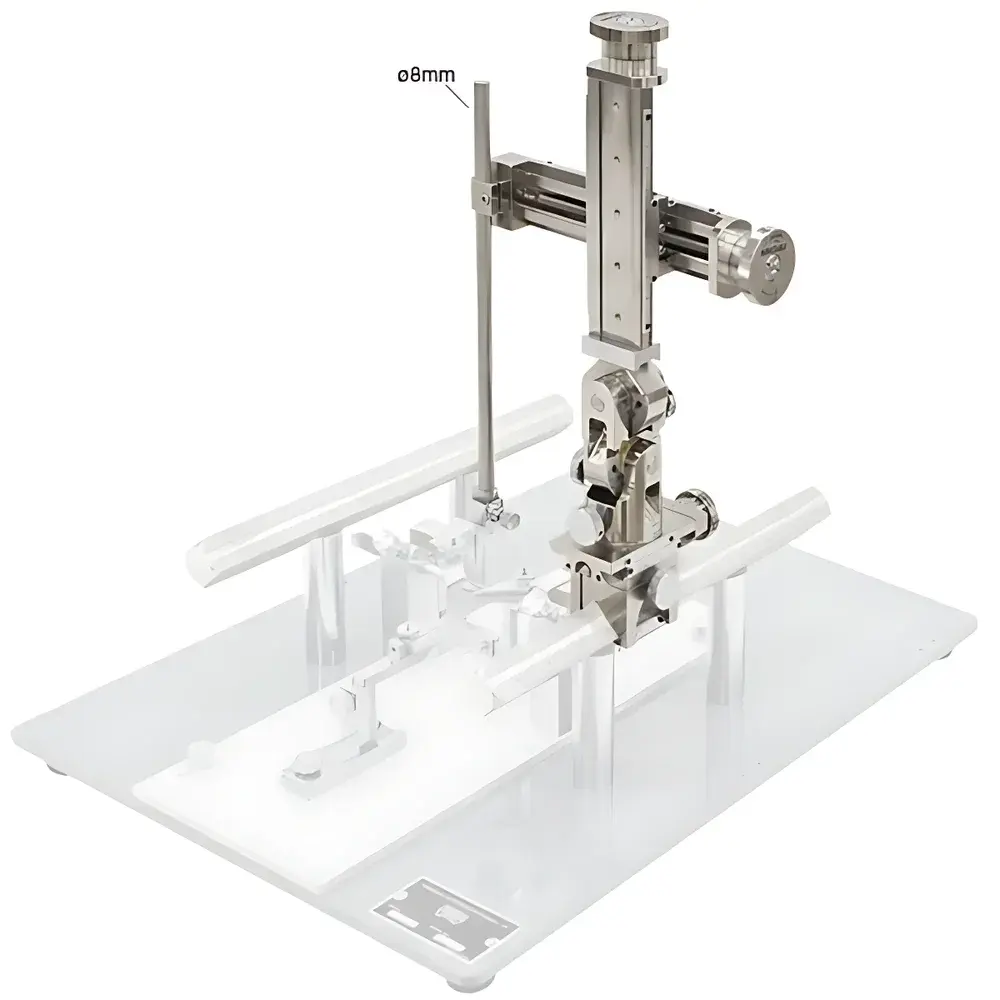
Narishige SMM-200 Stereotactic Micromanipulator
| Brand | Narishige |
|---|---|
| Origin | Japan |
| Model | SMM-200 |
| X Travel | 80 mm |
| Y Travel | 20 mm |
| Z Travel | 80 mm |
| Fine Adjustment Resolution | 10 µm per graduation |
| Full Knob Rotation | 1 mm |
| Dimensions (W×D×H) | 85 × 162 × 286 mm |
| Weight | 2.09 kg |
| Y-Axis Adjustment | AP-direction fine-tuning knob |
| Dual-Axis Tilt Capability | Adjustable tilt in both AP and ML planes |
| Included Accessories | 2 mm & 2.5 mm hex keys, dedicated electrode holder with mounting hardware, grounding screw, Belleville washer, flat washer |
Overview
The Narishige SMM-200 Stereotactic Micromanipulator is a precision-engineered mechanical positioning system designed for high-accuracy intracranial and intraspinal microprocedures in rodent and small-animal neuroscience research. Built upon Narishige’s decades of expertise in micromanipulation instrumentation, the SMM-200 operates on a robust orthogonal XYZ translation architecture combined with dual-axis angular adjustment—enabling precise alignment of electrodes, optical fibers, or silicon probes relative to stereotactic coordinates. Its core functionality relies on friction-free micrometer-driven motion with tactile feedback, eliminating backlash and ensuring positional repeatability critical for chronic implantation, acute electrophysiology, and optogenetic targeting. Unlike motorized alternatives, the SMM-200 prioritizes mechanical stability, thermal inertia resistance, and electromagnetic silence—making it especially suitable for low-noise extracellular recording environments and simultaneous multi-modal interventions.
Key Features
- Three-axis linear positioning (X: 80 mm, Y: 20 mm, Z: 80 mm) with calibrated micrometer dials offering 10 µm minimum graduation and 1 mm travel per full rotation
- Dedicated Y-axis control knob enabling fine anterior–posterior (AP) adjustments without disturbing X/Z alignment—essential for iterative depth calibration during probe insertion
- Independent AP- and ML-plane tilt capability of the upper manipulator assembly, allowing real-time angular compensation for non-horizontal skull surfaces or angled trajectories
- Modular electrode holder compatible with standard 1.0 mm OD glass pipettes, metal microelectrodes, and commercial silicon probes (e.g., Neuropixels, Cambridge Neurotech)
- Integrated grounding interface including M3 grounding screw, Belleville spring washer, and flat washer—ensuring stable electrical reference for DC-coupled recordings and noise-sensitive applications
- Compact footprint (85 × 162 × 286 mm) and lightweight aluminum alloy construction (2.09 kg) facilitating integration into confined stereotaxic rigs and shared imaging setups
Sample Compatibility & Compliance
The SMM-200 is validated for use across acute and chronic preparations in mice, rats, ferrets, and other small mammals under institutional animal care protocols. Its mechanical design conforms to widely adopted stereotactic frame interfaces—including Kopf, David Kopf Instruments, and Stoelting models—via standardized mounting holes and clamping geometry. While the device itself contains no electronic components and thus requires no CE/UL certification, its material composition (anodized aluminum, stainless steel fasteners, PTFE-insulated contact points) meets ISO 10993 biocompatibility guidelines for incidental tissue contact. All included hardware complies with JIS B 1001 metric thread standards. The manipulator supports GLP-aligned experimental documentation when used in conjunction with calibrated coordinate logs and procedural SOPs.
Software & Data Management
As a purely mechanical instrument, the SMM-200 does not incorporate embedded firmware, wireless connectivity, or proprietary software. Positional data acquisition is achieved externally via manual logging or integration with third-party digital calipers (e.g., Mitutoyo Absolute Series), video-based tracking systems (e.g., DeepLabCut), or motorized stage controllers (e.g., Ludl Electronic Products MAC5000) using analog voltage output adapters. For laboratories operating under FDA 21 CFR Part 11 or EU Annex 11 requirements, position records may be captured in validated electronic lab notebooks (ELNs) such as LabArchives or Benchling, with audit trails maintained for all coordinate entries, tilt angle settings, and hardware configuration changes.
Applications
- Single-unit and multi-unit extracellular recordings using tungsten, platinum-iridium, or silicon-based electrodes
- Chronic implantation of tetrodes, Michigan arrays, or flexible neural probes with post-operative stability verification
- Targeted optogenetic fiber placement for channelrhodopsin stimulation or inhibitory opsin delivery
- Ionophoretic or pressure ejection of neurochemical agents with spatially resolved cortical/subcortical targeting
- Combined electrophysiology–calcium imaging experiments requiring simultaneous probe and objective positioning
- Developmental neurobiology studies involving precise embryonic or neonatal brain injections
FAQ
Is the SMM-200 compatible with non-Narishige stereotaxic frames?
Yes—the base plate features universal ¼”-20 and M4 threaded mounting patterns, enabling secure attachment to Kopf, Stoelting, and custom-built frames.
Can the tilt angles be locked independently in AP and ML planes?
Yes—each tilt axis employs a dual-knob locking mechanism that secures angular orientation without slippage during long-duration recordings.
What is the maximum recommended load capacity for mounted electrodes?
The manipulator maintains sub-5 µm positional drift under static loads up to 150 g; optimal performance is achieved with electrodes weighing ≤100 g.
Are replacement parts available for wear-prone components such as micrometer dials or tilt bearings?
Narishige offers OEM spare kits (Part No. SMM-200-SK) including calibrated dials, phosphor-bronze bearing assemblies, and anti-backlash nut sets through authorized distributors.
Does the SMM-200 support vacuum or negative-pressure fixation for in vivo head-fixed preparations?
No—it lacks integrated vacuum ports; however, its rigid base allows integration with third-party vacuum-compatible stereotaxic adapters (e.g., E-series from Neuroscience Tools).



