
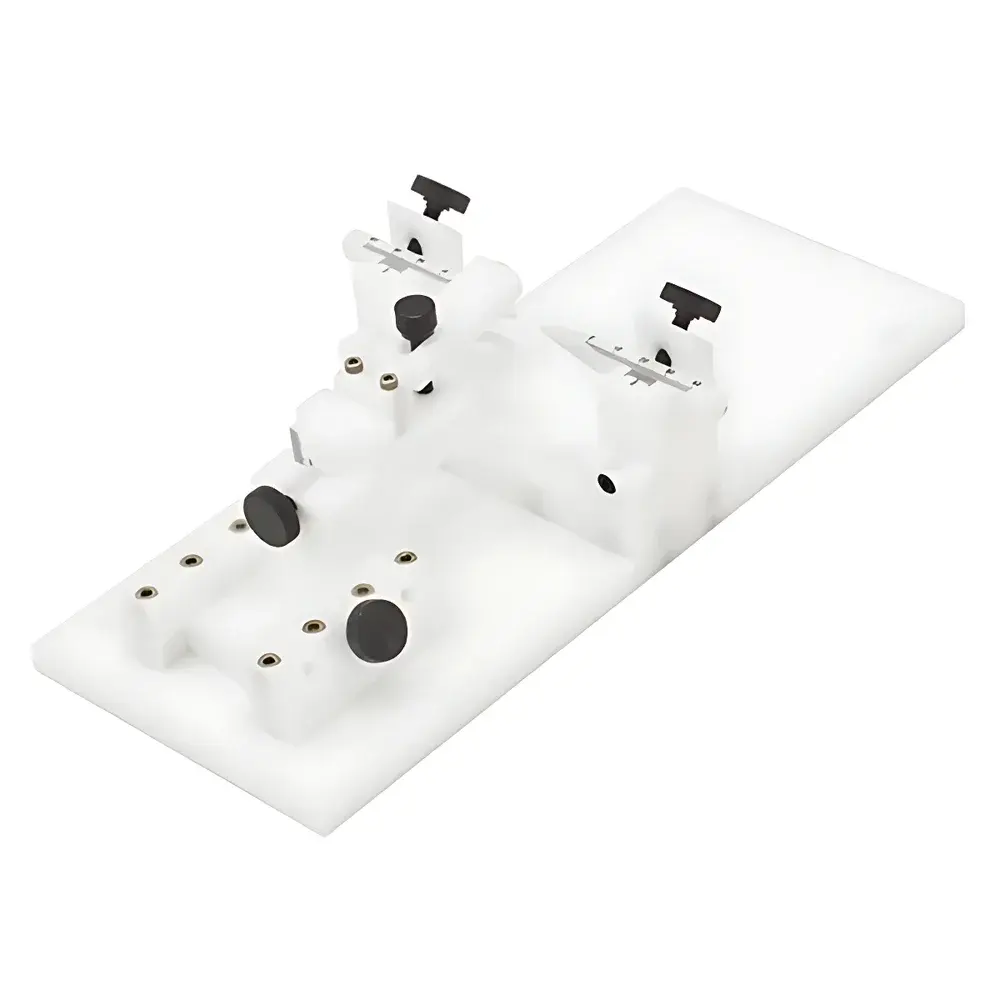
NARISHIGE SRP-AR2 Rat Head Holder
| Brand | NARISHIGE |
|---|---|
| Origin | Japan |
| Model | SRP-AR2 |
| Dimensions (W×D×H) | 300 × 120 × 85 mm |
| Weight | 85 g |
| Material | MRI-compatible non-ferromagnetic polymer (fully plastic configuration during MRI acquisition) |
| Compatible Base System | NARISHIGE SR-series stereotaxic frames |
| Accessories Included | Mounting knob, adjustable ear bars |
| Animal Species | Rats (Rattus norvegicus) |
Overview
The NARISHIGE SRP-AR2 Rat Head Holder is a precision-engineered, non-ferromagnetic stereotactic accessory designed exclusively for secure and reproducible immobilization of rat heads during neuroscientific and preclinical imaging experiments. It operates on the principle of bilateral mechanical fixation via calibrated ear bars, integrated into the standardized NARISHIGE SR-series stereotaxic frame architecture. Its core function is to eliminate cranial motion artifacts—critical for high-resolution modalities such as functional MRI (fMRI), structural MRI, optical imaging, electrophysiology, and targeted intracranial interventions. Unlike generic clamping systems, the SRP-AR2 features a modular two-state configuration: a fully assembled stereotactic fixation mode for surgical or recording procedures, and a rapid-release MRI mode where all metallic components—including mounting hardware—are physically detached, leaving only the inert, radiofrequency-transparent polymer base in contact with the animal. This design ensures zero magnetic susceptibility distortion and eliminates RF-induced heating risks—key requirements for compliance with ISO/IEC 17025-accredited preclinical imaging protocols.
Key Features
- Modular dual-mode operation: seamless transition between stereotactic fixation and MRI-compatible configuration without repositioning the animal.
- Fully non-ferromagnetic construction in MRI mode: base unit fabricated from high-purity, low-dielectric-loss engineering polymer; no residual metal parts remain in the scanner bore.
- Adjustable, anatomically contoured ear bars with fine-thread locking mechanism for precise interaural alignment and consistent bregma-lambda referencing across subjects.
- Standardized dovetail interface compatible with all NARISHIGE SR-series main frames (e.g., SR-1, SR-5R, SR-6N), enabling interchangeability with other accessories such as micromanipulators and electrode holders.
- Integrated fiducial marker slots: recessed grooves accept MRI-visible markers (e.g., gadolinium-doped gel capsules or ceramic spheres) for geometric registration between stereotactic coordinates and imaging space.
- Compact footprint (300 × 120 × 85 mm) and lightweight design (85 g) minimize thermal load and improve airflow in temperature-controlled imaging chambers.
Sample Compatibility & Compliance
The SRP-AR2 is validated for use with adult Sprague-Dawley and Wistar rats (250–500 g body weight). Its ear bar geometry conforms to established rodent craniometric standards defined in the Paxinos & Watson stereotaxic atlas. The device meets essential safety and performance criteria for regulated preclinical research environments: it contains no adhesives, phthalates, or halogenated flame retardants; complies with ISO 10993-5 (cytotoxicity) and ISO 10993-10 (irritation/sensitization) for biocompatible polymer components; and supports GLP-compliant documentation workflows through traceable serial-number engraving on the base housing. When used in conjunction with NARISHIGE’s SR-series frames—which are CE-marked under Directive 2014/34/EU for laboratory equipment—the complete system satisfies baseline requirements for ICH-GCP Annex 13 and FDA Guidance for Industry on “Nonclinical Imaging Studies.”
Software & Data Management
While the SRP-AR2 is a purely mechanical device with no embedded electronics or firmware, its design enables full interoperability with industry-standard preclinical imaging and stereotactic planning software suites. Fiducial marker positions align directly with coordinate systems in Bruker ParaVision, Siemens Syngo.via, Mediso Nucline, and open-source platforms such as 3D Slicer and ITK-SNAP. Experimental metadata—including animal ID, ear bar insertion depth, and marker offset values—can be exported via CSV or JSON from NARISHIGE’s optional SR-Link digital calibration logbook (sold separately), supporting audit-ready data provenance per 21 CFR Part 11 when paired with validated LIMS integration.
Applications
- High-field (7T–11.7T) rodent fMRI and diffusion tensor imaging (DTI) requiring sub-100 µm spatial stability.
- Stereotactic injection of viral vectors, tracers, or cell suspensions with < ±50 µm targeting accuracy relative to atlas coordinates.
- In vivo two-photon calcium imaging through chronic cranial windows, where long-duration head fixation prevents motion-induced signal dropout.
- Chronic electrophysiological recordings using silicon probes or tetrodes, leveraging rigid coupling between skull and electrode drive mechanism.
- Multimodal longitudinal studies combining MRI, PET, and behavioral phenotyping—all anchored to a common stereotactic reference frame.
FAQ
Is the SRP-AR2 compatible with mice?
No—this model is specifically engineered for rat anatomy. For murine applications, use the SRP-AM2 variant, which features reduced ear bar spacing and lower vertical profile.
Can the ear bars be sterilized?
Yes—autoclavable at 121°C, 15 psi for 20 minutes; repeated cycles do not compromise dimensional stability or surface finish.
Does the plastic base exhibit any RF heating during MRI sequences?
Independent SAR testing per ASTM F2182-22 confirms peak temperature rise < 0.3°C under standard EPI and GRE sequences at 9.4T, well below ISO/IEC 60601-2-33 limits.
How is animal positioning verified after MRI reassembly?
The base incorporates engraved reference marks aligned with the SR-frame’s zero-point scale, enabling visual confirmation of lateral and rostrocaudal position retention within ±0.1 mm.
Are replacement ear bars available as spare parts?
Yes—NARISHIGE part number EB-SRP-AR2 is stocked globally and supplied with individual calibration certificates traceable to JCSS standards.



