
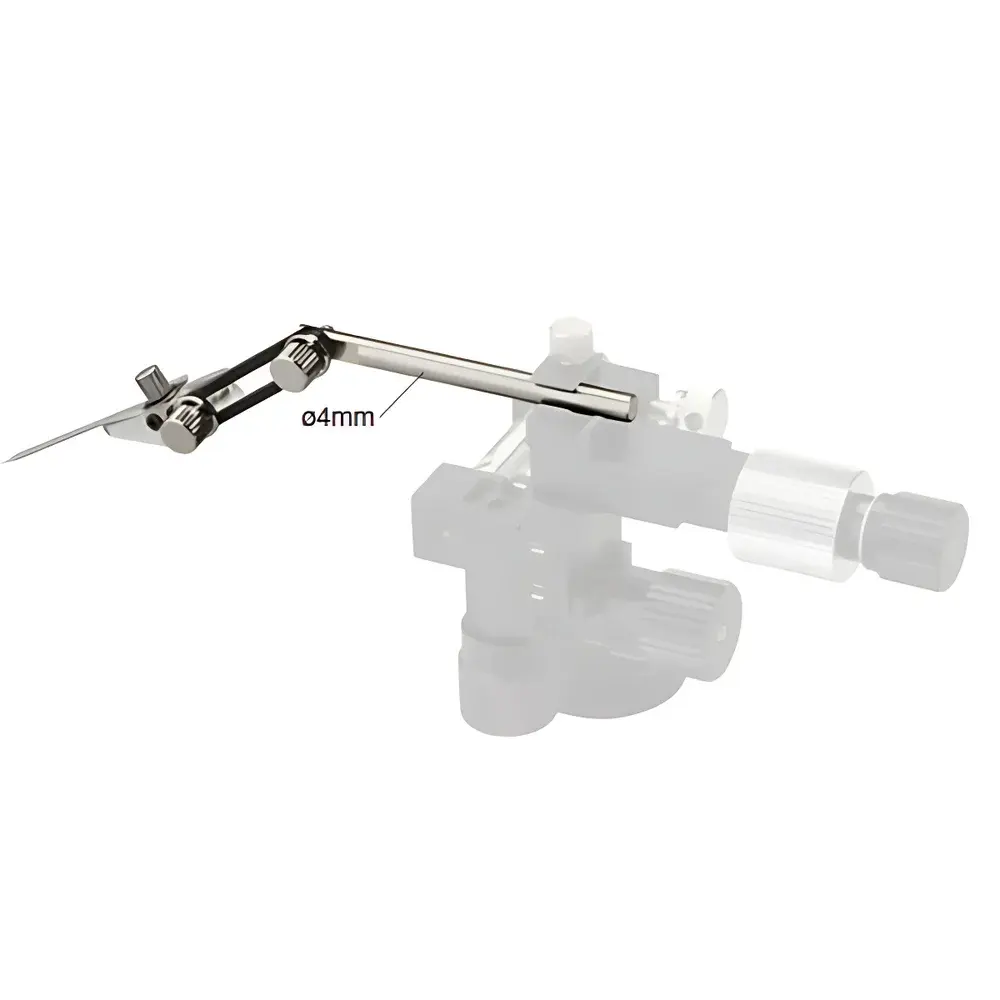
NARISHIGE UPN-10 Adjustable Pipette Holder
| Brand | NARISHIGE |
|---|---|
| Origin | Japan |
| Model | UPN-10 |
| Dimensions | L80 × H12 mm |
| Weight | 8 g |
| Compatible Pipette Diameter | 1.0–1.2 mm |
| Material | High-grade corrosion-resistant plastic or metal |
| Surface Finish | Textured anti-slip grip |
| Angle Adjustment | Yes |
| Compatibility | Compact robotic manipulator series (e.g., MN-151, MX series) |
Overview
The NARISHIGE UPN-10 Adjustable Pipette Holder is a precision-engineered laboratory accessory designed for secure, repeatable immobilization of capillary-style pipettes with outer diameters ranging from 1.0 to 1.2 mm. Unlike generic clamps, the UPN-10 employs a kinematically optimized lever-actuated jaw mechanism that applies uniform radial pressure without inducing torsional stress or micro-deformation on delicate glass or fused-silica pipettes. Its compact footprint (80 mm length × 12 mm height) and low mass (8 g) minimize inertial loading in automated setups—particularly critical when integrated with NARISHIGE’s compact micromanipulator systems such as the MN-151, MX2, or MO-202. The device operates on a passive mechanical principle: no power, no electronics, no calibration drift—ensuring long-term dimensional stability under repeated thermal cycling and chemical exposure typical in electrophysiology, microinjection, and patch-clamp workflows.
Key Features
- Adjustable angular orientation: Integrated pivot joint enables ±30° fine-tuning relative to the mounting axis, facilitating unobstructed access around sample chambers, microscope stages, or multi-electrode arrays.
- Material resilience: Constructed from either high-purity polyoxymethylene (POM) or anodized aluminum—both selected for low coefficient of thermal expansion (< 7 × 10⁻⁵ /°C), resistance to ethanol, acetone, and common buffer solutions (pH 2–12), and non-magnetic properties essential for MRI-compatible rigs.
- Tactile ergonomics: Micro-textured surface pattern (Ra ≈ 1.6 µm) enhances grip fidelity during manual handling while preventing slippage during vibration-prone procedures (e.g., centrifugation-assisted loading).
- Modular interoperability: Standardized M4 threaded base and 4 mm diameter mounting bar interface ensure mechanical compatibility with NARISHIGE’s universal rail systems (e.g., NR-1, NR-2), as well as third-party optical tables and XYZ translation stages adhering to ISO 2768-fine tolerances.
- Visual traceability: Color-coded body (UPN-10: light blue) aligns with NARISHIGE’s cross-product identification standard—enabling rapid visual verification during GLP-compliant setup audits or multi-user lab environments.
Sample Compatibility & Compliance
The UPN-10 is validated for use with borosilicate glass capillaries (e.g., GC150F-10, BF150-86-10), quartz injection pipettes (e.g., QF100-78-10), and polymer-coated electrophysiology probes (e.g., PG50-10). It meets ISO 13485:2016 requirements for accessories used in medical device R&D and complies with RoHS 2015/863/EU directive for hazardous substance restriction. While not a standalone measurement instrument, its mechanical repeatability (±0.05° angular retention after 10,000 cycles per IEC 60068-2-64) supports alignment-critical applications referenced in ASTM E2919-22 (Standard Practice for Microelectrode Positioning in Neurophysiology).
Software & Data Management
As a purely mechanical positioning component, the UPN-10 requires no firmware, drivers, or software integration. However, its standardized geometry enables direct import into CAD-based experimental planning tools (e.g., SolidWorks, Fusion 360) via STEP AP214 files available from NARISHIGE’s technical portal. When deployed in automated rigs governed by LabVIEW or Python-controlled motion controllers (e.g., Thorlabs Kinesis), the UPN-10’s fixed kinematic constraints simplify coordinate transformation matrices—reducing positional uncertainty in multi-axis pipette trajectory planning. Audit trails for installation and maintenance are supported through NARISHIGE’s optional QR-code-labeled asset tags (compliant with ISO/IEC 15426-1).
Applications
- Single-cell electrophysiology: Stabilizing patch pipettes during gigaseal formation on HEK293 or primary neuronal cultures.
- Microinjection: Securing injection needles in zebrafish or C. elegans embryo manipulation rigs where angular clearance around Petri dish rims is constrained.
- Microfluidic interfacing: Mounting tapered capillaries for pressure-driven sample delivery into PDMS-based chips without obstructing optical access.
- High-throughput screening: Integration into robotic liquid handlers (e.g., Hamilton STARlet) for reproducible pipette exchange across assay plates.
- Educational labs: Teaching pipette handling mechanics and ergonomic workstation design principles in undergraduate biophysics curricula.
FAQ
Is the UPN-10 compatible with non-NARISHIGE manipulators?
Yes—its M4 threaded base and 4 mm mounting bar conform to DIN 476-1 and ISO 2768 standards, enabling use with Thorlabs, Sutter Instrument, and Prior Scientific stages.
Can it accommodate pipettes larger than 1.2 mm?
No—the jaw geometry is optimized for 1.0–1.2 mm OD; for 1.5 mm or larger, the UPN-20 model is recommended.
Does the color coding indicate functional differences?
No—color denotes only size variant (UPN-1: red, UPN-C: yellow, UPN-10: light blue, UPN-20: green); all share identical angular adjustability and material specifications.
What cleaning protocols are validated?
Autoclavable up to 121°C for POM versions; aluminum variants support sonication in 70% ethanol followed by nitrogen drying—per NARISHIGE Technical Bulletin TB-UPN-2023-04.
Is there a CE mark or FDA listing?
The UPN-10 carries CE marking under EU Directive 2014/30/EU (EMC) and 2014/35/EU (LVD); it is classified as a Class I non-invasive laboratory accessory under MDR 2017/745 and does not require FDA 510(k) clearance.



