
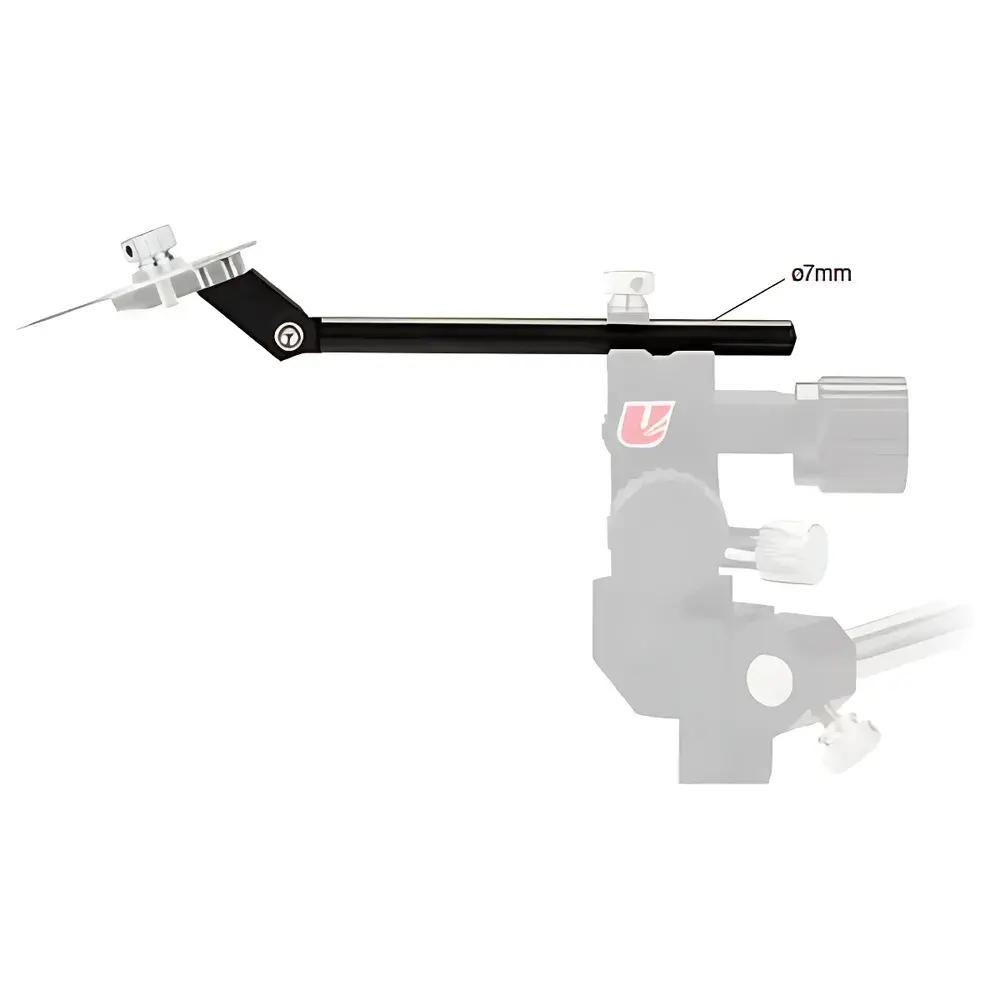
NARISHIGE UPZ-1 Pipette Holder
| Brand | NARISHIGE |
|---|---|
| Origin | Japan |
| Model | UPZ-1 |
| Dimensions | 125 mm (L) × 30 mm (H) |
| Weight | 15 g |
| Clamp Jaw Diameter | 7 mm |
| Compatible Pipette Outer Diameter | 1.0–1.5 mm |
| Mounting | Independent angular adjustment support |
| Recommended Compatibility | NARISHIGE YOU-series micromanipulators |
Overview
The NARISHIGE UPZ-1 Pipette Holder is a precision-engineered mechanical fixture designed for stable, reproducible positioning of glass or fused-silica capillary pipettes in electrophysiology, patch-clamp, microinjection, and single-cell manipulation applications. It operates on a rigid lever-and-spring clamping principle—without threaded fasteners or friction-dependent tightening—ensuring consistent holding force across repeated installations while minimizing mechanical stress on fragile pipettes. Unlike generic lab clamps, the UPZ-1 integrates directly with NARISHIGE’s modular YOU-series micromanipulator arms via standardized mounting interfaces, enabling sub-degree angular alignment and precise longitudinal translation control. Its compact profile (125 mm × 30 mm × 7 mm jaw clearance) and low mass (15 g) reduce inertial loading on fine-positioning stages, preserving positional stability during high-magnification imaging or voltage-clamp recordings.
Key Features
- Angular adjustability: Independent tilt mechanism allows continuous rotation ±15° about the vertical axis and ±10° pitch, facilitating optimal pipette approach angles for oblique tissue penetration or parallel electrode alignment.
- Low-deformation clamping: Dual-point spring-loaded jaws apply uniform radial pressure at 7 mm nominal bore diameter, accommodating pipettes with outer diameters from 1.0 to 1.5 mm—including borosilicate, quartz, and coated capillaries—without slippage or micro-fracture risk.
- Corrosion-resistant construction: Machined from anodized aluminum alloy (A6061-T6), offering long-term chemical resistance against ethanol, saline, and common electrophysiology buffers; surface hardness ≥60 HV prevents scratching during repeated pipette insertion/removal.
- Modular integration: Standardized M4 threaded base and lateral alignment grooves ensure direct compatibility with YOU-1, YOU-23, and YOU-F1 manipulator arms without adapters or shims.
- Serviceability: All components are field-replaceable using standard 1.5 mm hex keys; no adhesives or permanent bonding used in assembly.
Sample Compatibility & Compliance
The UPZ-1 is validated for use with standard borosilicate (e.g., Sutter BF150-86-10) and fused-silica (e.g., Sutter QF100-72-15) capillaries, as well as polymer-coated electrodes (e.g., Neurotar Parylene-C insulated probes). It meets ISO 9001-certified manufacturing requirements per NARISHIGE’s quality management system and conforms to IEC 61000-6-2/6-3 for electromagnetic compatibility in laboratory environments. While not a medical device, its design supports GLP-compliant workflows when used in preclinical neurophysiology studies involving live tissue preparations under controlled humidity and temperature conditions.
Software & Data Management
As a passive mechanical component, the UPZ-1 requires no firmware, drivers, or software integration. However, its geometric repeatability enables traceable experimental setup documentation: angular settings can be recorded manually or logged alongside manipulator coordinate data (e.g., via NARISHIGE’s YOU-Controller GUI or third-party acquisition platforms such as Spike2 or PatchMaster). For audit readiness, users may embed UPZ-1 orientation parameters into electronic lab notebook (ELN) entries—supporting 21 CFR Part 11–compliant metadata capture when paired with validated ELN systems.
Applications
- Patch-clamp electrophysiology: Secures recording pipettes during gigaseal formation and whole-cell configuration, reducing drift-induced capacitance transients.
- Intracellular microinjection: Maintains fixed pipette trajectory relative to target cells during pressure-controlled dye or mRNA delivery.
- Single-cell electroporation: Ensures consistent electrode-to-membrane distance and angle across multiple transfection events.
- Combined optical-electrical experiments: Enables co-registration of pipette tip position with confocal or two-photon imaging fields of view via calibrated stage coordinate mapping.
- High-throughput screening rigs: Integrated into automated patch-clamp platforms (e.g., Sophion QPatch) where mechanical stability directly impacts seal success rate and run-to-run reproducibility.
FAQ
Can the UPZ-1 hold pipettes larger than 1.5 mm OD?
No—maximum recommended outer diameter is 1.5 mm. Larger diameters exceed jaw travel limits and compromise clamping force uniformity.
Is the UPZ-1 compatible with non-NARISHIGE micromanipulators?
Mechanical adaptation is possible using custom mounting plates with M4 thread conversion, but angular alignment accuracy and load transfer integrity are not guaranteed outside the YOU-series ecosystem.
Does the UPZ-1 require calibration or periodic verification?
No calibration is needed; however, visual inspection for jaw wear or spring fatigue is recommended after 500+ pipette insertions, per NARISHIGE’s maintenance guidelines.
Can it be sterilized for in vivo use?
Yes—autoclavable at 121°C, 15 psi for 20 minutes; anodized surface remains intact, and dimensional stability is retained within ±0.02 mm post-sterilization.
What torque specification applies to the mounting screws?
Maximum tightening torque: 0.35 N·m (3.0 in·lb); overtightening may deform the base plate and impair angular adjustment smoothness.



