
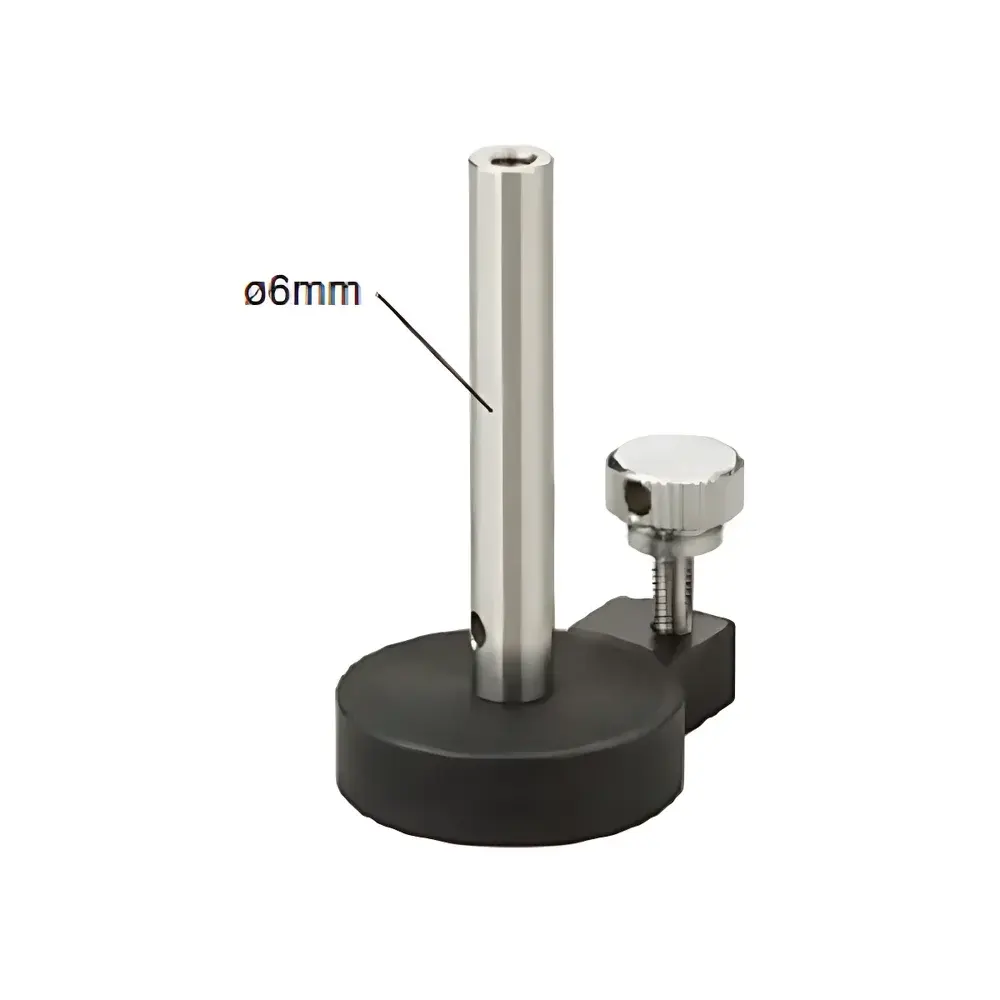
NARISHIGE USM-6 Magnetic Base
| Brand | NARISHIGE |
|---|---|
| Origin | Japan |
| Model | USM-6 |
| Outer Diameter | Ø6 mm |
| Dimensions | 35 × 25 × 47 mm (W × D × H) |
| Weight | 40 g |
| Compatible Rod Diameter | Ø6 mm |
| Optional Extension Rod | URC-1 |
Overview
The NARISHIGE USM-6 Magnetic Base is a precision-engineered mounting solution designed for stable, repeatable positioning of micromanipulators, optical components, and other compact laboratory instrumentation in life science, electrophysiology, and microinjection applications. Built upon NARISHIGE’s decades-long expertise in micro-handling systems, the USM-6 employs a high-coercivity neodymium magnet assembly housed within a corrosion-resistant stainless steel body, delivering consistent holding force on ferromagnetic surfaces without mechanical clamping or adhesives. Its operation relies on a manually actuated lever mechanism that toggles between full magnetic engagement and near-zero residual flux—enabling rapid, tool-free attachment and detachment while maintaining positional integrity during vibration-sensitive procedures such as patch-clamp recording or confocal imaging. The base is optimized for integration with NARISHIGE’s standard Ø6 mm support rods (e.g., UM-3, MO-10), forming part of a modular, scalable mounting architecture widely adopted in academic core facilities and industrial R&D labs.
Key Features
- High-strength rare-earth magnet system with >12 N holding force on clean, flat steel surfaces (ASTM A108)
- Ergonomic toggle lever for intuitive, one-handed magnetic on/off control—no torque tools or alignment adjustments required
- Compact footprint (35 × 25 × 47 mm) and ultra-lightweight construction (40 g) for minimal spatial impact on crowded optical tables or microscope stages
- Threaded Ø6 mm receptacle compatible with NARISHIGE’s universal rod series; supports vertical height adjustment via threaded rod coupling
- Optional URC-1 extension rod (sold separately) enables incremental height increase in 25 mm increments while preserving coaxial rigidity
- Electropolished stainless steel housing (AISI 304) ensures long-term resistance to cleaning agents, humidity, and incidental solvent exposure
Sample Compatibility & Compliance
The USM-6 is intended for use on smooth, unmagnetized ferrous substrates with surface roughness Ra ≤ 1.6 µm and minimum thickness ≥ 3 mm to prevent magnetic saturation. It is not suitable for non-ferromagnetic surfaces (e.g., aluminum, glass, plastic) without supplemental ferrous backing plates. While the device itself carries no intrinsic regulatory certification, its design conforms to general laboratory equipment safety principles outlined in IEC 61010-1:2010 (Safety Requirements for Electrical Equipment for Measurement, Control, and Laboratory Use). When deployed in GLP- or GMP-regulated environments, the USM-6 supports traceable setup documentation due to its fixed mechanical geometry and absence of electronic components—facilitating audit-ready configuration records.
Software & Data Management
The USM-6 is a fully passive mechanical component with no embedded electronics, firmware, or data interface. As such, it requires no software installation, driver configuration, or cybersecurity validation. Its operational parameters are invariant over time and unaffected by electromagnetic interference (EMI), making it compatible with MRI-adjacent setups, Faraday cages, and low-noise electrophysiology rigs. All dimensional and material specifications are documented in NARISHIGE’s publicly available technical datasheets (Rev. D, 2023), which are maintained per ISO 9001:2015 document control requirements and accessible via authorized distributor portals.
Applications
- Securing micromanipulators (e.g., MN-4, MM-33) during intracellular electrode placement in live-tissue slice experiments
- Mounting LED fluorescence illuminators or fiber-optic light guides on inverted microscopes without stage obstruction
- Stabilizing miniature cameras or laser alignment tools in custom-built optogenetics rigs
- Providing temporary, repositionable fixation for calibration standards during microscope objective characterization
- Supporting multi-axis probe positioning in scanning probe microscopy (SPM) auxiliary stages where vacuum compatibility is not required
FAQ
What is the maximum recommended surface thickness for optimal magnetic performance?
For full magnetic circuit closure and rated holding force, the underlying ferrous surface should be ≥3 mm thick and free of paint, rust, or non-magnetic coatings.
Can the USM-6 be used on stainless steel workbenches?
Only austenitic stainless steels (e.g., AISI 304, 316) exhibit negligible magnetic permeability—USM-6 will not adhere reliably. Use only on ferritic or martensitic grades (e.g., AISI 430, 410) or mild steel substrates.
Is the URC-1 extension rod compatible with all NARISHIGE Ø6 mm rods?
Yes—the URC-1 features standardized M4 × 0.7 thread pitch and is mechanically interoperable with UM-3, MO-10, and similar rods across the NARISHIGE ecosystem.
Does repeated actuation of the magnetic lever affect long-term reliability?
No—accelerated life testing per JIS C 5400 confirms ≥100,000 toggle cycles without measurable degradation in magnetic flux density or lever actuation torque.
How should the USM-6 be cleaned after exposure to saline or culture media?
Rinse immediately with deionized water, dry thoroughly with lint-free cloth, and inspect for residual moisture in the lever pivot cavity before reuse. Avoid alcohol-based cleaners on rubberized lever grips.



