
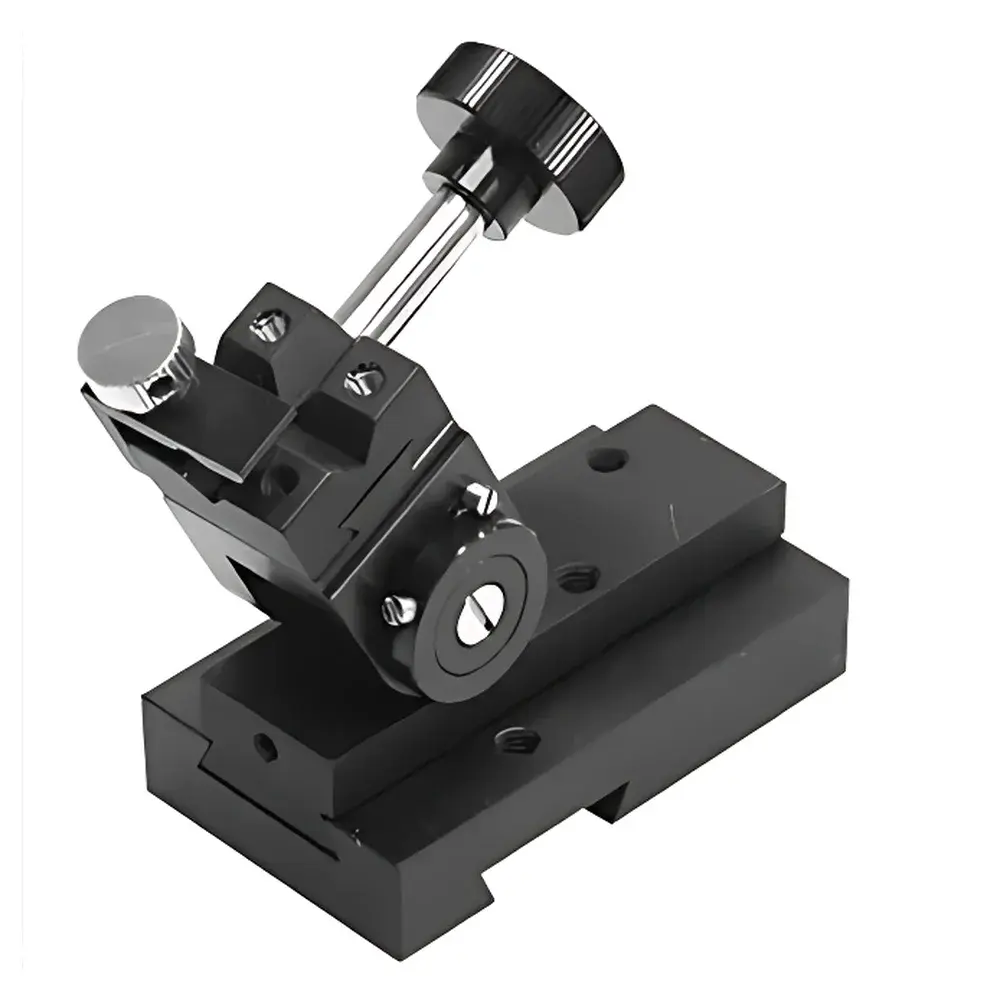
Narishige UST-2 Universal Joint Mount
| Brand | Narishige |
|---|---|
| Origin | Japan |
| Model | UST-2 |
| Dimensions (Mount) | 110 × 34 × 71 mm |
| Weight (Mount) | 80 g |
| Compatible Base | NMN-21 Micromanipulator |
| Adjustment Axes | Pitch & Yaw (Dual-Axis Tilt) |
| Control Mechanism | Single-Knob Dual-Axis Locking |
| Accessory | 1.5 mm Hex Key (70 × 35 × 60 mm, 220 g) |
Overview
The Narishige UST-2 Universal Joint Mount is a precision mechanical coupling component engineered for high-accuracy positioning in electrophysiology, patch-clamp, and microinjection workflows. Designed and manufactured in Japan by Narishige—a globally recognized leader in micromanipulation systems—the UST-2 serves as an intermediary interface between the drive unit of a three-axis hydraulic micromanipulator (e.g., Narishige MO-202 or MN-401 series) and pipette holders or injection holders. Its core function is to enable fine, decoupled angular alignment of the pipette tip via independent pitch (vertical tilt) and yaw (horizontal swing) adjustment—critical for achieving optimal electrode approach geometry relative to the target cell or tissue surface. Unlike fixed-angle mounts, the UST-2 implements a dual-axis gimbal architecture with friction-based locking, allowing stable repositioning without tool-assisted recalibration. The mount’s compact form factor (110 × 34 × 71 mm), low mass (80 g), and rigid aluminum alloy construction minimize mechanical drift and inertial lag during real-time manipulation—key performance attributes for intracellular recording and sub-micron probe placement.
Key Features
- Dual-axis angular adjustment: Independent control of pitch (±15° typical range) and yaw (±20° typical range) enables precise pipette tip orientation in both vertical and horizontal planes.
- Single-knob locking mechanism: A single ergonomic knob simultaneously engages friction locks on both axes, eliminating cross-axis slippage and ensuring repeatable angle retention under operational load.
- Direct NMN-21 compatibility: Engineered to mount seamlessly onto the Narishige NMN-21 universal base plate, providing rigid mechanical continuity with the manipulator’s hydraulic actuation system.
- Low-profile, high-rigidity design: Solid aluminum body (not hollow or composite) ensures minimal thermal expansion drift and long-term dimensional stability across laboratory temperature fluctuations (20–25°C).
- Tool-inclusive deployment: Supplied with a dedicated 1.5 mm hex key (70 × 35 × 60 mm, 220 g) for secure fastening of pipette holder clamps and auxiliary bracket attachments.
Sample Compatibility & Compliance
The UST-2 is intended exclusively for use with Narishige-compatible micropipette holders (e.g., MM-11, MP-11), injection holders (e.g., IM-11), and glass capillary electrodes ranging from 0.5 to 2.0 mm outer diameter. It does not interface directly with samples; rather, it supports sample-access instrumentation in accordance with standard electrophysiology and microsurgery protocols. While the UST-2 itself carries no standalone regulatory certification, its integration into Narishige-manufactured manipulator systems aligns with ISO 9001:2015 quality management practices for scientific instrument production. When deployed within GLP- or GMP-regulated environments (e.g., preclinical neurophysiology labs), the UST-2 contributes to procedural traceability through mechanical reproducibility—no electronic logging or audit trail functionality is embedded, as it is a passive mechanical component.
Software & Data Management
The UST-2 is a purely mechanical mounting solution with no embedded electronics, firmware, or software interface. It operates independently of digital control systems and requires no driver installation, calibration files, or firmware updates. Angle settings are manually recorded by the user in experimental logs or integrated into lab information management systems (LIMS) via manual entry. For labs requiring full 21 CFR Part 11 compliance, documentation of UST-2 positioning (e.g., via annotated microscope images or timestamped notebook entries) must be maintained separately, as the device provides no native electronic audit trail or user authentication capability.
Applications
- Patch-clamp electrophysiology: Enables rapid reorientation of patch pipettes to achieve orthogonal or oblique access angles on cultured neurons or brain slices.
- Intracellular microinjection: Facilitates precise needle alignment for cytoplasmic or nuclear delivery in oocytes, zebrafish embryos, or mammalian cells.
- Single-cell electroporation: Supports controlled electrode approach trajectories to minimize membrane damage during transient pore formation.
- Combined optical-electrical setups: Maintains stable pipette position during simultaneous confocal imaging and recording, minimizing parallax-induced misalignment.
- Custom rig integration: Frequently adapted into multi-probe rigs where independent angular control of multiple electrodes is required without shared axis interference.
FAQ
Is the UST-2 compatible with non-Narishige manipulators?
The UST-2 features proprietary mounting interfaces optimized for Narishige NMN-21 and related bases. Mechanical adaptation to third-party systems is possible only with custom adapter plates and may compromise angular repeatability and load-bearing integrity.
Does the UST-2 require periodic recalibration?
No. As a passive mechanical joint with no sensors or moving parts subject to wear-induced hysteresis, the UST-2 maintains factory-set geometric fidelity indefinitely. Repeatability relies solely on consistent knob torque application and clean contact surfaces.
Can the UST-2 support heavy-duty glass electrodes or metal probes?
It is rated for standard borosilicate or quartz patch pipettes (≤2.0 mm OD) and tungsten microelectrodes ≤0.5 mm diameter. Probes exceeding 5 g total mass at the tip may induce measurable flexure in the joint under sustained load.
What is the maximum recommended operating temperature range?
The aluminum alloy housing is stable from 15°C to 35°C. Prolonged exposure above 40°C may affect friction-lock consistency and dimensional tolerance due to thermal expansion mismatch with attached stainless-steel components.



