
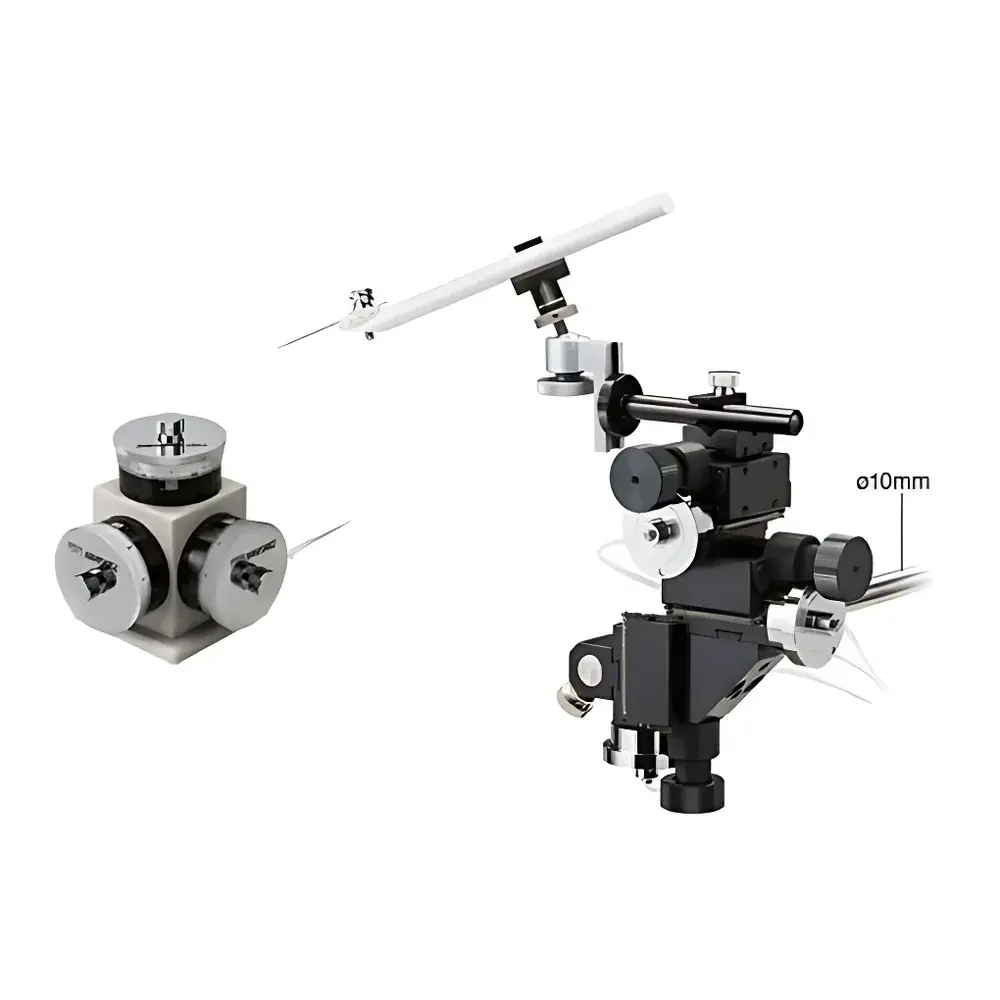
Narishige WR-6 Three-Axis Water-Hydraulic Micromanipulator
| Brand | Narishige |
|---|---|
| Origin | Japan |
| Model | WR-6 |
| Control Unit Dimensions | 115 × 115 × 132 mm, 1.6 kg |
| Drive Unit Dimensions | 110 × 60 × 140 mm, 0.4 kg |
| Hydraulic Tubing Length | 0.9 m |
| Coarse Travel (X/Y/Z) | 18 mm each axis |
| Fine Travel (X/Y/Z) | 2 mm each axis |
| Full-Rotation Knob Resolution | 50 µm |
| Minimum Graduation | 0.2 µm |
| Included Accessories | B-8A Spherical Joint, H-13 Electrode Holder, P-1A Height Adjustment Plate, Universal Wrench |
Overview
The Narishige WR-6 is a precision-engineered three-axis water-hydraulic micromanipulator designed for demanding electrophysiological and microsurgical applications—particularly whole-cell patch-clamp recording, intracellular injection, and live-cell microinjection. Unlike oil-based hydraulic systems, the WR-6 utilizes deionized water as its working fluid, offering superior thermal stability across ambient laboratory conditions (15–30 °C), negligible viscosity drift with temperature fluctuations, and near-zero risk of seal degradation or fluid leakage. This hydrostatic design ensures long-term mechanical reproducibility and eliminates contamination concerns associated with hydrocarbon-based oils—critical in sterile or low-particulate environments such as cleanroom-equipped neuroscience labs or core electrophysiology facilities.
Key Features
- Water-hydraulic actuation system delivering high-resolution, backlash-free motion with minimal hysteresis and exceptional positional repeatability (±0.3 µm over repeated fine adjustments)
- Dual-range motion control: coarse positioning (18 mm per axis) for rapid electrode approach, and fine adjustment (2 mm per axis) with calibrated rotary knobs enabling 50 µm per full rotation and 0.2 µm minimum discernible increment
- Ergonomic drum-style control unit with oversized knurled handles optimized for gloved operation and fatigue-resistant, straight-line translational movement—reducing operator-induced drift during prolonged recordings
- Modular drive unit (110 × 60 × 140 mm, 0.4 kg) mounted directly to microscope stages or custom rigs via standard M4 threaded holes; compact footprint minimizes stage occlusion
- 0.9 m reinforced polyurethane hydraulic tubing with quick-connect couplings, rated for continuous operation at up to 3.5 MPa working pressure and compatible with standard Narishige mounting brackets
Sample Compatibility & Compliance
The WR-6 is fully compatible with upright and inverted research-grade microscopes (e.g., Nikon Eclipse FN1, Zeiss Axio Examiner, Olympus BX53), supporting glass micropipettes (0.5–2.0 mm OD), sharp tungsten electrodes, and patch-clamp pipettes with tip diameters down to 0.1 µm. Its inert water-based fluid path meets ISO 8573-1 Class 3 purity requirements for non-oil-contaminated pneumatic/hydraulic instrumentation. While not certified to IEC 61000-4 electromagnetic immunity standards as a standalone unit, the WR-6 operates reliably within typical electrophysiology suites when used with grounded Faraday cages and shielded signal paths. It supports GLP-compliant documentation workflows when integrated with timestamped video capture and analog output interfaces (via optional DAQ modules).
Software & Data Management
The WR-6 operates as a manual, analog-controlled instrument without embedded firmware or digital connectivity—intentionally designed to eliminate electronic noise coupling into low-voltage (<100 µV) patch-clamp signals. All position data must be recorded externally via stage encoder outputs (when paired with compatible motorized stages) or synchronized video annotation tools (e.g., NIS-Elements, MetaMorph). For audit-trail compliance under FDA 21 CFR Part 11, users are advised to log manipulator settings alongside electrophysiology acquisition metadata using validated LIMS or ELN platforms. Narishige provides calibration certificates traceable to JCSS (Japanese Calibration Service System) upon request.
Applications
- Whole-cell and perforated-patch clamp recordings in brain slices, cultured neurons, and retinal explants
- Single-cell mRNA extraction and cytoplasmic aspiration using fire-polished pipettes
- Microinjection of CRISPR-Cas9 ribonucleoprotein complexes into zebrafish embryos or C. elegans gonads
- Targeted ablation of subcellular organelles using UV-laser-coupled micropipettes
- High-fidelity alignment of optical fibers or photostimulation probes in optogenetics rigs
FAQ
Is the WR-6 compatible with vibration-isolation tables?
Yes—the low-mass drive unit (0.4 kg) and rigid water-hydraulic transmission minimize resonance coupling; it is routinely deployed on active and passive isolation platforms without performance degradation.
Can the hydraulic fluid be refilled or replaced by the user?
Deionized water must be replaced annually or after any suspected contamination; Narishige supplies pre-filtered, pH-stabilized replacement fluid (Cat. No. WFL-1) and provides detailed purging protocols in the service manual.
Does the WR-6 support motorized or computer-controlled operation?
No—it is exclusively manually operated. For automated positioning, Narishige recommends pairing it with the MO-202 or MN-401 motorized micromanipulator series via shared mounting interfaces.
What maintenance intervals are recommended?
Quarterly inspection of O-rings and tubing integrity; biannual recalibration of fine-adjustment scales using Narishige’s certified gauge set (Cat. No. CAL-WR6); annual full-system flush and fluid replacement.
Is the B-8A spherical joint autoclavable?
The B-8A is constructed from anodized aluminum and stainless steel—compatible with dry-heat sterilization (160 °C, 2 h) but not steam autoclaving due to elastomer seal limitations.



