
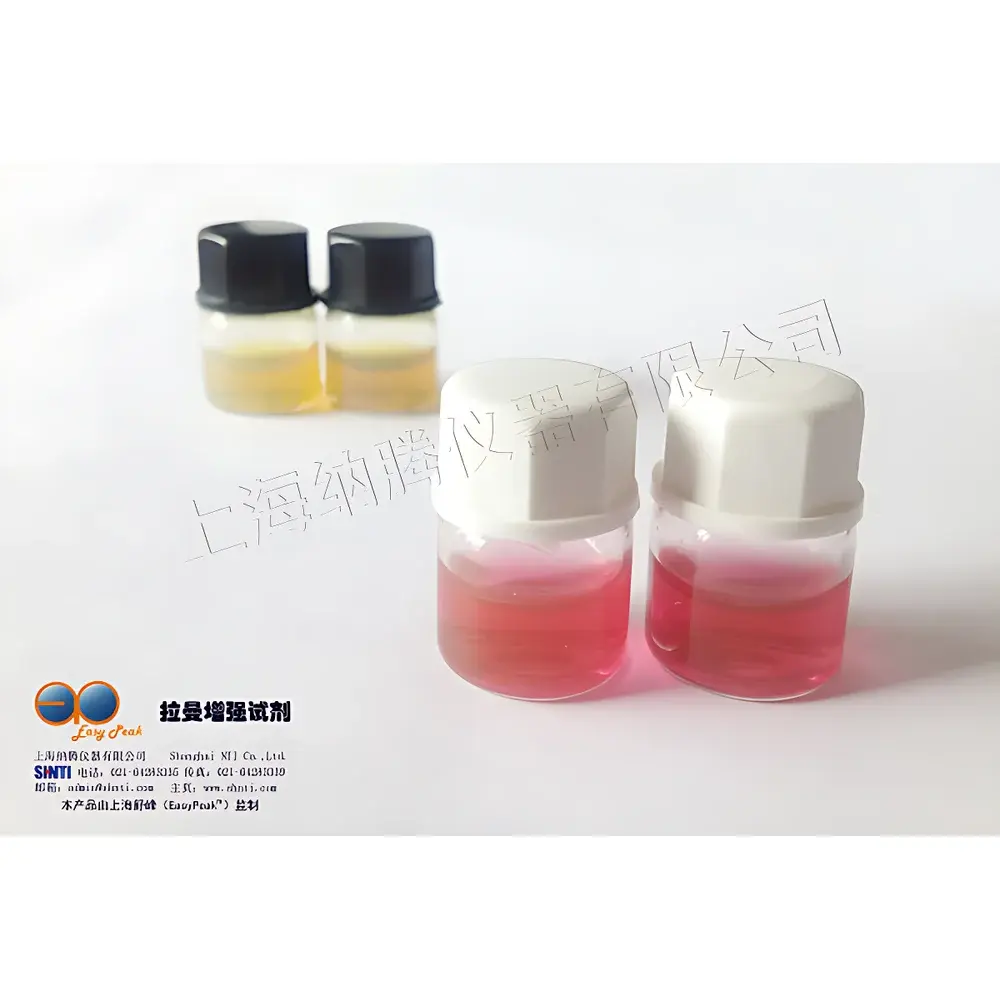
Naton SERS Substrates (Au & Ag Colloidal Sol)
| Origin | Shanghai, China |
|---|---|
| Manufacturer Type | Authorized Distributor |
| Product Origin | Domestic (PRC) |
| Models | EasyPeak™ Au Colloidal Sol, EasyPeak™ Ag Colloidal Sol |
| Price Range | USD 7,000 – 14,000 |
| Instrument Category | SERS Enhancement Reagents (Consumable/Accessory for Raman Spectrometers) |
| Spectral Range | Not Applicable (Substrate-Level Material) |
| Spectral Resolution | Not Applicable |
| Spatial Resolution | Not Applicable |
| Minimum Wavenumber | Not Applicable |
| Spectral Reproducibility | Not Applicable |
Overview
Naton SERS Substrates are high-performance colloidal enhancement reagents engineered for surface-enhanced Raman spectroscopy (SERS) applications. Developed in collaboration with EasyPeak™ R&D Center (Shanghai Shufeng Technologies), these substrates leverage plasmonic nanostructures—specifically citrate-stabilized gold (Au) and silver (Ag) nanoparticles—to generate intense electromagnetic field enhancement at optical frequencies. Unlike integrated SERS chips or patterned surfaces, these colloidal sols offer solution-phase compatibility, enabling homogeneous mixing with analytes and rapid, low-volume detection in microcentrifuge tubes or capillary cells. Their design adheres to fundamental SERS principles: localized surface plasmon resonance (LSPR) tuning near common laser excitation wavelengths (e.g., 532 nm, 633 nm, and 785 nm), controlled nanoparticle size distribution (typically 40–80 nm for Au; 30–60 nm for Ag), and colloidal stability under refrigerated storage. These substrates do not constitute standalone instruments but serve as critical consumables for quantitative and trace-level molecular identification in life sciences, environmental monitoring, pharmaceutical QC, and forensic analysis.
Key Features
- Two validated formulations: EasyPeak™ Ag Colloidal Sol (SERS-1) and EasyPeak™ Au Colloidal Sol (SERS-2), each optimized for distinct analyte classes and excitation conditions.
- High colloidal stability: SERS-1 retains uniform dispersion and enhancement capacity for ≥8 months at 4 °C; SERS-2 remains monodisperse and non-aggregated for ≥105 days under identical storage.
- Demonstrated sensitivity: SERS-1 achieves a limit of detection (LOD) of 3 × 10⁻⁶ mol/L using 2-mercaptopyridine as a benchmark probe; SERS-2 delivers sub-nanomolar LOD (3 × 10⁻⁹ mol/L) with rhodamine 6G and exhibits an experimentally verified enhancement factor (EF) exceeding 109.
- Benchmarked reproducibility: Batch-to-batch consistency is ensured through in-house TEM characterization, UV-Vis LSPR spectral validation, and standardized SERS intensity calibration against NIST-traceable reference molecules.
- Compatibility with routine lab workflows: Ready-to-use aqueous dispersions require no centrifugation, functionalization, or drying steps prior to assay—enabling direct addition to biological fluids, dye solutions, or environmental extracts.
Sample Compatibility & Compliance
These colloids are compatible with a broad spectrum of analytes containing Raman-active vibrational modes and surface-affinity groups (e.g., thiols, amines, carboxylates, aromatic rings). Proven applications include detection of neurotransmitters (dopamine, serotonin), antibiotics (tetracycline, ciprofloxacin), pesticides (thiram, paraoxon), and food adulterants (melamine, Sudan dyes). All batches undergo rigorous quality control per ISO/IEC 17025-aligned internal protocols. While not medical devices or IVD products, the substrates support GLP-compliant SERS method development in regulated environments when used with validated instrumentation and documented handling procedures. No animal-derived components or hazardous preservatives are included; material safety data sheets (MSDS) are provided upon request.
Software & Data Management
As consumable reagents, Naton SERS Substrates do not incorporate embedded firmware or proprietary software. However, they integrate seamlessly with standard Raman spectrometer platforms—including Horiba LabRAM, Renishaw inVia, Thermo Fisher DXR3, and Ocean Insight QE Pro—and associated spectral acquisition suites (e.g., Labspec 6, WiRE, OMNIC). Users retain full control over acquisition parameters (integration time, laser power, grating selection) and post-processing (baseline correction, peak fitting, multivariate analysis). For auditability, batch-specific LSPR spectra and SERS response curves (using rhodamine 6G or 4-mercaptobenzoic acid) are supplied in CSV and .spc formats to facilitate instrument qualification (IQ/OQ) and long-term performance trending per FDA 21 CFR Part 11 guidelines where electronic records are maintained.
Applications
- Ultra-trace detection of biomarkers in serum, saliva, and urine without pre-concentration.
- Real-time monitoring of catalytic reactions via in situ SERS in microfluidic reactors.
- Authentication and adulteration screening of herbal medicines and essential oils.
- Single-cell SERS mapping when combined with microdroplet encapsulation or centrifugal deposition.
- Development of lateral-flow SERS immunoassays using antibody-conjugated Au colloids.
- Environmental surveillance of heavy metal ions (e.g., Hg2+, Pb2+) via chelator-mediated signal amplification.
FAQ
Are these substrates certified to ISO or ASTM standards?
No formal third-party certification is issued, as colloidal SERS reagents fall outside the scope of ISO 17025 accreditation for testing laboratories. However, manufacturing and QC processes follow ISO 9001 principles, and all performance data align with ASTM E1840 (Standard Guide for Raman Shift Standards) and ASTM E2531 (Standard Practice for SERS Substrate Characterization).
Can I conjugate antibodies or aptamers to these colloids?
Yes—both Au and Ag sols support standard thiol-based bioconjugation protocols. Protocols for covalent immobilization of IgG, single-chain variable fragments (scFv), and DNA aptamers are available upon technical consultation.
What is the recommended storage condition after opening?
Store unopened vials at 4 °C in the dark. After opening, minimize freeze-thaw cycles and avoid prolonged exposure to ambient light or air; use within 30 days for optimal performance.
Do you provide custom particle size or surface charge tuning?
Yes—custom synthesis services (e.g., PEGylation, zeta potential adjustment, narrow-size distributions) are available under NDA for academic and industrial partners engaged in method development or regulatory submission.




