
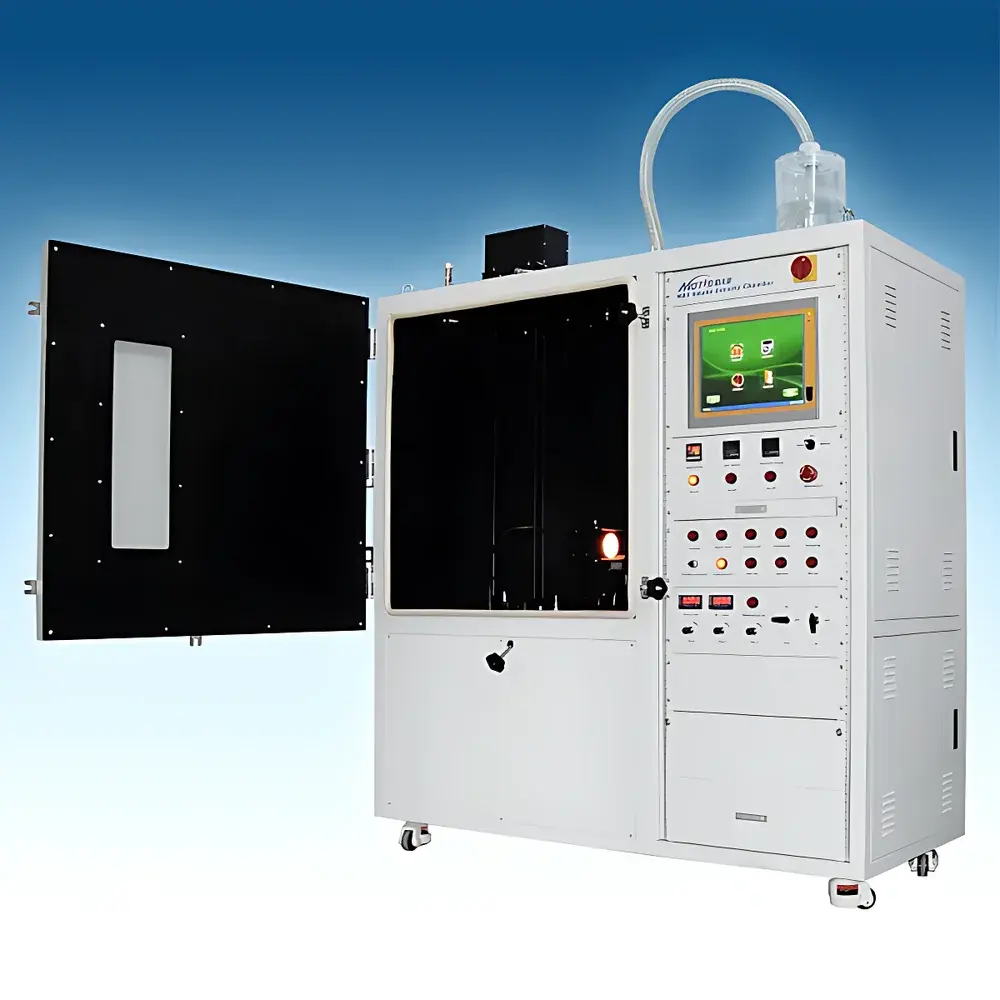
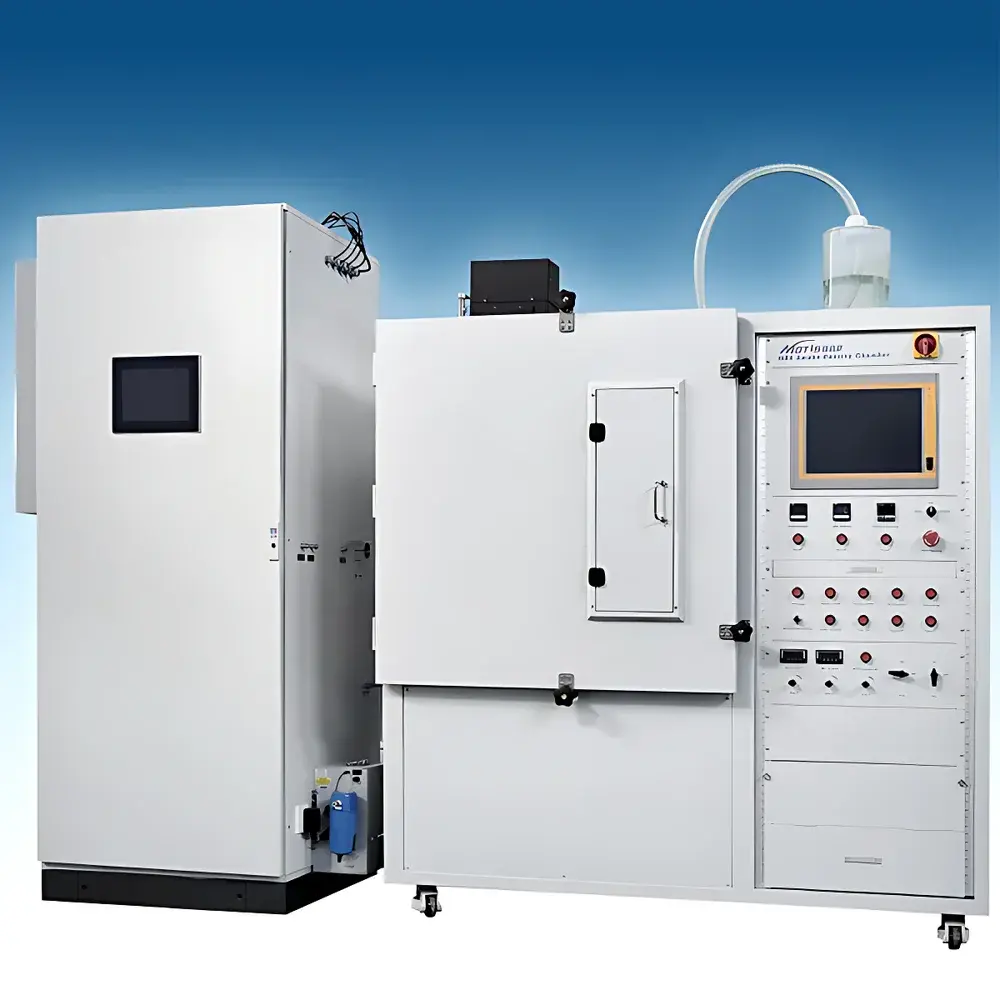
NBS Smoke Density Chamber SBD
| Origin | Tianjin, China |
|---|---|
| Manufacturer Type | Distributor |
| Origin Category | Domestic |
| Model | SBD |
| Price | USD 1,450 (FOB Tianjin) |
Overview
The NBS Smoke Density Chamber SBD is a precision-engineered benchtop combustion testing instrument designed to quantify the optical density of smoke generated by solid materials under controlled radiant and/or flaming exposure conditions. Based on the fundamental principle of light attenuation—measuring the reduction in transmitted luminous flux through a defined smoke column—the SBD chamber implements standardized photometric methodology per ASTM E662, ISO 5659-2, GB/T 8323, BS 6401, and NES 711. It operates as a closed-loop, volume-restricted optical measurement system: a calibrated DC 6.5 V tungsten halogen light source emits collimated radiation across a 1.5 m optical path; smoke generated within the test chamber attenuates this beam; and a side-window S-4 spectral-response photomultiplier tube (PMT) detects the residual intensity with resolution down to 0.00001% transmittance. The system’s optical dark box—mounted at the chamber top—integrates a motorized neutral-density filter wheel (ND3, ND2, and Dark positions), enabling automatic dynamic range adaptation during high-smoke-yield tests without manual intervention or signal saturation.
Key Features
- Multi-standard compliance: Dual-configurable heating modules—ASTM E662 radiation furnace (max 25 kW/m²) and ISO 5659-2 conical heater (max 50 kW/m²)—interchangeable via aviation-grade quick-connect couplings and mechanical mode switch.
- Flame ignition versatility: Supports both non-flaming (piloted-off) and piloted flaming modes—50 mL/min propane + 500 mL/min air (E662); 50 mL/min propane + 300 mL/min air (ISO 5659-2)—with integrated standard multi-nozzle burners.
- Thermal metrology traceability: Equipped with NIST-traceable water-cooled heat flux meter (MEDTHERM, compliant with cone calorimeter calibration protocols) for ISO 5659-2; air-cooled heat flux meter (MOTIS) for ASTM E662.
- Integrated gravimetric analysis: High-resolution mass loss module (0–2000 g range, ±0.1 g accuracy) enables simultaneous smoke density and thermal decomposition profiling (MOD-compliant mass loss rate calculation).
- Adaptive optical sensing: Motorized ND filter wheel (Clear/Filter/Dark positions), ND3 neutral density filter (100× higher transmission than ND2), and auto-ranging software that switches to Clear mode below 0.1% transmittance—ensuring linearity across low- and high-opacity regimes.
- Self-contained cooling: Optional closed-loop recirculating chiller eliminates dependency on external tap water or industrial cooling infrastructure.
Sample Compatibility & Compliance
The SBD accommodates flat, rigid specimens up to 100 mm × 100 mm × 50 mm (L × W × H), including thermoplastics, thermosets, composites, cables, textiles, and building insulation materials. All operational parameters—including radiant exposure level, flame duration, purge flow rate (1.5 L/s ± 0.1 L/s), and optical path geometry—strictly conform to dimensional and procedural requirements defined in ASTM E662 Annex A1, ISO 5659-2 Clause 6, GB/T 8323.2–2018 Section 7, and NES 711 Appendix B. Data acquisition and reporting support audit-ready GLP/GMP workflows, with timestamped raw transmittance logs, heat flux validation records, and specimen mass tracking—all exportable in CSV and Excel formats. System calibration certificates include full uncertainty budgets aligned with ISO/IEC 17025 principles.
Software & Data Management
The embedded Windows-based control software provides bilingual (English/Chinese) GUI with real-time visualization of transmittance (%T), specific optical density (Ds), and mass loss (%) versus time. It supports automated test sequencing, user-defined pass/fail thresholds, and batch report generation compliant with ASTM E662 Section 12 and ISO 5659-2 Clause 10. All data entries are logged with operator ID, test date/time, environmental conditions (ambient T/RH), and instrument configuration metadata. Export functions generate ISO/IEC 17025-compliant Excel reports containing raw photometer output, calculated Ds curves, peak smoke density (Dsmax), and time-to-Dsmax. Optional 21 CFR Part 11 add-on enables electronic signatures, audit trail logging, and role-based access control for regulated environments.
Applications
The SBD is deployed in fire safety R&D laboratories, material certification bodies (e.g., UL, Intertek, SGS), aerospace OEM supplier qualification programs, and national standards institutes for evaluating smoke toxicity precursors, fire growth modeling inputs, and regulatory compliance verification. Typical use cases include comparative screening of halogen-free flame retardants in polyolefins, smoke suppression efficacy assessment of intumescent coatings on steel substrates, validation of low-smoke zero-halogen (LSZH) cable jacket formulations, and generation of input data for CFD-based fire simulation tools (e.g., FDS, PyroSim). Its dual-standard architecture eliminates cross-lab variability when correlating results between North American (E662) and European/Asian (ISO 5659-2) regulatory frameworks.
FAQ
What standards does the SBD chamber fully support?
ASTM E662, ISO 5659-2, GB/T 8323.2–2018, BS 6401, and NES 711—verified via factory acceptance testing with certified reference materials.
Is NIST traceability provided for all calibrated components?
Yes: the MEDTHERM water-cooled heat flux meter includes an official NIST-traceable calibration certificate; the photomultiplier gain and neutral density filters are validated against NIST SRM 2032 and SRM 2036.
Can the system operate without external cooling water?
Yes—optional integrated recirculating chiller maintains stable PMT and heat flux meter temperatures without municipal water supply.
Does the software support automated report generation for regulatory submissions?
Yes: Excel-based reports include all required fields per ASTM E662 Section 12 and ISO 5659-2 Clause 10, with configurable headers, logos, and signature blocks.
How is optical alignment maintained over long-term operation?
The optical path incorporates kinematic mounts and self-diagnostic alignment verification routines; annual recalibration includes beam collimation verification using laser interferometry per ISO 10110-5.



