
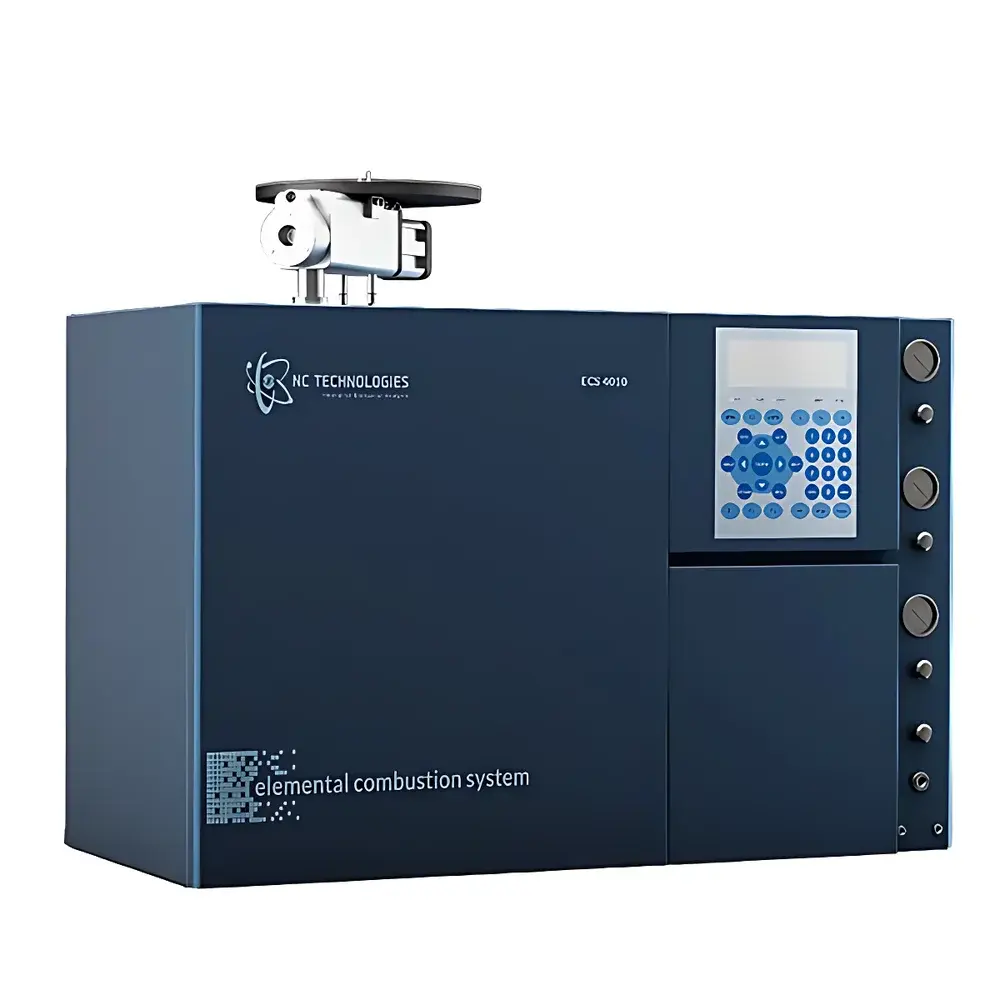
NC Technologies ECS 4010 Automated Elemental Analyzer
| Brand | NC Technologies |
|---|---|
| Origin | Italy |
| Model | ECS 4010 |
| Analysis Principle | High-Temperature Catalytic Combustion (Dumas Method) |
| Elements Measured | C, H, N, S (optional O) |
| Detection | Thermal Conductivity Detector (TCD), self-calibrating, reference-gas-free |
| Chromatographic Separation | Isothermal GC column (30–110 °C) |
| Automation Level | Fully automated microprocessor-controlled system with PC integration |
| Sample Introduction | Pneumatic and Zero-Blank electric autosamplers |
| Isotope Ratio Compatibility | Yes (MS-coupling enabled) |
| Compliance Framework | Designed for GLP/GMP environments |
Overview
The NC Technologies ECS 4010 Automated Elemental Analyzer is a high-precision, fully integrated combustion-based instrument engineered for quantitative determination of carbon (C), hydrogen (H), nitrogen (N), and sulfur (S) in homogeneous organic matrices—with optional oxygen (O) analysis via pyrolysis. It implements the Dumas method: samples are flash-combusted at temperatures up to 1,150 °C in an oxygen-rich environment over proprietary catalysts, converting elemental constituents into gaseous oxides (CO₂, H₂O, SO₂) and molecular nitrogen (N₂). These combustion products undergo isothermal gas chromatographic separation on a thermally stabilized column (adjustable between 30 °C and 110 °C), followed by selective quantification using a high-stability thermal conductivity detector (TCD). Unlike conventional TCD systems, the ECS 4010’s detector operates without reference gas—leveraging real-time baseline compensation and factory-traceable calibration protocols to ensure long-term signal integrity and inter-laboratory reproducibility.
Key Features
- Fully automated microprocessor-controlled platform with seamless Windows-based software integration for method setup, run scheduling, and real-time monitoring.
- Dual-furnace architecture enabling independent temperature zoning for optimized catalyst lifetime and reduced maintenance frequency—particularly advantageous for high-throughput CHNS workflows.
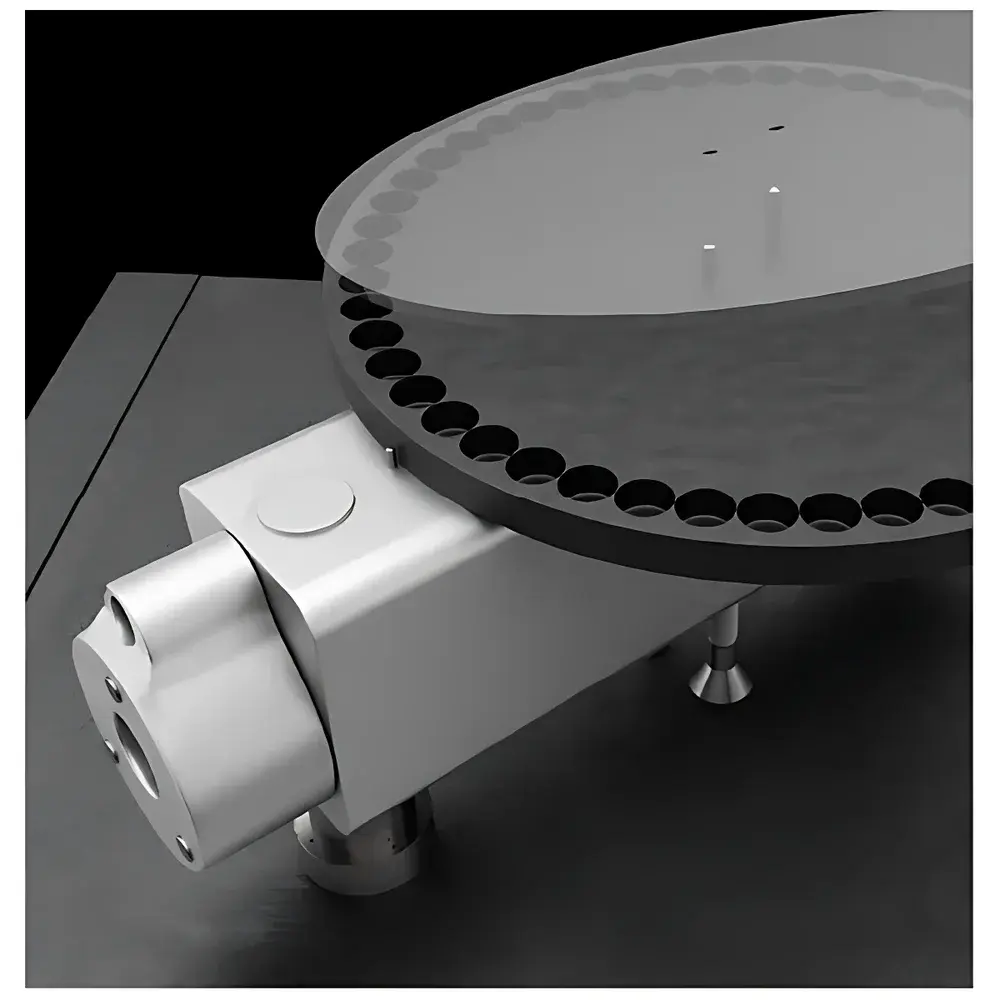
- Two interchangeable autosampler options: pneumatic sample introduction for routine throughput and Zero-Blank electric autosampler for ultra-low-background applications requiring sub-100 µg sample mass precision.
- Self-calibrating TCD with active drift compensation—eliminates need for reference gas cylinders, reduces consumables cost, and improves operational continuity.
- Modular design supporting direct coupling to isotope ratio mass spectrometers (IRMS) via standardized GC-MS interfaces for δ¹³C, δ¹⁵N, δ³⁴S, and δ¹⁸O stable isotope ratio analysis.
- Energy-efficient standby mode reducing carrier gas consumption by >60% and power draw during idle periods—validated per ISO 50001-aligned lab sustainability benchmarks.
Sample Compatibility & Compliance
The ECS 4010 accepts solid, liquid, and encapsulated samples (e.g., tin or silver capsules) within a typical mass range of 0.1–50 mg, depending on matrix volatility and heterogeneity. It is routinely deployed for pharmaceutical excipients, polymer additives, soil organic matter, marine particulates, petrochemical fractions, and certified reference materials (CRMs) such as IAEA-CH-6, USGS40, and NIST SRM 2710a. The system complies with ASTM D5291, ISO 16968, and EN 15104 for solid fuel and biomass analysis, and its data handling architecture supports full traceability under FDA 21 CFR Part 11, EU Annex 11, and GLP/GMP audit requirements—including electronic signatures, user-level access control, and immutable audit trails.
Software & Data Management
ECS Control Suite v4.x provides comprehensive instrument control, peak integration, stoichiometric correction (e.g., for halogen interference or nitrogen oxide formation), and uncertainty propagation per GUM (JCGM 100:2018). Raw chromatograms, calibration curves, QC reports, and batch summaries export natively to CSV, PDF, and LIMS-compatible XML formats. All data files are timestamped, digitally signed, and stored with metadata linking operator ID, instrument configuration, and environmental parameters (ambient temperature, pressure, gas purity logs)—ensuring full ALCOA+ compliance (Attributable, Legible, Contemporaneous, Original, Accurate, Complete, Consistent, Enduring, Available).
Applications
- Pharmaceutical QA/QC: Quantitative assay of active pharmaceutical ingredients (APIs) and degradation product profiling per ICH Q2(R2).
- Environmental science: Total organic carbon (TOC) and total nitrogen (TN) in sediments, aerosols, and wastewater sludge.
- Petroleum geochemistry: C/H/N/S ratios in crude oils, bitumens, and kerogen isolates for source rock evaluation.
- Food & agriculture: Protein content estimation (via nitrogen × 6.25 factor), adulteration screening, and fertilizer composition verification.
- Academic research: Stable isotope biogeochemistry in marine ecosystems, paleoclimate proxy development, and synthetic polymer characterization.
FAQ
Does the ECS 4010 require external reference gases for TCD operation?
No—the TCD employs dynamic baseline stabilization and internal reference cell compensation, eliminating dependence on reference gas streams.
Can the ECS 4010 be validated for regulated pharmaceutical testing?
Yes—its software architecture, electronic record controls, and hardware traceability meet FDA 21 CFR Part 11 and EU Annex 11 requirements for computerized system validation (CSV).
What sample forms are compatible with the Zero-Blank autosampler?
Powdered solids, lyophilized biomaterials, and viscous liquids encapsulated in sealed silver or tin capsules—optimized for masses down to 0.1 mg with <±0.3% RSD repeatability.
Is oxygen analysis performed in the same combustion step as CHNS?
No—oxygen determination requires separate pyrolytic reduction in a dedicated reactor zone at ~1,050 °C, using tungsten carbide catalyst and helium carrier gas.
How does dual-furnace design improve catalyst utilization?
By decoupling combustion and reduction zones, each furnace maintains optimal thermal profiles and catalyst loading—extending catalyst service life by up to 40% versus single-furnace configurations.





