
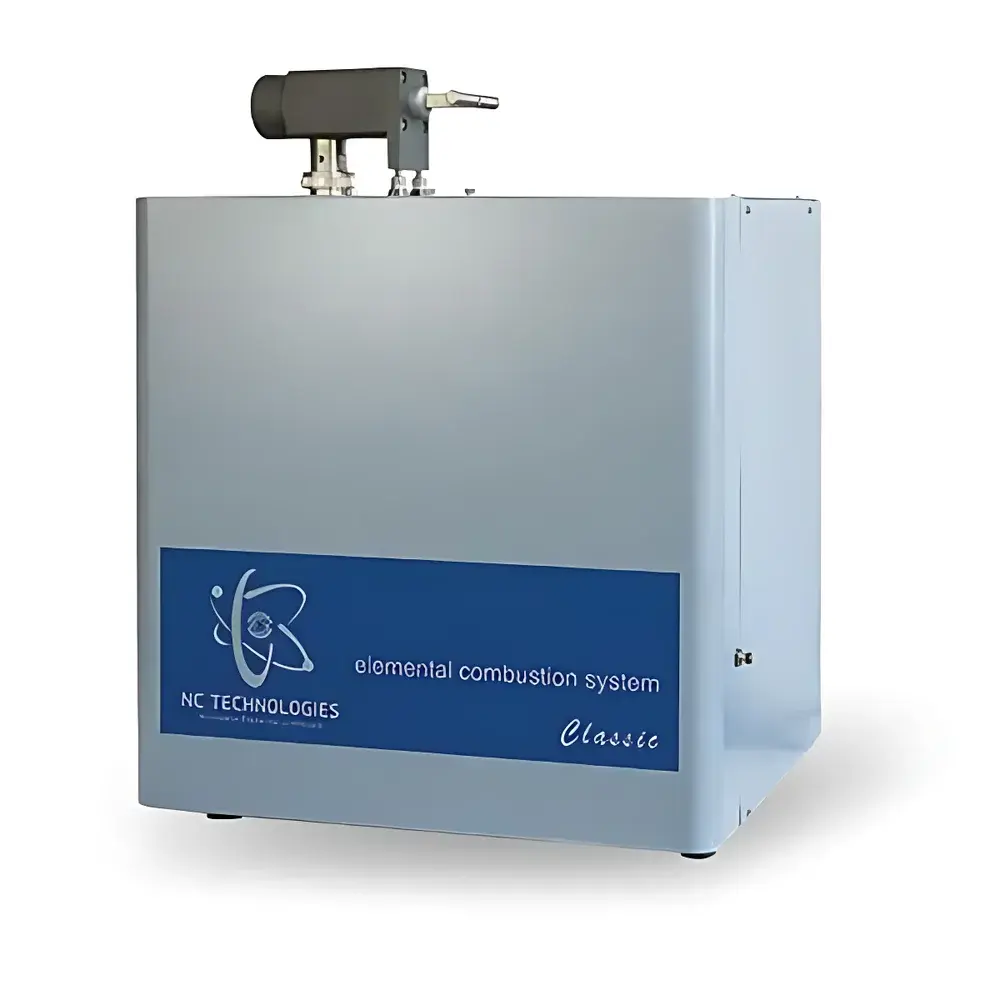
NC Technologies ECS 4024 Classic CHNS-O Elemental Analyzer
| Brand | NC Technologies |
|---|---|
| Origin | Italy |
| Model | ECS 4024 Classic CHNS-O Elemental Analyzer |
| Detection Principle | Flash Combustion coupled with Gas Chromatographic Separation |
| Elements Analyzed | C, H, N, S, O |
| Detection Range | 200 ppm – 100% |
| Sample Mass | 0.01–100 mg (matrix-dependent) |
| Accuracy | < 0.2% (vs. certified reference materials) |
| Precision | < 0.1% RSD (vs. certified reference materials) |
| Combustion Furnace Temperature | 800–1100 °C |
| GC Column Temperature Range | 30–110 °C |
| TCD Limit of Quantification | 1–5 µg |
| Analysis Time | 15 min (CHNS), 3 min (CN, using 2-m GC column) |
| Auto-samplers | Pneumatic (up to 147 positions), Electronic (32/50/100 positions), Manual |
| Software | EAS CLARITY for Windows |
| Gas Requirements | He (99.999%, 3–5 bar), O₂ (99.999%, 3–5 bar), Oil-free dry compressed air |
| Dimensions | 760 × 350 × 700 mm (L×W×H) |
| Power Supply | 230 VAC ±10%, 1–10 A |
Overview
The NC Technologies ECS 4024 Classic CHNS-O Elemental Analyzer is a high-performance, microprocessor-controlled combustion-based instrument engineered for the simultaneous quantitative determination of carbon (C), hydrogen (H), nitrogen (N), sulfur (S), and oxygen (O) in organic and inorganic solid and liquid samples. It implements the Dumas combustion method—standardized under ASTM D5291, ISO 11843, and EN 15407—where samples are flash-combusted in a high-temperature furnace (800–1100 °C) under controlled oxygen flow. The resulting gaseous effluent (CO₂, H₂O, SO₂, N₂, and CO for oxygen analysis) is dried, homogenized, and separated via temperature-programmable gas chromatography using a thermostated packed or capillary column (30–110 °C selectable). Detection is performed using a high-stability thermal conductivity detector (TCD), delivering robust baseline resolution and sub-microgram quantification limits (LOQ: 1–5 µg per element). The system operates without carrier-gas zeroing or reference gas calibration cycles, eliminating nitrogen background interference and reducing operational complexity.
Key Features
- True CHNS-O capability in a single run, enabled by integrated oxygen pyrolysis module and CO-selective reduction chemistry
- Three configurable autosampler options: pneumatic carousel (stackable, up to 147 positions), electronic turntable (32/50/100 positions), and manual loading for rapid method development
- Modular detection architecture—TCD output is fully compatible with external isotope-ratio mass spectrometers (IRMS) via standardized analog/digital interfaces, supporting δ¹³C, δ¹⁵N, δ¹⁸O, and δ³⁴S applications
- No nitrogen purge requirement: proprietary oxygen-dilution combustion eliminates atmospheric N₂ contamination, ensuring trace-level accuracy in low-nitrogen matrices
- Real-time combustion chamber viewing port with integrated LED illumination for visual verification of sample ignition and ash residue formation
- Multi-order calibration support (linear, quadratic, cubic) with active recalibration triggers based on drift thresholds or user-defined intervals
Sample Compatibility & Compliance
The ECS 4024 accommodates diverse sample types—including pharmaceutical APIs, polymers, soils, sediments, biological tissues (blood, hair, serum), coal, catalysts, and environmental particulates—within a mass range of 0.01–100 mg. Its robust oxidation chemistry handles halogen-rich, fluorinated, and metal-containing matrices without pre-treatment. The analyzer meets GLP and GMP documentation requirements through audit-trail-enabled software (EAS CLARITY), compliant with FDA 21 CFR Part 11 for electronic records and signatures. Routine operation adheres to ISO/IEC 17025 method validation protocols, and results are traceable to NIST SRMs (e.g., 8573, 8574, 2782). Oxygen analysis follows ASTM D5373 and EN 15407 procedures, while CHNS modes align with AOAC 993.13 and USP .
Software & Data Management
EAS CLARITY is a dedicated Windows-based acquisition and evaluation platform offering full instrument control, real-time chromatogram visualization, peak integration with manual override, and automated report generation in PDF, CSV, and XML formats. The software supports multi-user role-based access, electronic signature workflows, and secure database archiving with version-controlled method storage. All raw signal data, calibration logs, maintenance events, and operator actions are timestamped and stored with cryptographic integrity—enabling full forensic reconstruction during regulatory audits. Integration with LIMS is achieved via ASTM E1384-compliant HL7 or ODBC drivers.
Applications
This analyzer serves as a core tool across regulated and research-intensive domains: pharmaceutical QC (API stoichiometry, excipient purity), polymer science (elemental composition of bioplastics, flame-retardant additives), environmental monitoring (C/N ratios in soils, TOC in wastewater filtrates), geochemistry (organic carbon in shales, sulfur speciation in coals), food authenticity (protein nitrogen in dairy, adulteration screening), and forensic toxicology (elemental profiling of seized substances). Its reproducibility (<0.1% RSD) and wide dynamic range (200 ppm–100%) make it suitable for both routine batch testing and method development in ISO 17025-accredited laboratories.
FAQ
Does the ECS 4024 require helium as the sole carrier gas?
No—helium is recommended for optimal TCD sensitivity and retention time stability, but argon or nitrogen may be used for specific method adaptations, subject to validation.
Can oxygen analysis be performed independently of CHNS?
Yes—oxygen mode uses a separate pyrolysis reactor and tungsten carbide reductant; it can be scheduled as a standalone sequence or interleaved within CHNS-O runs.
Is method transfer supported between different ECS 4024 units?
Yes—EAS CLARITY exports complete method packages (calibration curves, GC parameters, combustion profiles) as encrypted .emf files, ensuring consistent performance across installations.
What maintenance intervals are recommended for the combustion tube and GC column?
Combustion tubes typically last ≥1,000 injections with proper sample conditioning; GC columns are rated for ≥500 runs under standard operating conditions. Both are field-replaceable without tools.
How is compliance with 21 CFR Part 11 enforced in EAS CLARITY?
Through mandatory electronic signatures for critical actions (method save, result approval), automatic audit trail logging, and password-protected user roles with configurable permissions (e.g., analyst, reviewer, administrator).





