
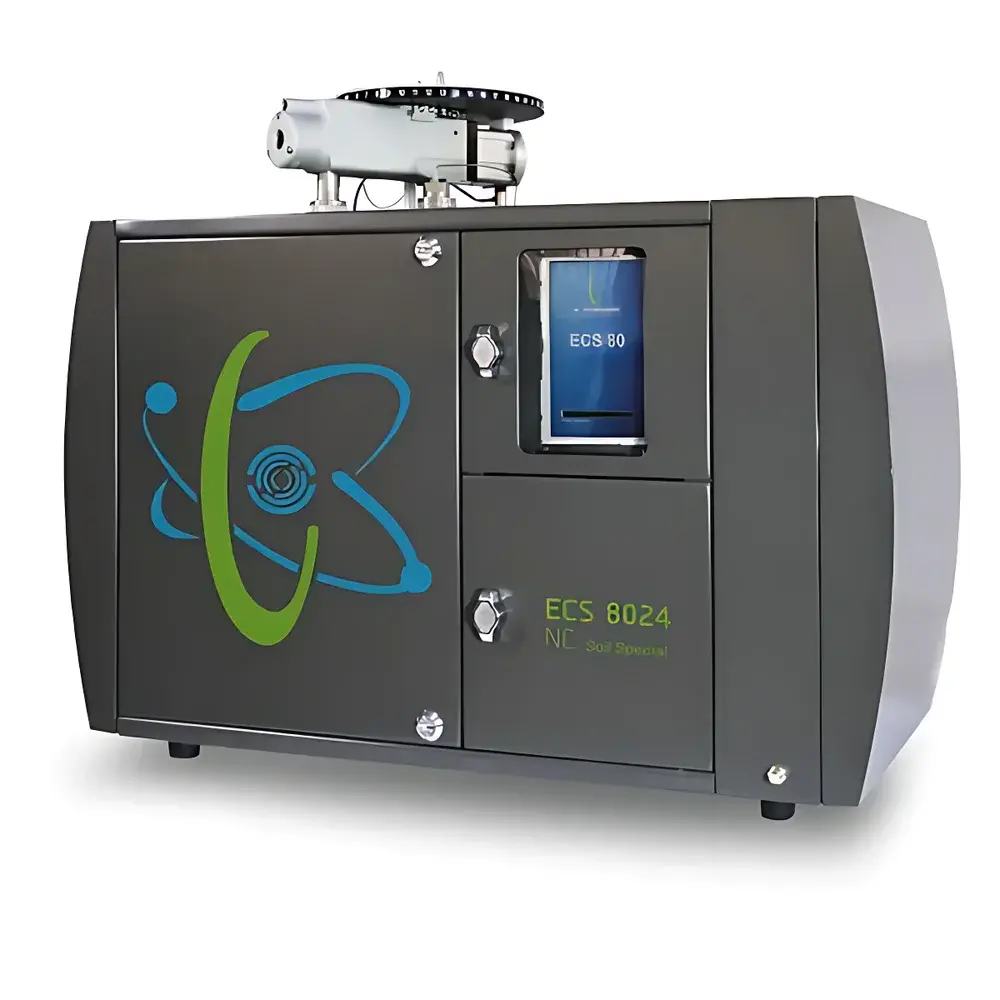
NC Technologies ECS 8024 Dumas-Based Soil-Specific Carbon and Nitrogen Elemental Analyzer
| Brand | NC Technologies |
|---|---|
| Origin | Italy |
| Model | ECS 8024 Soil-Specific CN Elemental Analyzer |
| Measurement Principle | Dumas combustion coupled with gas chromatographic separation |
| Detection | High-resolution thermal conductivity detector (TCD) |
| Sample Throughput | Up to 147 positions (pneumatic/electronic/manual samplers) |
| Analysis Time | ~5 min per CN determination |
| Quantification Range | 0.002–20 mg C and N per sample |
| Accuracy | <0.2% RSD (relative standard deviation) |
| Precision | <0.1% RSD |
| Dual-Furnace System | Left & right furnaces, up to 1100 °C each |
| Separation Oven Temperature | Up to 110 °C |
| Carrier Gas | Helium |
| Oxidant | Automated oxygen dosing |
| GC Column | 3 m packed capillary column |
| Software | EAS Clarity™ with linear/quad/cubic calibration, active recalibration, audit trail, and GLP-compliant data handling |
| Compliance | Designed for ASTM D5373, ISO 13878, USP <281>, and EN 15936 workflows |
Overview
The NC Technologies ECS 8024 is a dedicated Dumas combustion-based elemental analyzer engineered exclusively for the accurate, high-throughput quantification of total carbon (C) and total nitrogen (N) in soil, sediment, compost, biosolids, and other heterogeneous environmental matrices. Unlike general-purpose CHNS analyzers, the ECS 8024 integrates hardware and software optimizations specific to soil analysis—including robust catalyst management, dual-zone high-temperature combustion, and matrix-tailored calibration protocols—to ensure reliable recovery across variable organic matter content, clay mineralogy, and inorganic carbonate interference. The instrument operates on the principle of flash combustion at controlled stoichiometric oxygen excess, followed by catalytic reduction, water removal, and selective separation of CO₂ and N₂ on a dedicated 3-meter packed gas chromatographic column. Detection is performed using a high-stability, low-drift thermal conductivity detector (TCD), eliminating the need for reference gas streams and enabling long-term baseline integrity under routine laboratory conditions.
Key Features
- Dual-furnace combustion architecture (two independent zones, each programmable up to 1100 °C) ensures complete oxidation of refractory soil carbon and efficient conversion of nitrate/nitrite species to molecular nitrogen.
- Automated oxygen dosing system calculates optimal oxidant volume per sample mass—critical for minimizing NOₓ formation and maximizing N recovery in high-nitrate soils.
- Integrated consumables monitoring module tracks catalyst activity, desiccant saturation, and column lifetime, triggering alerts and logging replacement events for full traceability.
- Three sampler configurations supported: 147-position pneumatic auto-sampler (for unattended overnight runs), 50-position electronic auto-sampler (for mid-throughput labs), and manual loading mode (for method development or low-volume QA/QC).
- Touchscreen HMI with intuitive workflow navigation enables method setup, real-time status monitoring, and diagnostics without external PC dependency.
- Low-power standby mode reduces helium consumption by >70% and eliminates furnace idle energy draw—validated for daily start-stop operation without thermal stress on ceramic components.
Sample Compatibility & Compliance
The ECS 8024 accepts solid samples ranging from 1–100 mg (optimized for 20–50 mg soil aliquots) in standard 5 × 8 mm quartz or ceramic boats. It accommodates air-dried, freeze-dried, or oven-dried soils without pretreatment—provided samples are homogenized and free of visible stones or root fragments. The system complies with internationally recognized standards for soil C/N analysis, including ASTM D5373 (Standard Test Methods for Instrumental Determination of Carbon, Hydrogen, and Nitrogen in Petroleum Products and Lubricants—adapted for soils), ISO 13878 (Soil quality — Determination of total nitrogen — Modified Kjeldahl method and combustion methods), EN 15936 (Characterization of waste — Determination of total carbon and total nitrogen), and USP (Elemental Impurities – Limits). All calibration, validation, and reagent blank procedures adhere to GLP principles; raw signal traces, integration parameters, and detector response factors are permanently archived with time-stamped metadata.
Software & Data Management
EAS Clarity™ software provides full control over acquisition, processing, and reporting. It supports multi-point calibration curves (linear, quadratic, cubic), automatic outlier rejection based on residual analysis, and batch-wise correction for drift via internal standard spikes. Audit trail functionality records every user action—including method edits, calibration updates, and result overrides—with immutable timestamps and operator ID linkage. Data export conforms to ASTM E1461 and ISO/IEC 17025 requirements: CSV, XML, and PDF reports include instrument configuration logs, gas flow histories, furnace temperature profiles, and TCD voltage baselines. Optional 21 CFR Part 11 compliance package available with electronic signatures, role-based access control, and encrypted database storage.
Applications
- Quantification of total organic carbon (TOC) and total Kjeldahl nitrogen (TKN) equivalents in agricultural, forest, and reclaimed mine soils.
- Monitoring carbon sequestration efficacy in regenerative agriculture trials and biochar amendment studies.
- Regulatory compliance testing for landfill cover soils, dredged sediments, and contaminated site remediation endpoints.
- Method validation and cross-laboratory harmonization studies requiring inter-laboratory reproducibility <0.3% RSD.
- Stable isotope ratio preparation: the ECS 8024’s modular GC outlet allows direct coupling to IRMS systems (e.g., Thermo Delta V, Elementar Isoprime) for δ¹³C and δ¹⁵N analysis without cryofocusing.
FAQ
Can the ECS 8024 be upgraded to measure sulfur or chlorine?
Yes—the instrument platform supports CHNS and CHNS-O configurations via optional furnace modifications, additional catalytic stages, and extended GC column sets. Upgrade kits are factory-installed and validated per ISO/IEC 17025.
Is helium the only acceptable carrier gas?
Helium is required for optimal TCD sensitivity and resolution of CO₂/N₂ peaks. Hydrogen or argon may be used for method scouting but compromise detection limits and reproducibility.
How often must the combustion catalyst be replaced?
Under typical soil analysis loads (≤50 samples/day), the dual-stage Pt/CuO catalyst lasts ≥6 months; the system’s real-time catalyst health algorithm estimates remaining service life based on peak symmetry and baseline noise trends.
Does the software support LIMS integration?
Yes—EAS Clarity™ includes configurable ODBC drivers and HL7-compatible output modules for seamless bidirectional communication with major LIMS platforms (e.g., LabWare, STARLIMS, Thermo Fisher SampleManager).
What maintenance is required beyond catalyst replacement?
Quarterly verification of furnace thermocouple accuracy, annual GC column bake-out, and semiannual TCD filament resistance check—documented in the built-in Preventive Maintenance Scheduler.




