
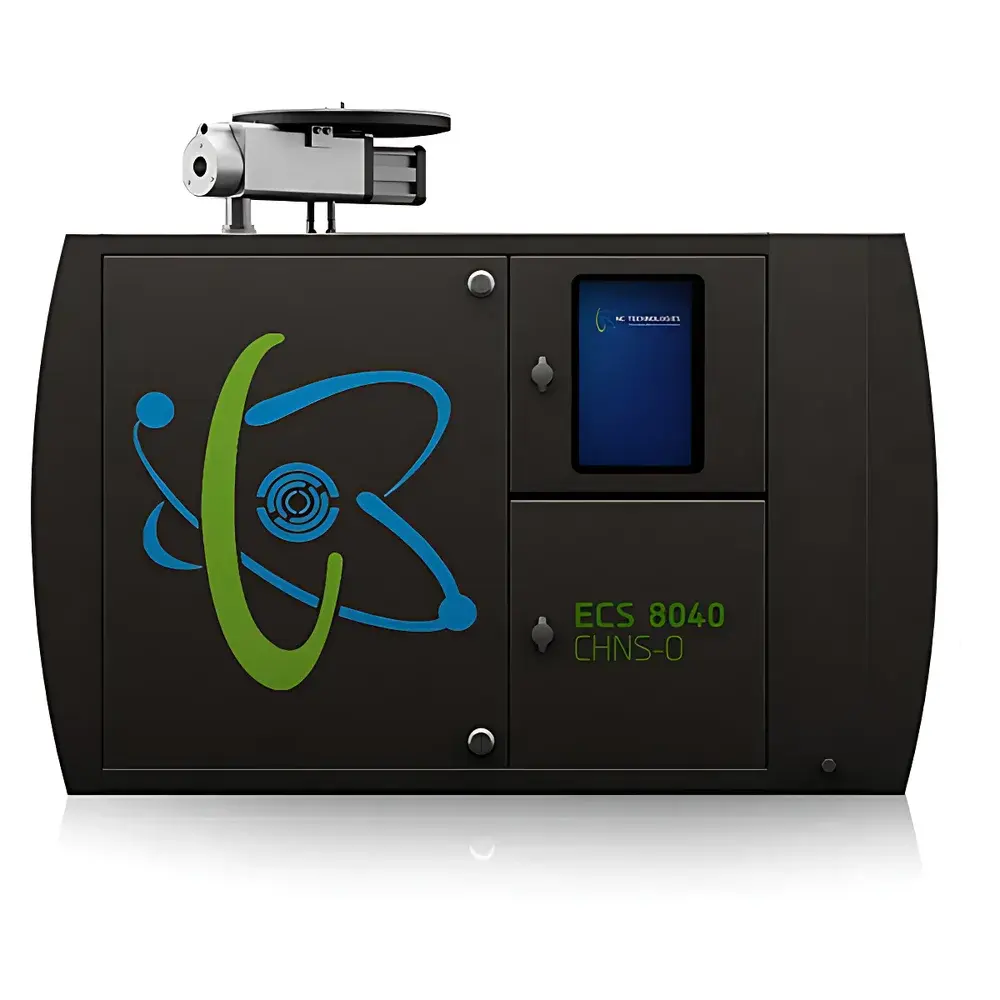
NC Technologies ECS 8040 CHNS-O Organic Elemental Analyzer
| Brand | NC Technologies |
|---|---|
| Origin | Italy |
| Model | ECS 8040 CHNS-O Organic Elemental Analyzer |
| Measurement Principle | Dumas combustion coupled with gas chromatographic separation and thermal conductivity detection (TCD) |
| Elemental Range | C, H, N, S, O (0.002–20 mg for C/H/N |
| Accuracy | <0.2% (certified reference materials, purity >99.9%) |
| Precision | <0.1% RSD (certified reference materials, purity >99.9%) |
| Combustion Temperature | up to 1100 °C |
| Reduction Oven Temperature | up to 110 °C |
| Carrier Gas | Helium |
| Oxygen Delivery | Automated dosing with electronic flow control |
| GC Column | 0.8–4 m capillary or packed GC column (dedicated for CO₂, H₂O, N₂, SO₂ separation) |
| Detector | High-sensitivity, reference-free TCD |
| Sample Throughput | Up to 147 positions (pneumatic autosampler), 32/50/100 positions (electronic autosampler), manual option available |
| User Interface | Integrated touchscreen display |
| Software | EAS Clarity™ with linear/quadratic/cubic calibration, active recalibration, audit trail, and GLP-compliant data handling |
| Power Management | Standby mode for reduced He/O₂ consumption and energy use |
| Compliance | Designed to support ASTM D5291, ISO 16968, USP <28>, and FDA 21 CFR Part 11 requirements (when configured with full audit trail and electronic signature modules) |
Overview
The NC Technologies ECS 8040 CHNS-O Organic Elemental Analyzer is a high-performance, Dumas combustion-based elemental analysis system engineered for precise quantification of carbon, hydrogen, nitrogen, sulfur, and oxygen in organic and organometallic samples. Unlike Kjeldahl-based methods, the ECS 8040 employs flash combustion at temperatures up to 1100 °C in a pure oxygen atmosphere, followed by catalytic reduction and selective gas-phase separation via dedicated chromatographic columns. The resulting gaseous products—CO₂, H₂O, N₂, and SO₂—are resolved and quantified using a high-stability, reference-free thermal conductivity detector (TCD). This architecture eliminates dependency on reference gases, enhances long-term baseline stability, and supports unattended operation across diverse sample matrices including pharmaceuticals, polymers, food ingredients, environmental solids, and catalyst precursors.
Key Features
- Single-furnace combustion design optimized for uniform thermal distribution and extended catalyst lifetime—reducing maintenance frequency and operational variability.
- Modular, rapid-installation hardware platform enabling tool-free access to combustion tubes, catalyst beds, and GC columns for routine service and method reconfiguration.
- Three sampling options: high-capacity pneumatic autosampler (147 positions), compact electronic autosampler (32/50/100 positions), and manual loading—ensuring adaptability from R&D screening to regulated QC workflows.
- Integrated touchscreen interface with real-time status monitoring—including catalyst saturation indicators, gas pressure diagnostics, and consumables lifecycle tracking—to proactively manage instrument readiness.
- Standby mode automatically reduces helium carrier flow and pauses heating cycles during idle periods, lowering annual gas consumption by up to 40% and minimizing thermal stress on critical components.
- Open architecture supporting direct interfacing with isotope ratio mass spectrometers (IRMS) or other external detectors for δ¹³C, δ¹⁵N, δ³⁴S, and δ¹⁸O stable isotope analysis.
Sample Compatibility & Compliance
The ECS 8040 accommodates solid, liquid, and viscous samples weighing 0.002–20 mg (C/H/N), 0.002–6 mg (S), and 0.002–2 mg (O), with minimal sample preparation required. Its robust oxidation protocol handles challenging matrices such as nitrates, sulfonates, halogenated compounds, and heterogeneous biological tissues. The system meets analytical requirements outlined in ASTM D5291 (petroleum products), ISO 16968 (soil and sediment), USP (pharmaceutical elemental impurities), and EN 15936 (feedstuffs). When deployed with EAS Clarity™ software configured for full audit trail, user authentication, and electronic signatures, it satisfies FDA 21 CFR Part 11 and EU Annex 11 expectations for regulated laboratories operating under GLP or GMP frameworks.
Software & Data Management
EAS Clarity™ is a dedicated, Windows-based analytical suite providing comprehensive control, calibration, and reporting functionality. It supports multi-point linear, quadratic, and cubic calibration models with automatic weighting and outlier rejection. Active recalibration—triggered by user-defined thresholds or time intervals—ensures continuous traceability without interrupting batch runs. All raw signals, integration parameters, calibration history, and operator actions are timestamped and stored in encrypted project files. Optional configuration enables full 21 CFR Part 11 compliance, including role-based access control, immutable audit logs, and electronic signature capture for release-critical reports.
Applications
The ECS 8040 delivers validated performance across academic, industrial, and regulatory environments. Typical use cases include: verification of molecular formulae in synthetic chemistry; quantification of residual solvents and counterions in API batches; determination of protein content (via nitrogen) in nutritional labeling; assessment of sulfur content in low-sulfur fuels per ISO 8754; oxygen stoichiometry analysis in battery cathode materials (e.g., LiCoO₂, NMC); and certification of certified reference materials (CRMs) for environmental and clinical metrology. Its ability to analyze all five elements in a single run—without method switching or hardware reconfiguration—significantly improves lab throughput and inter-element correlation reliability.
FAQ
What combustion principle does the ECS 8040 employ?
It uses high-temperature Dumas combustion (up to 1100 °C) in dynamically controlled oxygen, followed by catalytic reduction and gas chromatographic separation.
Is helium the only acceptable carrier gas?
Yes—helium is required for optimal TCD sensitivity and baseline stability; hydrogen or nitrogen are not supported due to detector design constraints.
Can the system be validated for GMP use?
Yes—when equipped with EAS Clarity™ Part 11 mode, IQ/OQ documentation packages, and qualified installation by NC Technologies field engineers.
How is oxygen quantified separately from nitrogen and carbon?
Oxygen is determined via pyrolytic decomposition in a graphite furnace under inert atmosphere, generating CO, which is subsequently oxidized to CO₂ and measured in the same TCD channel used for carbon.
What maintenance intervals are recommended for routine operation?
Catalyst replacement every 1,000–1,500 injections (depending on sample type); combustion tube inspection every 6 months; GC column replacement every 12–18 months under continuous use.




