
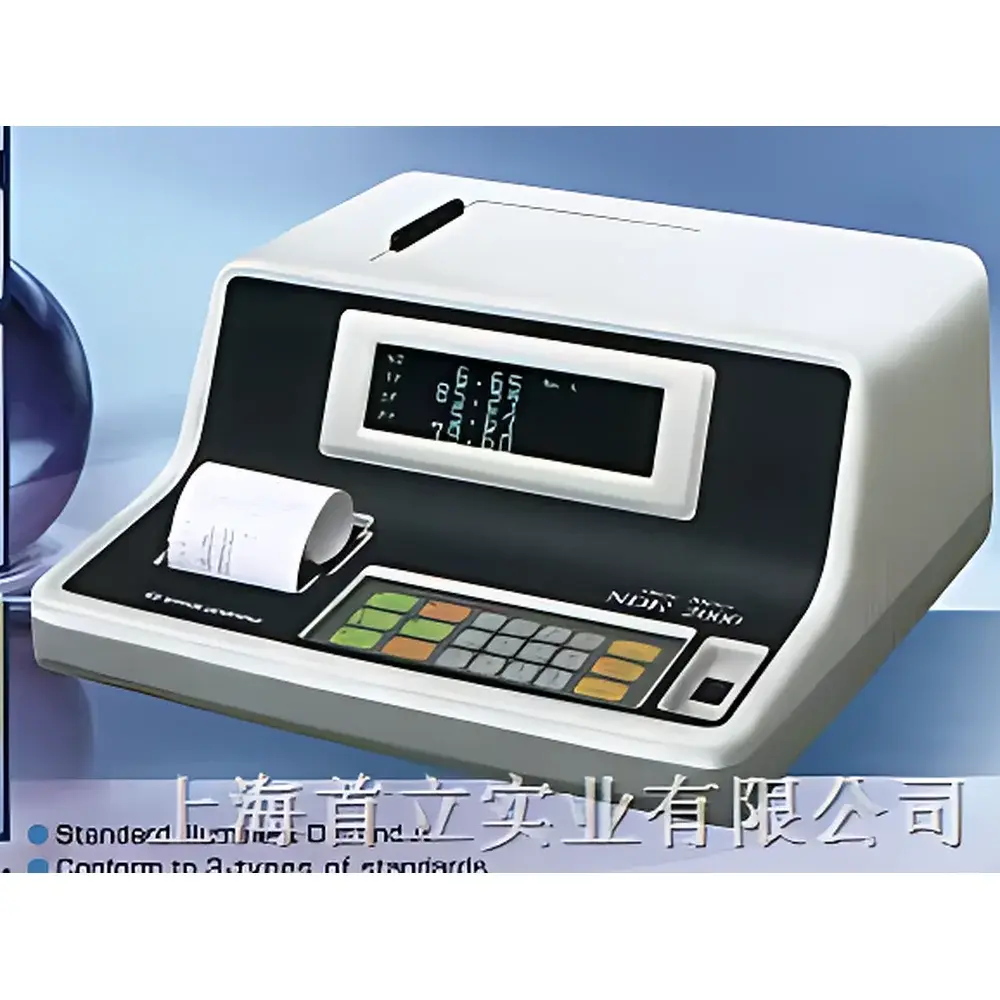
NDH-2000 Haze Meter
| Origin | Japan |
|---|---|
| Manufacturer Type | Authorized Distributor |
| Origin Category | Imported |
| Model | NDH-2000 |
| Pricing | Upon Request |
Overview
The NDH-2000 Haze Meter is a precision optical instrument engineered for quantitative assessment of light scattering and transmission characteristics in transparent and semi-transparent materials. Based on the principle of integrating sphere photometry, it measures haze (turbidity), total transmittance, diffuse transmittance, and regular (parallel) transmittance—parameters critical to optical quality control across polymer, packaging, glass, and water analysis applications. The system employs a 150 mm diameter integrating sphere with dual-mode measurement capability: standard (non-compensated) and aperture-compensated configurations—enabling correction of sphere wall scatter effects per ISO 13468-1 and ASTM D1003 protocols. Illumination is provided by a stabilized 5 V / 9 W halogen lamp (rated life: 5,000 h), with selectable CIE standard illuminants D65 (daylight) and A (incandescent), ensuring metrological consistency across global regulatory frameworks.
Key Features
- Compliance with international standards: JIS K 7361, JIS K 7136 (2000), JIS K 7105, ISO 13468-1/-2, ISO 14782, and ASTM D1003—validated for both industrial QA and regulatory reporting.
- High-stability optical architecture featuring low-drift, high-speed 16-bit A/D conversion (with built-in 18-bit auto-calibration), delivering repeatability of ±0.05% FS (after 20 min thermal stabilization at 23 °C).
- Fixed-path geometry: 11 mm collimated beam tube with 20 mm target aperture eliminates sample repositioning—enabling rapid, operator-independent measurements.
- Integrated 256 × 64-dot fluorescent display (166 × 41 mm active area, blue-green phosphor) optimized for wide-angle readability under laboratory lighting conditions.
- Onboard thermal printer (256 × 8 dots/line; 1.1 sec/line) with automatic timestamping (YY/MM/DD HH:MM) and alphanumeric sample ID entry support.
- Embedded real-time clock and non-volatile memory preserve calibration settings, optical configurations, and user-defined test parameters—even after power interruption.
- RS-232C serial interface (standard) enables bidirectional data exchange with LIMS or QC software platforms, supporting GLP-compliant audit trails and FDA 21 CFR Part 11–ready metadata logging.
Sample Compatibility & Compliance
The NDH-2000 accommodates flat, rigid, or flexible sheet specimens up to 150 mm in diameter—including plastic films (PET, PP, PE), cellophane, tempered glass, optical lenses, and aqueous solutions (drinking water, surface water, seawater). Standard 10 mm cuvettes are supplied for liquid-phase turbidity analysis; optional 50 mm cuvettes and sample holders extend versatility for irregular or thick substrates. All optical path components meet ISO 9001-certified manufacturing tolerances. Device firmware and measurement algorithms are validated against NIST-traceable reference standards for haze and transmittance. Environmental operating range: 0–40 °C ambient temperature, 30–80% RH (non-condensing). Continuous operation is limited to ≤20 hours per day to maintain thermal stability of the halogen source and detector electronics.
Software & Data Management
While the NDH-2000 operates as a standalone instrument, its RS-232C port supports ASCII-based command-response protocol for integration into automated testing workflows. Raw data output includes: haze (%), total transmittance (%), diffuse transmittance (%), regular transmittance (%), and turbidity (TURB units)—all timestamped and tagged with user-assigned sample IDs. When connected to external PCs or industrial controllers, the device complies with basic GLP/GMP data integrity requirements: no data overwrite capability, sequential record numbering, and immutable time-stamped logs. Firmware does not support remote update or cloud connectivity—ensuring deterministic behavior required in regulated environments where validation documentation must remain static.
Applications
- Plastics & Films: QA/QC of injection-molded parts, extruded sheets, and laminated packaging—verifying compliance with automotive interior gloss specifications or medical device transparency thresholds.
- Optical Glass & Lenses: Quantification of surface scattering defects and bulk inhomogeneity prior to anti-reflective coating application.
- Water Quality Monitoring: Turbidity screening per ISO 7027 and EPA Method 180.1 for municipal treatment plants and environmental field labs.
- Pharmaceutical Packaging: Verification of blister foil clarity and vial transparency in accordance with USP and ICH Q5C guidelines.
- Academic Research: Fundamental studies of light-matter interaction in nanocomposite polymers and bio-based films requiring trace-level haze resolution.
FAQ
Does the NDH-2000 comply with FDA 21 CFR Part 11 requirements?
The instrument supports foundational elements—audit trail-capable timestamping, user-assignable IDs, and non-erasable data export—but lacks electronic signature functionality and role-based access control; therefore, it serves as a Part 11–compatible data source when integrated with validated host software.
What is the maximum allowable sample thickness?
The standard 150 mm integrating sphere accepts samples up to 25 mm thick; optional fixtures extend this to 50 mm for molded glass or composite panels.
Can the NDH-2000 measure turbidity in nephelometric turbidity units (NTU)?
Yes—when used with 10 mm or 50 mm cuvettes and calibrated against formazin standards, it reports TURB values traceable to ISO 7027, with linearity verified from 0.1 to 1,000 NTU.
Is routine calibration required?
Annual verification against certified haze and transmittance standards (e.g., NIST SRM 1979) is recommended; daily zero-check using the supplied black shutter is mandatory before each measurement session.
How is thermal drift mitigated during extended use?
The halogen lamp power supply incorporates active current regulation and thermal feedback; measurements are only enabled after internal temperature sensors confirm stabilization within ±0.5 °C of nominal setpoint.





