
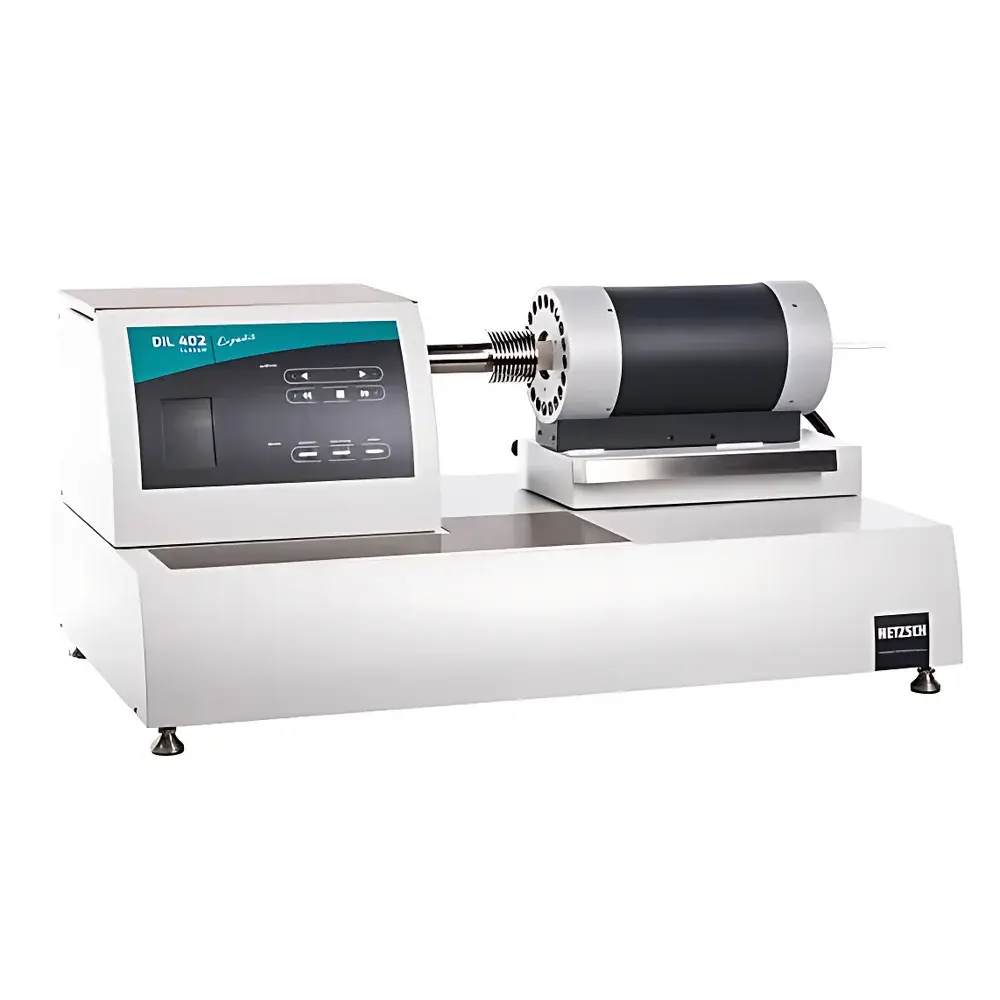
Netzsch DIL 402 Expedis Classic Thermal Dilatometer
| Brand | Netzsch |
|---|---|
| Origin | Germany |
| Model | DIL 402 Expedis Classic |
| Temperature Range | RT to 1600°C |
| Heating Rate | 0.001–50°C/min |
| Temperature Accuracy | ±0.1°C |
| Sample Length | 25–50 mm |
| Atmosphere Control | Integrated MFC (1 standard, up to 3 optional) |
| Vacuum Capability | Sealed vacuum chamber (optional auto-vacuum) |
| Force Control | Programmable contact force with stepwise or linear ramping |
| Displacement Resolution | 2 nm (NanoEye optical encoder) |
| 炉体配置 | Single-furnace integrated design |
| Compliance | ASTM E228, ISO 11359-1/-2, DIN 51045, USP <671> |
Overview
The Netzsch DIL 402 Expedis Classic is a high-precision horizontal push-rod thermal dilatometer engineered for reproducible measurement of linear dimensional changes in solid and semi-solid materials as a function of temperature. It operates on the fundamental principle of contact-based mechanical displacement detection under controlled thermal conditions: a calibrated quartz or alumina push-rod transmits minute axial expansions or contractions from the sample to an ultra-stable optical displacement sensor — the NanoEye encoder — which delivers sub-nanometer resolution across the full temperature range. Designed for routine quality control and advanced R&D applications in ceramics, metals, composites, glasses, and refractory materials, the system maintains strict compliance with international standards including ASTM E228 (linear thermal expansion of solids), ISO 11359-1 (general principles) and ISO 11359-2 (determination of linear coefficient of thermal expansion), as well as DIN 51045 and USP for pharmaceutical excipient characterization.
Key Features
- Integrated NanoEye Optical Encoder: A maintenance-free, linear optical position sensor delivering 2 nm resolution and exceptional linearity over ±5 mm displacement range — eliminating hysteresis, drift, and thermal noise associated with traditional LVDT or capacitive sensors.
- Programmable Contact Force System: Enables precise, repeatable application of initial contact load (e.g., 0.01–0.5 N) prior to heating, critical for fragile, porous, or low-modulus samples such as foams, thin films, or sintered green bodies — ensuring no plastic deformation or loss of contact during thermal cycling.
- Modular Furnace Architecture: Single-furnace configuration with SiC or Fused Silica (FuSi) heating elements; rapid, tool-free furnace exchange; buffered lid closure mechanism preserves sample alignment and minimizes mechanical disturbance during insertion.
- MultiTouch Sample Loading: Intuitive tail-end sample positioning ensures optimal vertical alignment and uniform rod-sample interface — reducing tilt-induced measurement error and improving inter-operator repeatability.
- Sealed Gas Environment: Integrated mass flow controller (MFC) supports single-gas (standard) or multi-gas (optional 3-channel) delivery directly into the measurement zone; vacuum-tight sample chamber (<10⁻² mbar base pressure, optional auto-vacuum pump) enables inert, reducing, oxidizing, or vacuum-controlled testing per ASTM E1113 and ISO 11359-2.
- Adjustable Thermocouple Positioning: Sliding thermocouple mount allows precise placement adjacent to the sample mid-length without bending wires — ensuring accurate, localized temperature feedback aligned with the measured expansion zone.
Sample Compatibility & Compliance
The DIL 402 Expedis Classic accommodates cylindrical or prismatic specimens 25–50 mm in length and up to 12 mm in diameter. Compatible sample holders include fused silica, high-purity alumina, and graphite (optional), enabling measurements from ambient to 1600°C in air, N₂, Ar, He, H₂, CO, CO₂, or vacuum. The system meets GLP/GMP documentation requirements through Proteus®7 software audit trails, electronic signatures (21 CFR Part 11 compliant modules available), and calibration traceability to NIST-certified reference materials. All hardware and firmware designs adhere to IEC 61000-6-2/6-4 EMC standards and CE conformity for laboratory use in EU and North America.
Software & Data Management
Proteus®7 dilatometry software provides full instrument control, real-time data visualization, and standardized reporting. Core functions include automatic sample length detection, dynamic force profiling (linear, constant, stepped, or ramped), and c-DTA® — a proprietary technique that extracts differential thermal signal (heat flow analog) simultaneously with expansion data, supporting temperature calibration and phase transition identification without auxiliary DSC hardware. Optional modules extend functionality: Density Measurement calculates volumetric expansion and density evolution for liquids, melts, and anisotropic solids; Rate-Controlled Sintering (RCS) enables closed-loop shrinkage rate regulation; Curve Identification performs pattern-matching against user-defined or manufacturer-provided reference libraries for QC pass/fail decisions. All raw and processed data are stored in vendor-neutral ASCII or HDF5 formats, supporting third-party analysis in MATLAB®, Python, or OriginLab.
Applications
- Thermal expansion coefficient (CTE) determination of structural ceramics and refractories per ASTM C372
- Sintering kinetics analysis of metal and ceramic powders, including onset temperature, densification rate, and final shrinkage
- Softening point detection in glasses and amorphous polymers using derivative (dL/dT) inflection analysis
- Phase transition characterization (e.g., martensitic transformations in shape-memory alloys, α↔β transitions in Ti alloys)
- Thermal stability assessment of composite laminates, battery electrode materials, and nuclear fuel forms
- Density evolution monitoring during thermal processing of polymer melts, slurries, and pharmaceutical granules
FAQ
What is the maximum operating temperature for the DIL 402 Expedis Classic?
The standard configuration supports continuous operation from room temperature to 1600°C using SiC or fused silica furnace elements.
Is vacuum capability standard or optional?
Vacuum sealing is standard; automated vacuum pumping is an optional accessory.
Can the system measure both expansion and contraction accurately?
Yes — the NanoEye encoder is bidirectional and linear across its full ±5 mm range, supporting reliable quantification of both positive and negative dimensional changes.
How does c-DTA® differ from conventional DSC?
c-DTA® derives a thermal signal from the second derivative of displacement vs. temperature, offering complementary transition detection without requiring separate calorimetric hardware — though it does not replace quantitative enthalpy measurement.
Is the Proteus®7 software compliant with FDA 21 CFR Part 11?
Yes — validated 21 CFR Part 11 modules are available, including electronic signatures, audit trail logging, and role-based access control.



