
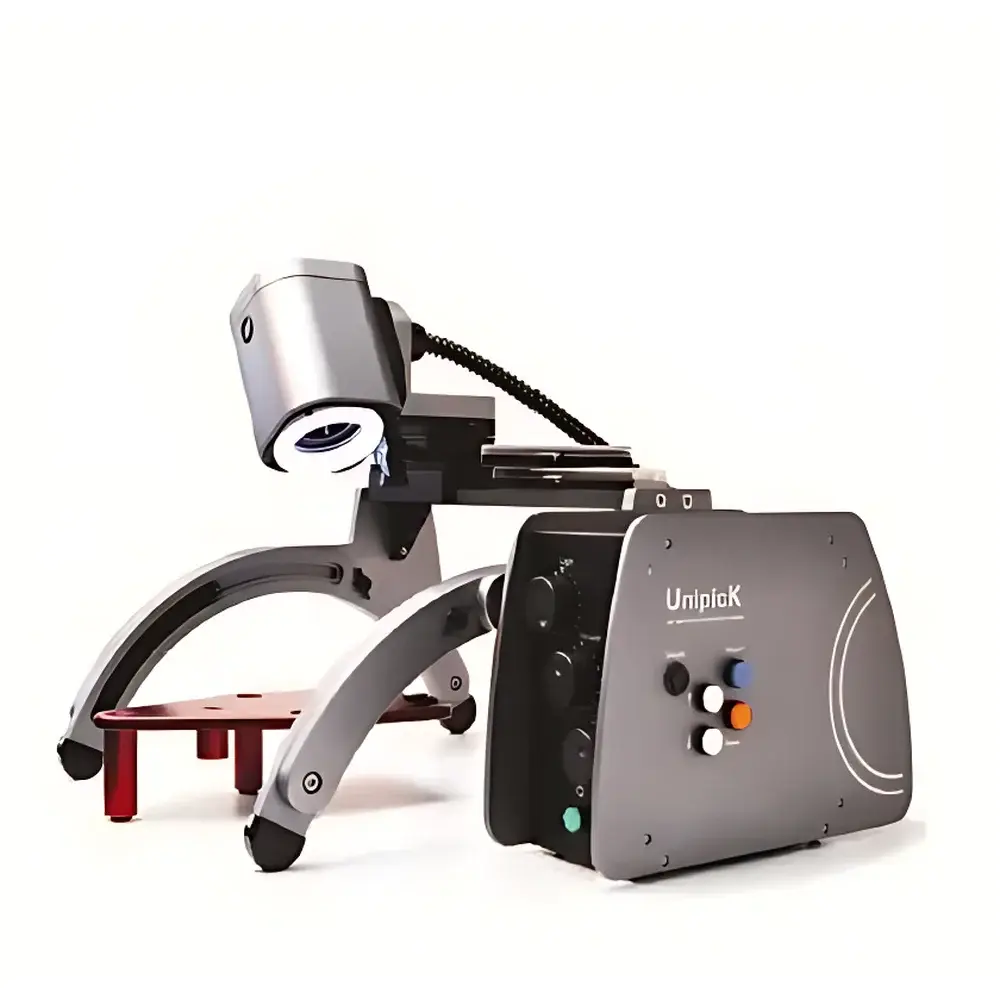
NeuroIndx Kuiqpick Single-Cell Capture and Microdissection System for Inverted Microscopes
| Origin | USA |
|---|---|
| Manufacturer Type | Authorized Distributor |
| Origin Category | Imported |
| Model | Kuiqpick |
| Quotation | Upon Request |
| Vacuum Pressure Range | 0–588.8 mmHg |
| Vacuum Pulse Duration | 0–1 s |
| Linear Actuator Step Resolution | 1.5 µm |
| Linear Actuator Max Travel | 8.9 mm |
| Linear Actuator Max Speed | 0.35 mm/s |
| Illumination | 144-LED Ring Light (Lifespan: 10,000 h) |
| Compatible Tissue Thickness | 5–300 µm |
| Compatible Sample Types | Fresh-frozen, sucrose-processed, and live unfixed tissues |
| Capillary Inner Diameters | 15, 20, 30, 40, 50, 60, 80, 100 µm |
| Capillary Total Length | 4.2 ± 0.2 cm |
| Operating Temperature | 5–40 °C |
| Relative Humidity | 30–80% (at 31 °C) |
| Compatible Microscopes | Olympus CKX31/CKX41, Labomed TCM400 |
Overview
The NeuroIndx Kuiqpick Single-Cell Capture and Microdissection System is an engineered precision upgrade module designed to convert standard inverted microscopes—specifically the Olympus CKX31/CKX41 and Labomed TCM400—into fully functional platforms for contact-free, vacuum-assisted single-cell isolation and targeted tissue microdissection. Unlike laser-based or thermal ablation methods, Kuiqpick operates on a non-destructive physical principle: controlled negative pressure applied through calibrated glass capillaries enables gentle aspiration and retrieval of intact cells or tissue regions under direct visual guidance. This approach preserves native cellular integrity, viability, and molecular fidelity—critical for downstream applications including clonal expansion, RNA-seq, ATAC-seq, proteomic profiling, and quantitative RT-PCR. The system is purpose-built for laboratories requiring high-fidelity sample procurement without chemical fixation, cryosectioning artifacts, or photothermal damage inherent in laser capture microdissection (LCM). Its modular architecture ensures seamless integration with existing microscope infrastructure, eliminating capital expenditure on dedicated LCM platforms.
Key Features
- Vacuum-driven, capillary-based aspiration eliminates mechanical shear stress and thermal perturbation—enabling recovery of viable, transcriptionally intact single cells from adherent monolayers, suspension cultures, and complex 3D organoids.
- Compatible with fresh-frozen, sucrose-protected, and live unfixed tissue sections (5–300 µm thick), bypassing formalin fixation, paraffin embedding, or dehydration steps that degrade nucleic acid and protein quality.
- Eight standardized capillary inner diameters (15–100 µm) allow precise selection based on target cell size, morphology, or tissue density—optimized for neuronal soma, immune subsets, tumor spheroids, or epithelial crypt fragments.
- Sub-micron linear actuator resolution (1.5 µm step size) and programmable vacuum pulse timing (0–1 s) ensure reproducible, operator-independent positioning and aspiration control.
- Integrated 144-LED ring illumination provides uniform, shadow-free contrast across wide-field and high-magnification objectives—critical for real-time morphological assessment during manual or semi-automated targeting.
- Designed for GLP-aligned workflows: no consumables beyond sterile capillaries; no optical alignment calibration required; minimal maintenance beyond routine vacuum pump servicing.
Sample Compatibility & Compliance
Kuiqpick supports biospecimen integrity standards aligned with ISO 20387:2018 (biobanking) and FDA 21 CFR Part 11 (electronic records/e-signatures) when paired with validated laboratory information management systems (LIMS). It accommodates specimens processed per established neurobiological and oncology biobanking protocols—including OCT-embedded frozen brain sections, collagenase-digested tumor digests, and Matrigel-embedded iPSC-derived neural rosettes. Because it imposes no exogenous energy input (e.g., UV, IR, or electrical current), samples retain native post-translational modifications and epigenetic marks essential for ChIP-seq, bisulfite sequencing, and phosphoproteomics. The absence of chemical fixatives or solvents also satisfies stringent requirements for single-cell multi-omics integration studies where cross-platform batch effects must be minimized.
Software & Data Management
Kuiqpick operates via dedicated acquisition software (Kuiqpick Control Suite) that logs timestamped metadata for every aspiration event—including capillary ID, vacuum duration, XY coordinates relative to stage reference points, and user-defined annotation tags (e.g., “GFAP+ astrocyte”, “CD45− stromal fragment”). All data exports in CSV and HDF5 formats compatible with Python (Pandas, Scanpy), R (Seurat), and commercial bioinformatics pipelines. Audit trails comply with ALCOA+ principles (Attributable, Legible, Contemporaneous, Original, Accurate, Complete, Consistent, Enduring, Available) for regulatory submissions. Optional integration with microscope-mounted digital cameras enables synchronized image capture before/after each capture event—facilitating retrospective validation and spatial mapping of retrieved regions.
Applications
- Neuroscience: Isolation of layer-specific cortical neurons, hippocampal interneurons, or microglia from fresh-frozen human postmortem brain sections for spatial transcriptomics.
- Oncology: Retrieval of morphologically distinct carcinoma nests from patient-derived xenograft (PDX) tissue sections for parallel WES and methylation array profiling.
- Stem Cell Biology: Serial harvesting of individual cardiomyocyte clusters from differentiated embryoid bodies to assess lineage heterogeneity via scRNA-seq.
- Immunology: Targeted collection of antigen-presenting dendritic cells from lymph node cryosections for TCR repertoire analysis.
- Developmental Biology: Microdissection of somite boundaries or neural tube hinge points from E9.5 mouse embryos for ATAC-seq-based chromatin accessibility mapping.
FAQ
Can Kuiqpick be used on fixed or paraffin-embedded tissues?
No. Kuiqpick is explicitly designed for unfixed, non-dehydrated specimens—including fresh-frozen, sucrose-cryoprotected, and live tissues—to preserve molecular integrity. Formalin-fixed paraffin-embedded (FFPE) tissues are incompatible due to altered tissue elasticity and capillary clogging risk.
Is the system compatible with upright microscopes?
No. Kuiqpick requires inverted microscope geometry to enable bottom-up capillary access to culture vessels and tissue sections mounted on standard glass slides or dishes.
What is the typical yield and viability rate for captured single cells?
Published validation studies report >92% post-capture viability (measured by Calcein-AM/PI staining) and >85% clonogenic efficiency in adherent lines such as HEK293T and primary fibroblasts—provided standard aseptic technique and appropriate capillary diameter selection are maintained.
Does Kuiqpick require specialized training?
Minimal training is required. Operators proficient in basic inverted microscopy and micromanipulation typically achieve consistent single-cell capture within two supervised sessions. A comprehensive SOP library and video-based troubleshooting guides are included with shipment.
How does Kuiqpick compare to laser capture microdissection (LCM) in terms of RNA quality?
Independent comparative studies (e.g., J. Mol. Diagn. 2022;24:112–121) demonstrate significantly higher RIN scores (median RIN 9.4 vs. 7.1 for LCM) and reduced 3′ bias in poly-A-selected RNA libraries—attributable to absence of thermal degradation and rapid processing time (<2 min per region).




