
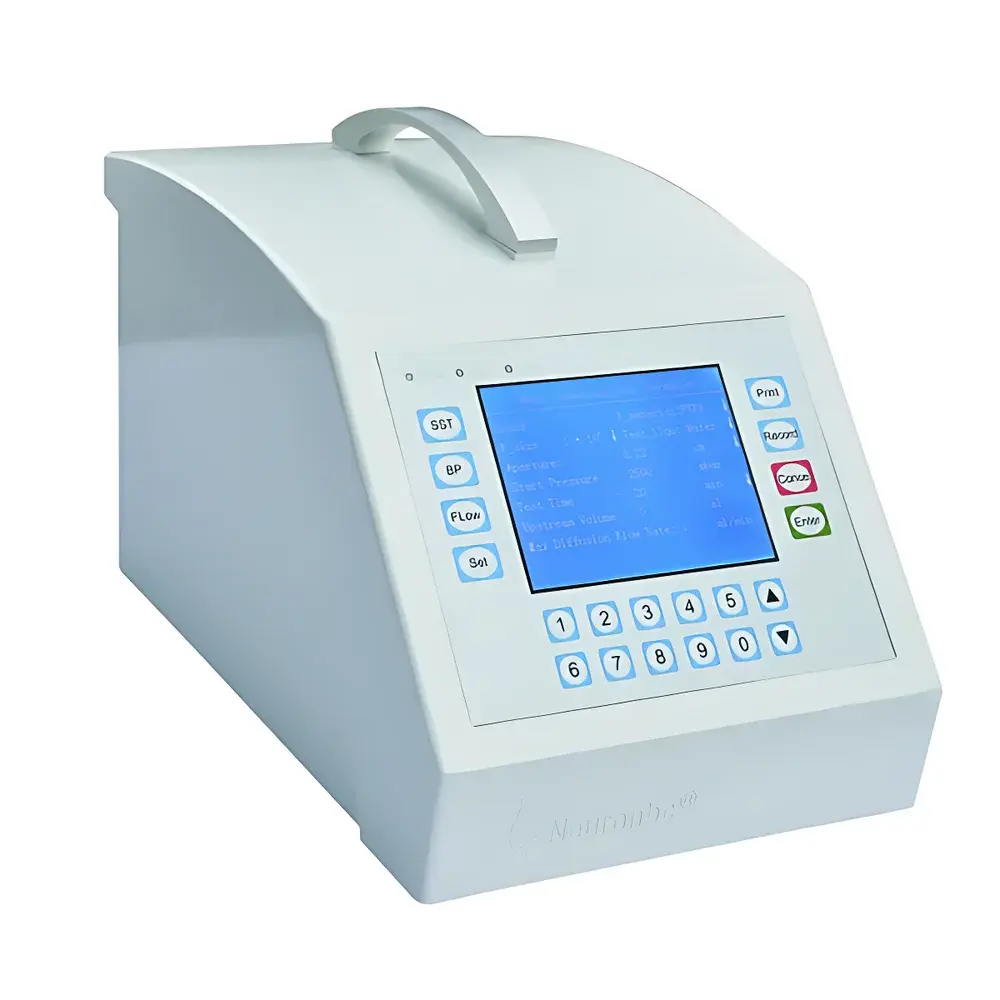
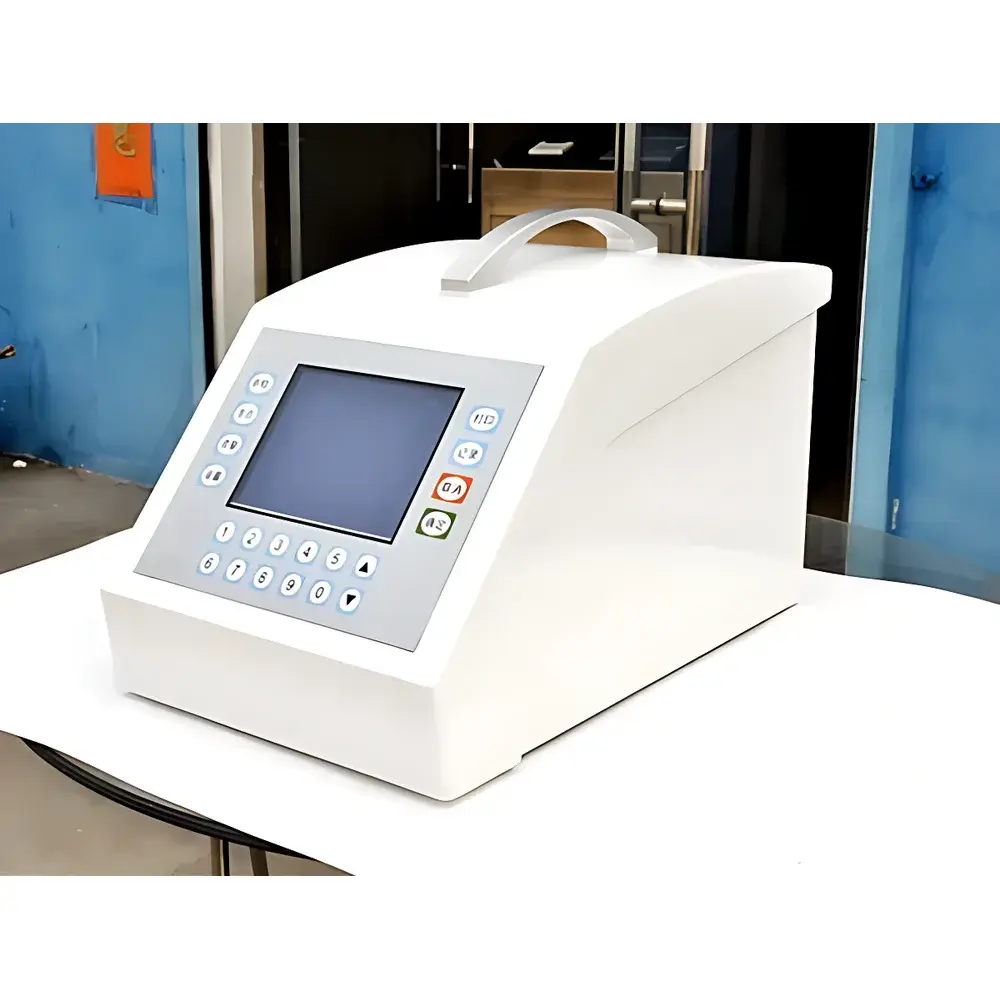
NeuronBC Integtest™ V3.0 Automated Filter Integrity Tester
| Brand | NeuronBC |
|---|---|
| Origin | Beijing, China |
| Model | V3.0 |
| Power Supply | 100–240 V AC, 50/60 Hz, 100 W |
| Dimensions (W×D×H) | 400 × 380 × 235 mm (height includes dual-level chassis design) |
| Test Pressure Range | 100–8000 mbar (1.5–116 psi) |
| Bubble Point Accuracy | ±50 mbar |
| Diffusion Flow Accuracy | ±4% |
| Net Volume Measurement Accuracy | ±4% |
| Test Duration (typical) | Bubble Point: 15 ±2 min |
| Enhanced Bubble Point | 20 ±2 min |
| Diffusion Flow | 10 ±2 min |
| Net Volume Determination | 5 ±2 min |
| Operating Environment | 5–35 °C, 10–80% RH |
| Data Storage | 500 test records with full pressure-time curves |
| Display | 5.7" monochrome TFT LCD with backlight |
| Interface | RS232 serial port |
| Language Support | English, Chinese |
| Compliance | Meets requirements of USP <1207>, ISO 13408-2, ASTM F838-22, and EU GMP Annex 1 for sterile filtration validation |
Overview
The NeuronBC Integtest™ V3.0 Automated Filter Integrity Tester is an engineered solution for quantitative, regulatory-compliant integrity verification of hydrophobic and hydrophilic membrane filters used in aseptic processing. It operates on the physical principles of gas diffusion and capillary flow—measuring the rate of gas permeation through wetted pores (diffusion flow test) and identifying the minimum pressure at which bulk gas breakthrough occurs (bubble point test). Unlike single-parameter bubble point assessment, the V3.0 implements dual-method validation per USP and ISO 13408-2, enabling robust correlation between pore size distribution, wetting state, and microbial retention capability. Its architecture integrates real-time pressure control, high-resolution transducers, and adaptive pneumatic regulation to ensure repeatability across diverse filter configurations—from small-diameter disc membranes to multi-cartridge systems.
Key Features
- Automated upstream volume determination: Eliminates manual input errors by dynamically calculating filter housing volume during test initiation, critical for accurate diffusion flow normalization.
- Dual-core embedded processor with proprietary AI-assisted algorithm suite: Enables adaptive pressure ramping, noise-resistant signal filtering, and automatic endpoint detection for both standard and enhanced bubble point protocols.
- Real-time graphical monitoring: 5.7″ backlit monochrome TFT display renders pressure vs. time curves, flow rate trends, and pass/fail thresholds during active testing.
- Regulatory-grade data governance: All tests generate timestamped, operator-annotated records—including raw sensor outputs, derived parameters, and full test curves—stored locally with tamper-evident indexing.
- Multi-mode operation: Supports diffusion flow, standard bubble point, enhanced bubble point (stepwise pressure hold), and pressure hold (decay) methods in accordance with ASTM F838-22 and EU GMP Annex 1 guidance.
- RS232 serial interface for secure integration into validated laboratory networks, supporting bidirectional communication with LIMS or MES systems under 21 CFR Part 11-compliant software environments.
Sample Compatibility & Compliance
The Integtest™ V3.0 accommodates a broad range of sterile-grade filtration assemblies: disc membranes (Φ25 mm to Φ300 mm), standard cylindrical cartridges (2.5″ to 40″ length, 1–15 elements), capsule filters, mini-cartridges, and vent filters for tank air breathers. Its pressure control system maintains stability within ±0.5% of setpoint across the full 100–8000 mbar range, ensuring reliable performance with low-diffusion hydrophobic PTFE membranes and high-capacity hydrophilic PVDF or PES devices. The instrument’s test methodology satisfies the scientific rationale outlined in USP , ISO 13408-2:2021, and the European Medicines Agency’s reflection paper on filter integrity testing. It supports GLP/GMP audit readiness through built-in electronic signatures, audit trails, and exportable CSV reports traceable to individual test events.
Software & Data Management
The V3.0 includes a Windows-based upper-level software package for remote configuration, batch report generation, and long-term trend analysis. Data files comply with ALCOA+ principles: attributable, legible, contemporaneous, original, accurate, complete, consistent, enduring, and available. Each stored record contains metadata (operator ID, filter ID, lot number, test date/time), calibrated sensor readings, interpolated bubble point values, normalized diffusion flow rates (mL/min @ specified test pressure), and annotated pass/fail logic based on user-defined acceptance criteria. Export functions support PDF, CSV, and XML formats compatible with eDMS and quality management systems. Firmware updates are delivered via signed binary packages to maintain cryptographic integrity.
Applications
This instrument is deployed in regulated biopharmaceutical manufacturing environments for pre-use post-sterilization integrity testing of: (1) liquid sterilizing filters in API and final formulation lines; (2) compressed gas and process air filters supplying isolators, filling lines, and cleanrooms; (3) tank vent filters on purified water and WFI storage vessels; and (4) point-of-use filters installed immediately prior to aseptic connectors or filling nozzles. Its precision and method flexibility make it suitable for both routine QC release testing and formal filter qualification studies required under ICH Q5A and Q5D.
FAQ
Does the V3.0 require manual entry of upstream volume for diffusion flow calculation?
No. The instrument performs an automated upstream volume measurement sequence prior to diffusion flow testing, eliminating operator dependency and reducing risk of calculation error.
Can test results be exported in a format compliant with 21 CFR Part 11?
Yes—when used with the optional validated software module, all electronic records include digital signatures, immutable audit logs, and role-based access controls meeting Part 11 requirements.
Is calibration traceable to national standards?
Calibration certificates are provided annually, with pressure transducers traceable to NIM (National Institute of Metrology, China) or equivalent ISO/IEC 17025-accredited laboratories.
What filter materials are supported?
All common pharmaceutical-grade membranes: polyethersulfone (PES), polyvinylidene fluoride (PVDF), nylon, mixed cellulose ester (MCE), and hydrophobic fluoropolymers including PTFE and modified PTFE.
How is environmental variability mitigated during testing?
Built-in temperature and humidity sensors trigger automatic compensation algorithms for pressure decay calculations, maintaining accuracy across ambient conditions from 5°C to 35°C and 10–80% RH.
Related Products






