
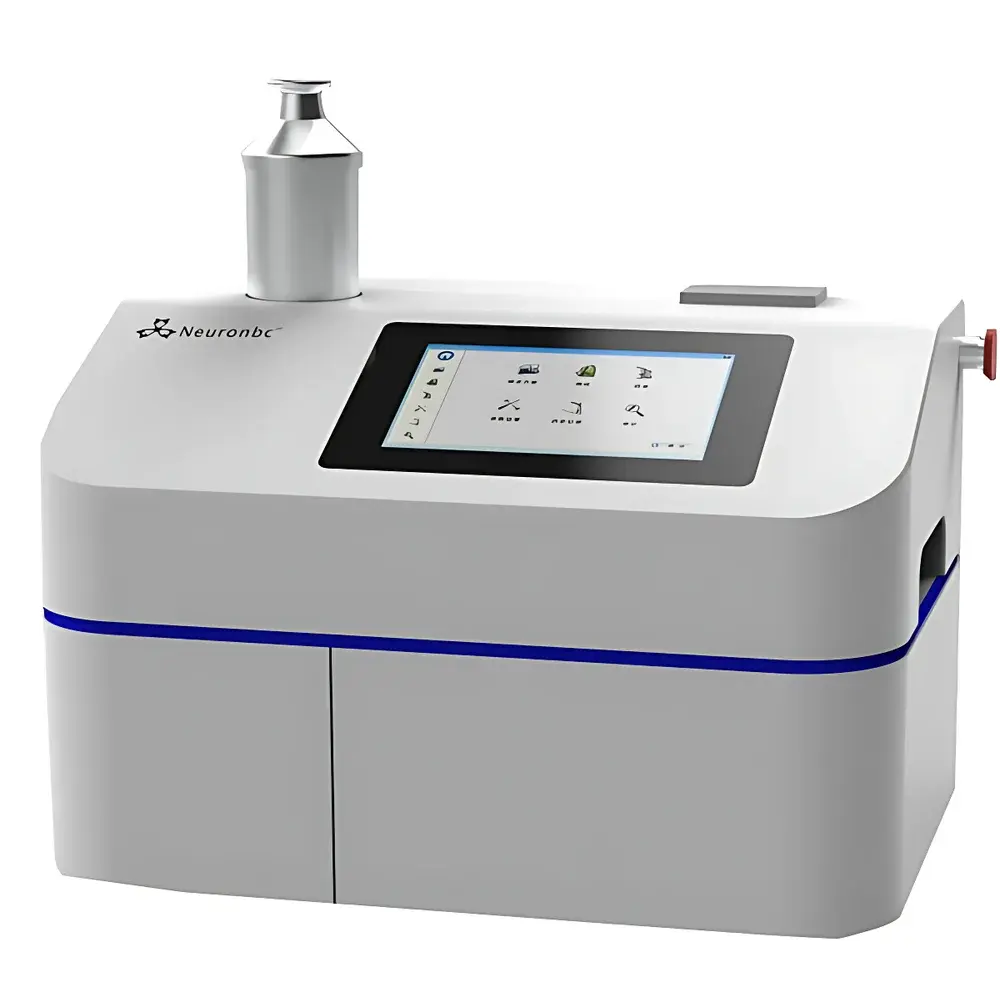
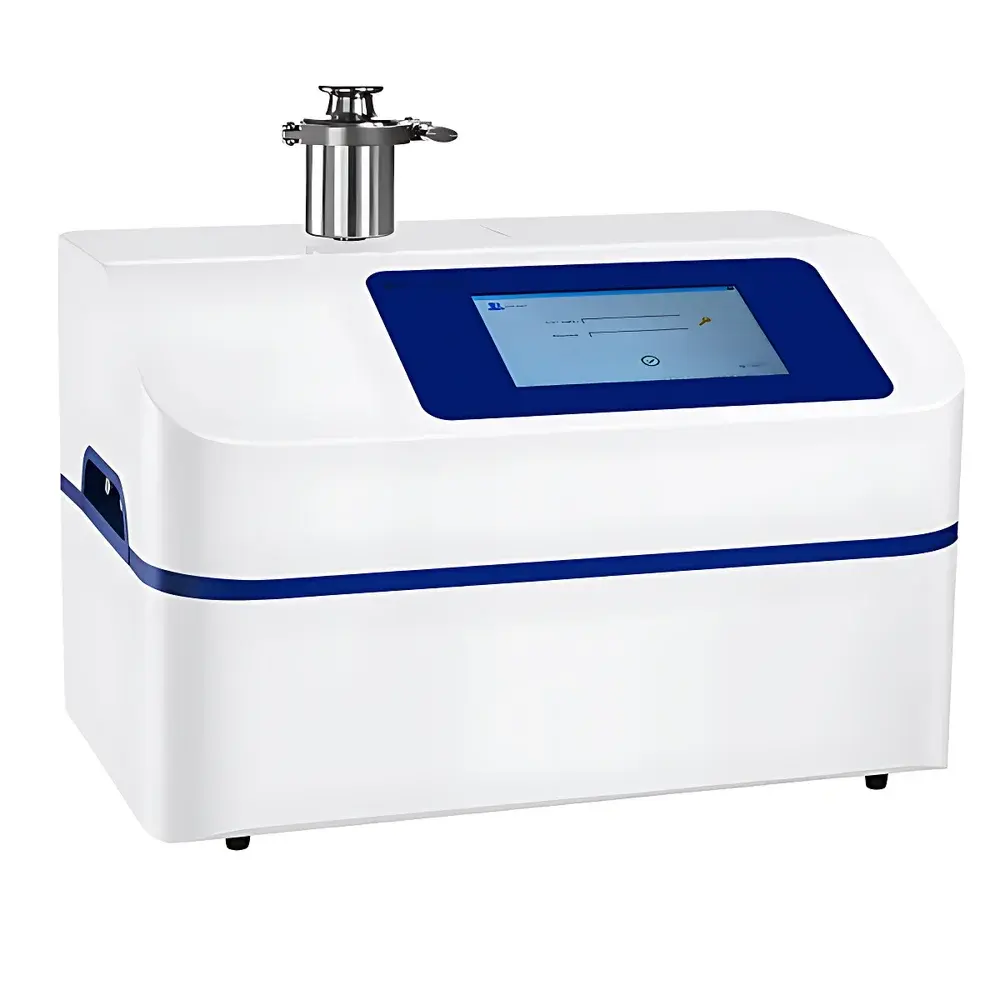
NeuronBC MFT-900 Non-Destructive Package Seal Integrity Tester
| Brand | NeuronBC |
|---|---|
| Origin | Beijing, China |
| Model | MFT-900 |
| Detection Principle | Vacuum Decay / Differential Pressure Method |
| Compliance | USP <1207>, ASTM F2338-22, FDA Guidance on Container Closure Integrity Testing (CCIT) |
| Automation Level | Semi-Automatic |
| Detection Sensitivity | Equivalent to ≥2 µm defect aperture |
| Pressure Range | −0.1 to 1.0 MPa (selectable ranges: −0.1–0.2 MPa / −0.1–0.7 MPa / −0.1–1.0 MPa) |
| Differential Pressure Sensor | ±2 kPa, Accuracy ≤0.5% FS, Resolution: 0.1 Pa |
| Test Pressure Sensor Accuracy | ≤±1% FS |
| Display | 10-inch color capacitive touchscreen |
| Data Storage | ≥5 years audit-trail-enabled event logs & test records |
| User Management | 4-tier role-based access control (RBAC), password-authenticated login |
| Regulatory Support | Full 21 CFR Part 11 compliance (electronic signatures, audit trail, data integrity) |
| Interface Options | Ethernet, USB, RS485, 4–20 mA analog output, 12 V alarm signal |
| Power Supply | AC 100–240 V, 50/60 Hz, ≤200 W |
| Data Export | USB flash drive backup |
| Optional Peripherals | External thermal printer |
Overview
The NeuronBC MFT-900 is a semi-automated, non-destructive package seal integrity tester engineered for pharmaceutical and biotechnology manufacturers requiring robust, regulatory-compliant container closure integrity testing (CCIT). It employs the vacuum decay method—also known as differential pressure decay—to quantitatively assess the hermeticity of rigid and semi-rigid primary packaging systems without compromising product sterility or stability. Unlike probabilistic dye ingress or microbial challenge methods, the MFT-900 delivers objective, quantitative leakage data traceable to calibrated reference leaks, enabling direct correlation between measured pressure decay rate and equivalent defect aperture size (µm). This principle aligns with the physics-based CCIT paradigm endorsed by USP , ASTM F2338-22, and the U.S. FDA’s 2022 Guidance for Industry on CCIT, supporting lifecycle management from development through commercial release.
Key Features
- Vacuum decay-based measurement with high-resolution differential pressure sensing (0.1 Pa resolution, ±2 kPa range, ≤0.5% FS accuracy)
- Automated leak-rate-to-aperture conversion algorithm, generating standardized µm-equivalent defect size reports per test cycle
- Integrated certified reference standard leak (NIST-traceable positive control vial) for daily system suitability verification
- Four-level hierarchical user authentication and role-based access control (RBAC), fully compliant with 21 CFR Part 11 requirements for electronic records and signatures
- Comprehensive audit trail logging—including operator ID, timestamp, parameter changes, test outcomes, and system events—with ≥5 years retention capability
- Modular, top-mounted test chamber design allowing rapid interchange of application-specific fixtures for diverse formats: vials (glass/plastic), syringes (PFS), cartridges, ampoules, blister packs, pouches, BFS/FFS containers, and pressurized metered-dose inhaler (pMDI) systems
- Touchscreen-driven workflow: intuitive navigation, pre-configurable test protocols, one-touch start, and minimal manual intervention (sample loading/unloading only)
- Multi-interface connectivity (Ethernet, USB, RS485) supporting integration into MES/LIMS environments and industrial automation networks
Sample Compatibility & Compliance
The MFT-900 supports a broad spectrum of pharmaceutical primary packaging configurations, including but not limited to: glass and polymer vials (e.g., West Pharma, SCHOTT), prefilled syringes (PFS), cartridge systems, ampoules, aluminum collapsible tubes, foil-laminated pouches, cold-formed blisters, blow-fill-seal (BFS) units, form-fill-seal (FFS) sachets, and pressurized aerosol containers (e.g., columnar pump sprays, bag-on-valve, elastomeric actuator devices). All test methods are validated in accordance with ICH Q5A(R2), ISO 11607-2, and Annex 1 (EU GMP) requirements for sterility assurance. The instrument’s firmware and data handling architecture meet ALCOA+ principles (Attributable, Legible, Contemporaneous, Original, Accurate, Complete, Consistent, Enduring, Available), ensuring data integrity during GLP, GMP, and regulatory inspections.
Software & Data Management
Built-in embedded software provides full lifecycle data governance: automatic timestamping, digital signature capture for critical actions (e.g., method validation, calibration confirmation), and immutable event logging across all operational states. Audit trails include system startup/shutdown, parameter modification history, failed test attempts, and user login/logout sequences. Data export is supported via encrypted USB drives in CSV and PDF report formats, preserving metadata and digital signatures. Optional LIMS integration enables bidirectional data exchange using HL7 or ASTM E1384-compliant messaging. All stored records adhere to 21 CFR Part 11 Subpart B technical controls, including electronic signature validation, password complexity enforcement, and session timeout policies.
Applications
- Final container closure integrity verification prior to market release (batch release testing)
- Stability study support: periodic retesting under accelerated and real-time storage conditions
- Process validation: qualification of sealing equipment (e.g., crimpers, stopper inserters, heat sealers)
- Root cause analysis of package failures during transportation or aging studies
- Method development and transfer for new product introductions (NPI), including sensitivity mapping and limit-of-detection (LOD) determination
- Support for regulatory submissions (e.g., ANDA, BLA, MAA) with fully documented IQ/OQ/PQ protocols and validation reports
FAQ
Does the MFT-900 require helium or tracer gases?
No. It operates exclusively on compressed air or nitrogen, eliminating consumable gas costs and safety hazards associated with flammable or asphyxiant gases.
Can test methods be validated per ICH Q2(R2)?
Yes. The platform supports full method validation—including specificity, accuracy, precision (repeatability and intermediate precision), linearity, range, LOD, and robustness—as required for CCIT in regulated environments.
Is custom fixture design available for novel packaging formats?
Yes. NeuronBC offers engineering consultation and bespoke chamber fabrication services, including CAD-based design review, mechanical prototyping, and performance qualification against client-defined acceptance criteria.
What calibration and maintenance support is provided?
Annual certified calibration of differential pressure sensors and reference leak verification is available through NeuronBC’s ISO/IEC 17025-accredited service center. On-site preventive maintenance contracts include sensor recalibration, leak-path inspection, and firmware updates.
How does the system handle false positives from environmental fluctuations?
The MFT-900 incorporates temperature-compensated pressure transducers and dynamic baseline stabilization algorithms that suppress drift caused by ambient thermal gradients or barometric shifts—ensuring stable baselines over extended test cycles.






