
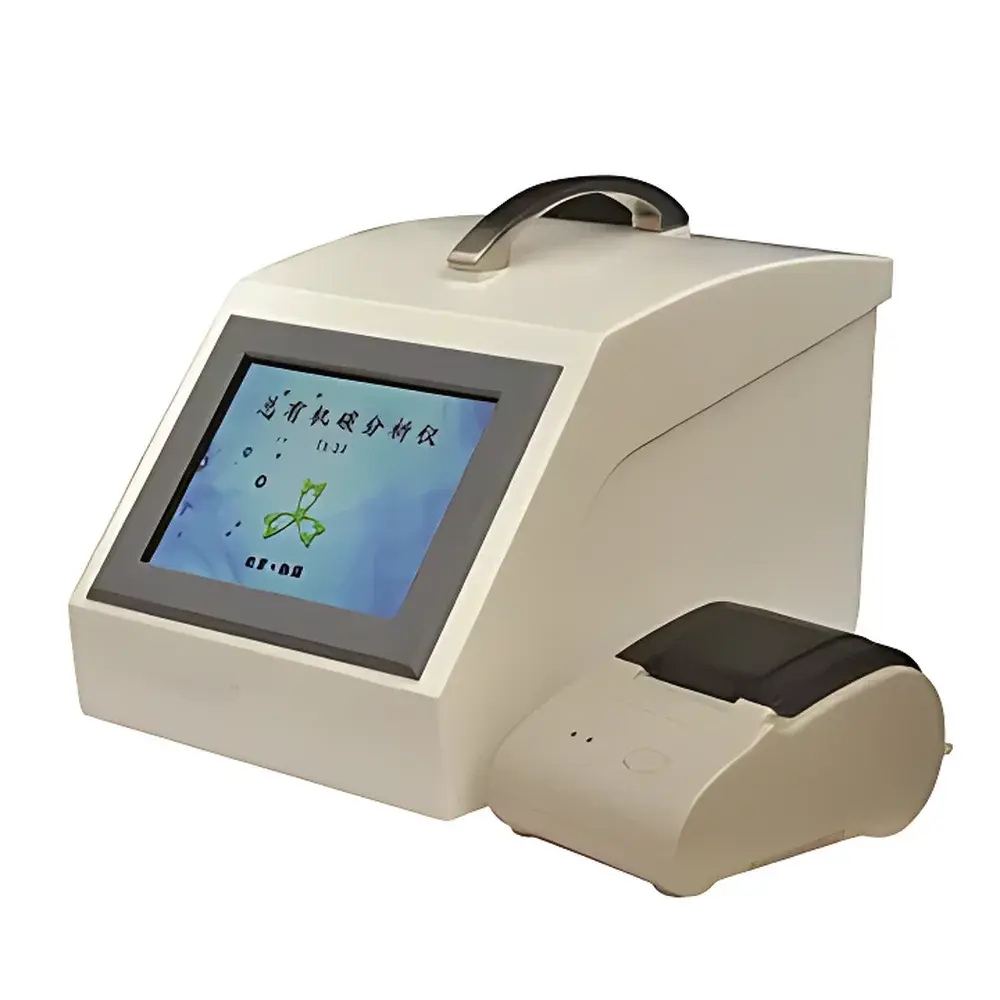
NeuronBC TA-2.0 Total Organic Carbon Analyzer (Online/Offline Dual-Mode)
| Brand | NeuronBC |
|---|---|
| Origin | Beijing, China |
| Model | TA-2.0 |
| Instrument Type | Online/Offline Dual-Mode TOC Analyzer |
| Detection Principle | Direct Conductivity Measurement |
| Oxidation Method | UV Photolysis (185/254 nm) |
| Measurement Range | 0.001–1.0 mg/L (1–1000 ppb) |
| Accuracy | ±3% of reading |
| Resolution | 0.001 mg/L |
| Detection Limit | 0.001 mg/L |
| Repeatability | ±3% RSD |
| Conductivity Detection Range | 0.055–8.000 µS/cm |
| Analysis Time | ≤5 min per cycle |
| Sample Temp. Range | 1–95 °C |
| Ambient Operating Temp. | 5–65 °C |
| Power Supply | 100–240 VAC, 50 Hz, 120 W |
| Dimensions (L×W×H) | 400×240×270 mm |
| Weight | 8.5 kg |
| Data Storage | ≥5000 records |
| Audit Trail | 16-event log with timestamped entries |
| User Access Control | 4-tier role-based authentication |
| Compliance | FDA 21 CFR Part 11, GLP/GMP-ready |
Overview
The NeuronBC TA-2.0 Total Organic Carbon Analyzer is an engineered dual-mode analytical platform designed for rigorous water quality monitoring in regulated and research environments. It operates on the principle of direct conductivity detection following complete oxidation of organic carbon to CO2 via low-pressure ultraviolet (UV) photolysis at 185 nm and 254 nm wavelengths. This oxidation method ensures efficient conversion of non-purgeable organic carbon (NPOC) without requiring chemical reagents or high-temperature combustion—making it ideal for ultra-low TOC applications in pharmaceutical water systems (PW, WFI), semiconductor rinse water, and environmental surface/groundwater monitoring. The instrument supports both online continuous monitoring (up to three sampling points via optional manifold integration) and offline laboratory analysis, enabling seamless transition between process validation, routine QC testing, and investigative analysis—all within a single hardware architecture.
Key Features
- Reagent-free UV photolysis oxidation system with dual-wavelength lamps (185/254 nm) for consistent, low-maintenance carbon mineralization
- Pumpless flow path design eliminates tubing wear, pressure regulation hardware (e.g., back-pressure regulators), and associated calibration drift—enhancing long-term measurement stability and reducing consumables cost
- High-precision mass-flow controlled sample introduction ensures reproducible residence time in the oxidation chamber and detector cell
- Embedded industrial-grade CPU with real-time OS enables deterministic response timing, onboard data processing, and robust multi-tasking for concurrent communication protocols
- Integrated color touchscreen HMI (Human-Machine Interface) with intuitive navigation, real-time trend visualization, and contextual help overlays
- Comprehensive I/O architecture: Ethernet (TCP/IP), RS-232 serial port, digital power output for external solenoid valves or alarms, and USB host port for encrypted U disk-based data export
- Onboard memory stores ≥5,000 complete analytical records with full metadata (timestamp, operator ID, method name, raw conductivity values, calculated TOC)
Sample Compatibility & Compliance
The TA-2.0 is validated for use with purified water (PW), water for injection (WFI), clean steam condensate, municipal drinking water, wastewater effluent, and groundwater samples meeting ISO 8466-2 and USP guidance. Its detection limit of 0.001 mg/L (1 ppb) satisfies stringent pharmacopeial requirements for Grade A/B cleanroom utilities and semiconductor fab ultrapure water (UPW) specifications (SEMI F63). The system’s audit trail functionality captures 16 distinct event types—including method changes, calibration actions, user logins/logouts, and data exports—with immutable timestamps and operator identifiers. Four-tier role-based access control (Administrator, Supervisor, Analyst, Viewer) enforces segregation of duties and fulfills FDA 21 CFR Part 11 Subpart B requirements for electronic records and signatures. All firmware and software revisions are traceable, and configuration settings are protected against unauthorized modification.
Software & Data Management
Data acquisition and reporting are managed through embedded firmware compliant with ASTM D5905-22 and ISO 20674:2016 frameworks. Raw conductivity measurements (0.055–8.000 µS/cm) are digitized at 24-bit resolution and processed using temperature-compensated algorithms per IEC 60746-2. Exported datasets include calibrated TOC concentration (mg/L), conductivity baseline, oxidation efficiency index, and diagnostic flags for lamp intensity decay or flow anomaly detection. U disk exports generate CSV files compatible with LIMS integration and statistical process control (SPC) platforms such as Minitab or JMP. Historical data queries support time-range filtering, operator-specific retrieval, and method-version cross-referencing—facilitating root cause analysis during regulatory audits or deviation investigations.
Applications
- Real-time TOC surveillance in pharmaceutical water distribution loops (PW/WFI) per EU GMP Annex 1 and USP
- Clean-in-place (CIP) and sterilize-in-place (SIP) validation support via offline grab-sample analysis with traceable chain-of-custody
- Environmental compliance monitoring of treated effluent discharge points under EPA Method 415.3 and ISO 8245
- Ultrapure water quality assurance in microelectronics manufacturing (ASTM D5127, SEMI F63)
- Research-grade carbon budgeting in limnological and hydrogeological field studies
- Validation of membrane integrity in RO/EDI systems through TOC breakthrough detection
FAQ
Does the TA-2.0 require acidification or sparging prior to analysis?
No. The instrument employs NPOC methodology by default—samples are acidified and sparged internally within the sealed reaction loop, eliminating manual pretreatment steps and operator variability.
Can the TA-2.0 be integrated into a SCADA or DCS environment?
Yes. Modbus TCP and ASCII-based RS-232 protocols are supported natively; OPC UA integration is available via optional middleware configuration.
What maintenance intervals are recommended for UV lamps and conductivity cells?
UV lamps are rated for ≥12,000 hours of operation; conductivity cells require quarterly cleaning with dilute nitric acid and verification against NIST-traceable KCl standards.
Is method validation documentation provided with the instrument?
Yes. Factory-installed IQ/OQ protocols, system suitability test (SST) templates, and blank correction procedures are included in the delivered documentation package.
How is data integrity preserved during power interruption?
Non-volatile flash memory retains all active measurements and audit events during brownout or blackout conditions; unsaved data is automatically recovered upon reboot.







