
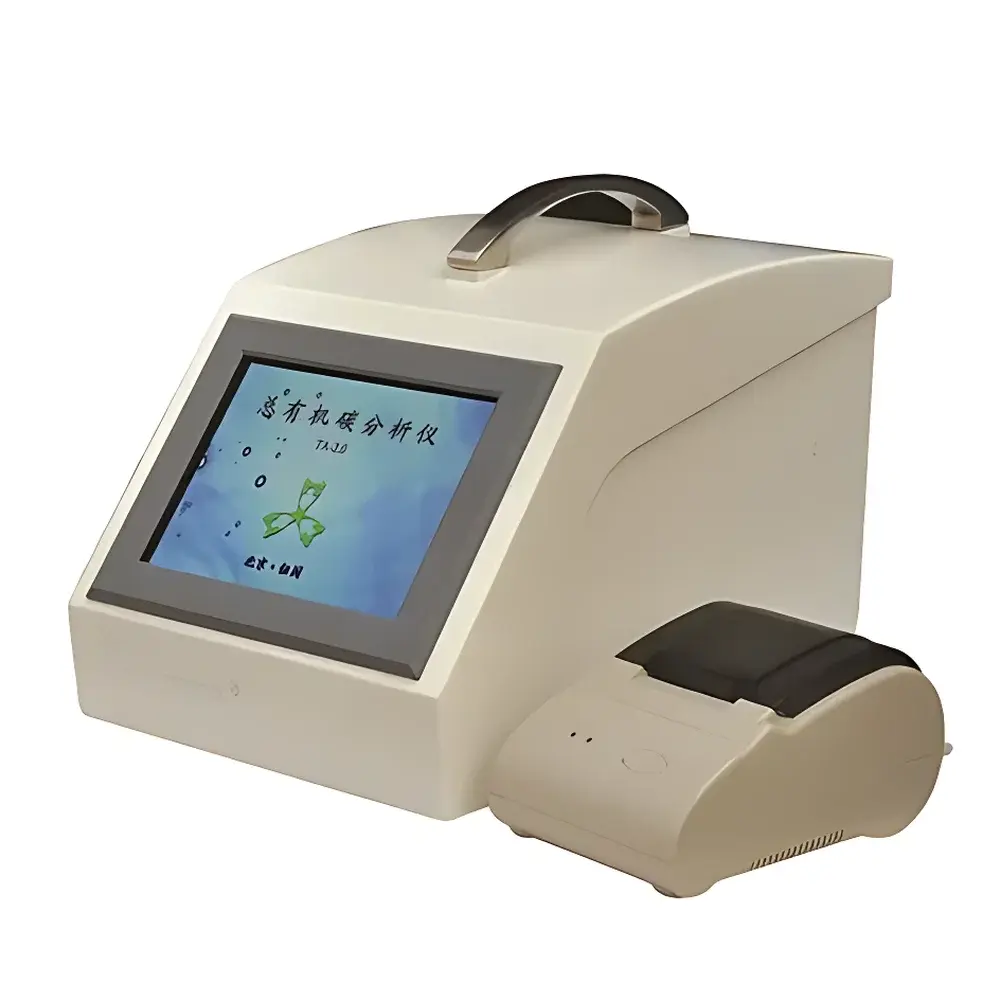
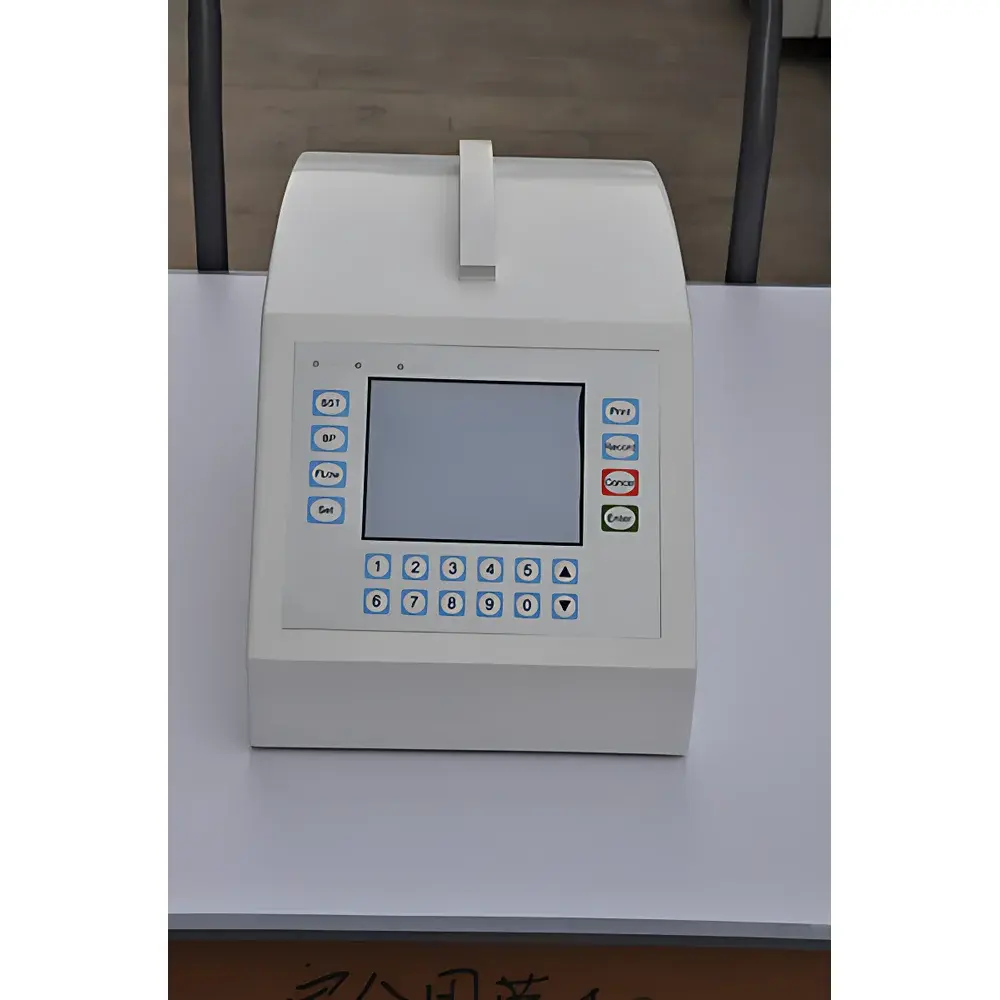
NeuronBC TA-2.0 Total Organic Carbon Analyzer (Online & Offline)
| Brand | NeuronBC |
|---|---|
| Origin | Beijing, China |
| Model | TA-2.0 |
| Detection Principle | Direct Conductivity Method |
| Oxidation Method | UV Photolysis |
| Measurement Range | 1–1000 ppb |
| Accuracy | ±3% |
| Resolution | 1 ppb |
| Detection Limit | 1 ppb |
| Repeatability | ±3% |
| Power Supply | 100–240 VAC, 50 Hz, 120 W |
| Conductivity Range | 0.055–8.000 µS/cm |
| Sample Temp. | 1–95 °C |
| Ambient Temp. | 5–65 °C |
| Data Storage | >5000 records |
| Audit Trail | 16-event log with timestamped queries |
| User Access | 4-tier role-based authentication compliant with FDA 21 CFR Part 11 |
| Display | Color touchscreen |
| Dimensions (L×W×H) | 400 × 240 × 270 mm |
| Weight | 8.5 kg |
Overview
The NeuronBC TA-2.0 Total Organic Carbon Analyzer is a dual-mode analytical instrument engineered for high-fidelity quantification of total organic carbon in aqueous matrices using the direct conductivity detection principle. It operates in both online continuous monitoring and offline laboratory configurations—enabling seamless transition between real-time process surveillance and discrete sample analysis. The system employs ultraviolet (UV) photolysis at 185/254 nm to oxidize non-purgeable organic carbon (NPOC) to CO₂, which dissolves in deionized water to form carbonic acid, thereby altering solution conductivity. This change is measured by a high-stability, temperature-compensated conductivity cell with sub-microsiemens resolution. Designed specifically for regulated pharmaceutical water systems—including purified water (PW), water for injection (WFI), and clean-in-place (CIP) rinse solutions—the TA-2.0 delivers trace-level sensitivity (LOD: 1 ppb as C) and metrological consistency required for USP , EP 2.2.44, and JP 17 compliance.
Key Features
- True dual-mode architecture: switch between online multi-point monitoring (up to three independent sampling lines) and offline batch analysis without hardware modification
- Pumpless fluidic design eliminates peristaltic tubing, pressure regulators, and associated maintenance—reducing carryover risk and improving flow stability across variable backpressures
- Dedicated high-performance CPU with embedded real-time operating system ensures deterministic response timing (<5 min analysis cycle) and synchronized data acquisition
- Integrated 4-tier user authentication framework with encrypted password storage, session timeout, and full audit trail logging (16 configurable event types), satisfying FDA 21 CFR Part 11 electronic record and signature requirements
- Large-capacity non-volatile memory supports >5000 measurement records with timestamp, operator ID, method ID, and raw conductivity values—accessible via on-device color touchscreen or external query
- Modular I/O interface including Ethernet (TCP/IP), RS-232, and isolated digital output ports for integration into DCS, SCADA, or MES platforms
Sample Compatibility & Compliance
The TA-2.0 is validated for use with low-conductivity water streams typical of pharmaceutical manufacturing: PW (≤1.3 µS/cm), WFI (≤1.0 µS/cm), and steam condensate. It accommodates sample temperatures from 1 °C to 95 °C and ambient operating conditions from 5 °C to 65 °C. All wetted components—including the oxidation chamber, conductivity cell, and sample manifold—are constructed from electropolished 316L stainless steel and PFA fluoropolymer to prevent adsorption or leaching. The instrument conforms to ISO 9001 quality management standards during production and supports GLP/GMP documentation workflows through exportable UVC-compliant data packages (CSV/Excel via USB port). Calibration verification follows ASTM D5904-21 protocols using potassium hydrogen phthalate (KHP) reference standards traceable to NIST SRM 1012.
Software & Data Management
Data integrity is maintained through a deterministic firmware architecture that enforces write-once data logging: once recorded, measurement entries cannot be edited or deleted. The embedded audit trail captures operator login/logout events, method parameter changes, calibration actions, alarm triggers, and system errors—with immutable timestamps and user identifiers. Historical datasets are retrievable by date range, operator, or sample ID directly on the 7-inch capacitive touchscreen or exported in FDA-acceptable formats via USB mass storage. Optional OPC UA server module enables secure bidirectional communication with enterprise LIMS or PI System instances, supporting automated report generation and deviation alerting based on configurable thresholds.
Applications
- Continuous TOC surveillance of PW/WFI distribution loops in sterile manufacturing facilities
- Post-sanitization rinse water validation during equipment cleaning cycles (cleaning verification per EU Annex 15)
- TOC trending for root cause analysis of carbon breakthrough in polishing resin beds or membrane filters
- Offline verification of water system component qualification (e.g., distillation column effluent, storage tank outlet)
- Supporting regulatory submissions requiring documented proof of water quality consistency over time (e.g., ANDA, BLA, MAH renewal dossiers)
FAQ
Does the TA-2.0 require carrier gas or chemical oxidants?
No. It uses only UV photolysis (185/254 nm) for oxidation and direct conductivity detection—eliminating dependency on persulfate, ozone, or compressed air.
Can the instrument be integrated into an existing PLC-controlled water system?
Yes. Standard Modbus TCP and ASCII RS-232 protocols are supported; custom protocol mapping is available upon request.
How is calibration verified under GMP conditions?
Calibration verification uses certified KHP standards at 250 ppb and 750 ppb levels; results are stored with operator signature and timestamp in the audit trail.
Is remote diagnostics supported?
Remote firmware updates and diagnostic log retrieval are enabled via secure HTTPS connection with TLS 1.2 encryption.
What maintenance intervals are recommended for routine operation?
UV lamp replacement every 12 months; conductivity cell cleaning every 3 months or after exposure to high-TOC samples (>500 ppb).







