
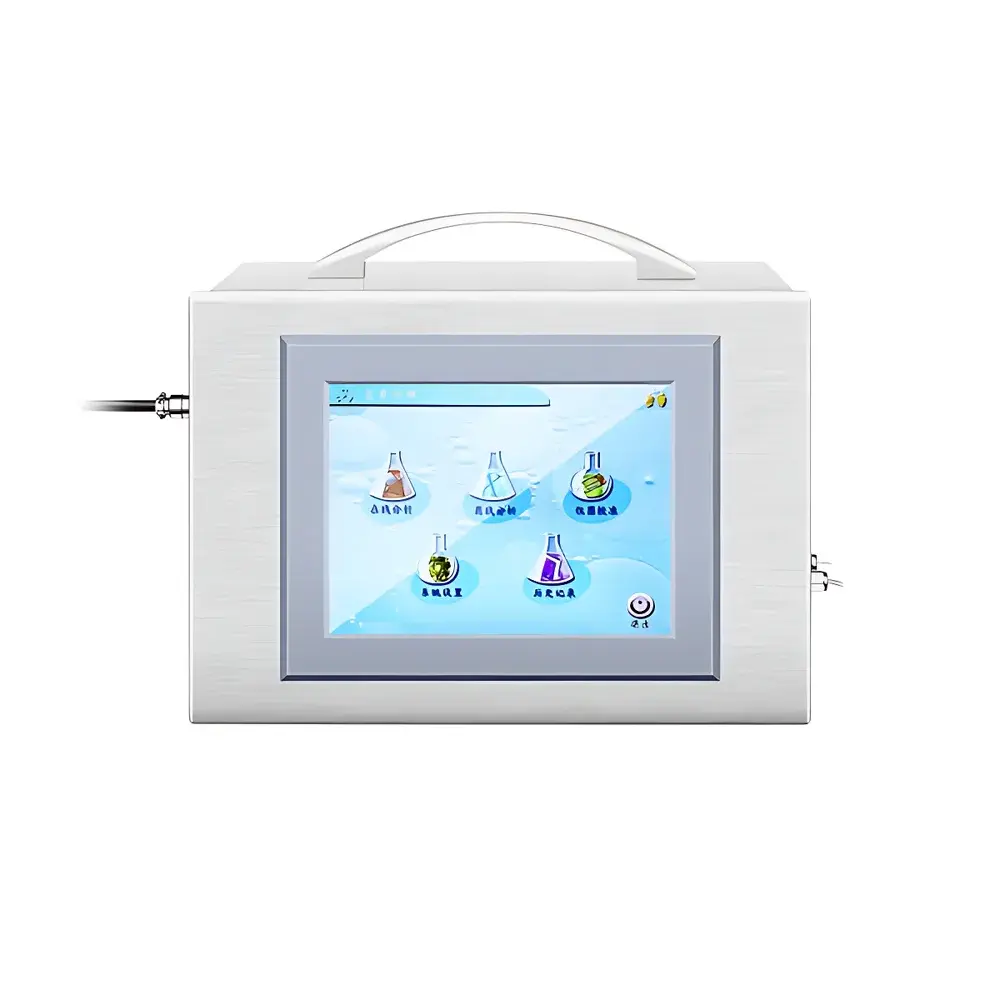
NeuronBC TA-3.0 Online Total Organic Carbon Analyzer
| Brand | NeuronBC |
|---|---|
| Origin | Beijing, China |
| Model | TA-3.0 |
| Instrument Type | Online TOC Analyzer |
| Detection Principle | Direct Conductivity Method |
| Oxidation Method | UV Photolysis (185/254 nm) |
| Measurement Range | 0.001–1.0 mg/L (1–1500 ppb) |
| Accuracy | ±3% of reading |
| Resolution | 0.001 mg/L |
| Detection Limit | 1 ppb |
| Repeatability | ±3% RSD |
| Conductivity Range | 0.055–8.000 µS/cm |
| Response Time | ≤5 minutes |
| Sample Temperature Range | 1–95 °C |
| Ambient Operating Temperature | 5–65 °C |
| Power Supply | 100–240 VAC, 50 Hz, 120 W |
| Data Logging | ≥5000 records |
| Audit Trail | 16-event timestamped log |
| User Access Control | 4-tier role-based authentication (compliant with FDA 21 CFR Part 11) |
| Display | Color touchscreen (7-inch) |
| Dimensions (L×W×H) | 300 × 210 × 250 mm |
| Weight | 8.5 kg |
| Enclosure Material | 304 stainless steel |
| IP Rating | IP54 (splash-resistant) |
Overview
The NeuronBC TA-3.0 Online Total Organic Carbon Analyzer is an engineered solution for continuous, real-time monitoring of organic carbon content in ultrapure water systems. It operates on the direct conductivity detection principle following UV photolytic oxidation — a method standardized in USP , EP 2.2.44, and ASTM D5905. In this process, dissolved organic compounds are oxidized to CO₂ using dual-wavelength (185 nm + 254 nm) ultraviolet light in a quartz reaction coil under controlled residence time. The resulting CO₂ dissolves in deionized water to form carbonic acid, inducing a measurable increase in solution conductivity. This change is quantified via high-stability, temperature-compensated conductivity cells calibrated traceably to NIST-certified standards. Designed specifically for regulated environments, the TA-3.0 delivers consistent performance across pharmaceutical purified water (PW) and water for injection (WFI) loops, semiconductor rinse water lines, and critical clean-in-place (CIP) validation streams.
Key Features
- Stainless steel (304) enclosure rated IP54 — suitable for humid, high-temperature utility corridors and cleanroom support areas
- Modular architecture enabling seamless integration with PLCs, DCS, or SCADA systems via Modbus RTU/TCP or optional Profibus DP
- True online operation with continuous sampling and analysis — no manual injection or calibration required during routine monitoring
- UV oxidation reactor optimized for low carryover and minimal memory effect; validated for <1 ppb system blank and <3% RSD over 24-hour stability testing
- Onboard color touchscreen interface with intuitive navigation, real-time trend graphs, and alarm status visualization
- Comprehensive data integrity framework: 4-level user authentication, electronic signatures, and immutable 16-event audit trail compliant with FDA 21 CFR Part 11 Annex 11 requirements
- Internal data storage for ≥5000 measurement records; exportable via USB flash drive in CSV format for LIMS or QA review
Sample Compatibility & Compliance
The TA-3.0 is validated for use with non-particulate, low-conductivity aqueous matrices including PW, WFI, clean steam condensate, and ultrapure rinse water (UPW). It meets ISO 20977:2019 for online TOC analyzers and supports compliance with pharmacopeial monographs (USP , EP 2.2.44, JP 17 ). Its design accommodates variable flow rates (10–100 mL/min) and pressure ranges up to 6 bar, with integrated backpressure regulation to ensure laminar sample delivery. All wetted parts — including the oxidation coil, conductivity cell, and fluidic path — are constructed from quartz, PFA, and electropolished 316L SS to prevent adsorption or leaching. The analyzer undergoes factory verification per IQ/OQ protocols aligned with GMP Annex 15 and is supplied with a Certificate of Conformance and as-built schematics.
Software & Data Management
Firmware v3.2 includes embedded data handling logic supporting ALCOA+ principles: Attributable, Legible, Contemporaneous, Original, Accurate, Complete, Consistent, Enduring, and Available. Each measurement is time-stamped with UTC synchronization capability and linked to operator ID, method version, and system status flags (e.g., “Oxidation Active”, “Calibration Due”). Historical datasets can be filtered by date range, parameter threshold, or event type (e.g., “High TOC Alert”). Optional NeuronLink™ software provides remote configuration, predictive maintenance alerts (based on lamp hours and cell drift), and automated report generation (PDF/Excel) for internal audits or regulatory submissions. All firmware updates are digitally signed and require dual-authorization approval before installation.
Applications
- Real-time TOC surveillance of PW/WFI distribution loops in pharmaceutical manufacturing facilities (aligned with EU GMP Annex 1 and PIC/S PI 007)
- Monitoring post-purification stages in biotech upstream/downstream processing water systems
- Supporting cleaning validation studies by detecting organic residue carryover in CIP return lines
- Continuous compliance tracking for semiconductor fab UPW supply networks (SEMI F57-0218)
- Environmental discharge monitoring where sub-ppb sensitivity is mandated by local regulatory agencies (e.g., EPA Method 415.3)
- Reference standard verification in metrology labs requiring traceable, low-drift TOC baselines
FAQ
Does the TA-3.0 require periodic re-calibration?
Yes — a two-point conductivity calibration (zero and span) is recommended every 7 days or after maintenance; full system verification using certified TOC standards (e.g., potassium hydrogen phthalate) is required prior to batch release in GMP environments.
Can it operate unattended for extended periods?
Yes — with stable power, ambient temperature control, and uninterrupted sample flow, the TA-3.0 supports >30 days of continuous operation without intervention; UV lamp lifetime is rated at 12,000 hours.
Is external cooling or degassing required?
No — the analyzer includes integrated thermal stabilization and automatic air bubble rejection; it is designed for direct connection to pressurized water loops without ancillary hardware.
How is data integrity ensured during power loss?
All measurements and audit events are written to non-volatile memory before power-down; the system resumes logging within 15 seconds of recovery with no data gap.
What validation documentation is provided?
Factory acceptance test (FAT) report, IQ/OQ protocol templates, calibration certificates for conductivity cell and UV source, and a complete traceability matrix linking hardware IDs to test results.
Related Products







