
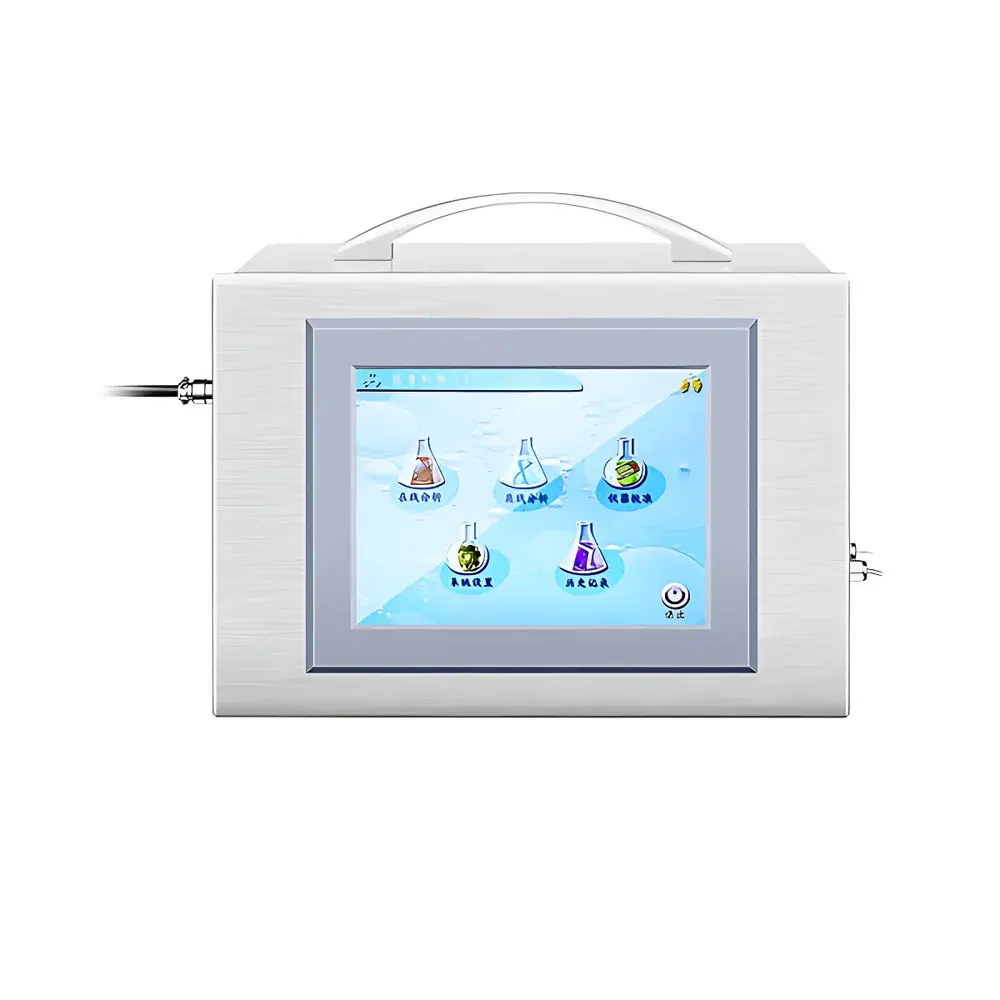
NeuronBC TA-3.0 Online Total Organic Carbon Analyzer
| Brand | NeuronBC |
|---|---|
| Origin | Beijing, China |
| Model | TA-3.0 Online |
| Instrument Type | Online TOC Analyzer |
| Detection Principle | Direct Conductivity Method |
| Oxidation Method | UV Photolysis (185/254 nm) |
| Measurement Range | 1–1000 ppb (as C) |
| Accuracy | ±3% of reading |
| Detection Limit | 1 ppb |
| Resolution | 1 ppb |
| Repeatability | ±3% RSD |
| Conductivity Detection Range | 0.055–8.000 µS/cm |
| Sample Temperature Range | 1–95 °C |
| Ambient Operating Temperature | 5–65 °C |
| Power Supply | 100–240 VAC, 50 Hz, 120 W |
| Data Logging | >5000 records with timestamp |
| Audit Trail | 16-event log with time-stamped user actions |
| User Access Control | 4-tier role-based authentication (compliant with FDA 21 CFR Part 11) |
| Display | Color TFT touchscreen (7-inch) |
| Dimensions (L×W×H) | 300 × 210 × 250 mm |
| Weight | 8.5 kg |
| Enclosure Material | 304 stainless steel |
| IP Rating | IP54 (splash-resistant) |
Overview
The NeuronBC TA-3.0 Online Total Organic Carbon Analyzer is a purpose-built, continuous-monitoring instrument engineered for real-time quantification of total organic carbon in high-purity water systems. It operates on the direct conductivity detection principle following ultraviolet (UV) photolysis oxidation—utilizing dual-wavelength UV lamps (185 nm and 254 nm) to mineralize non-purgeable organic compounds into CO2, which dissolves in the aqueous matrix to form carbonic acid and subsequently alters solution conductivity. This method eliminates the need for chemical oxidants or carrier gases, reducing operational complexity and consumable dependency while maintaining compliance with pharmacopeial requirements including USP , EP 2.2.44, and JP 2.60. Designed for integration into pharmaceutical, biotechnology, and semiconductor facility water distribution networks, the TA-3.0 delivers stable, low-range TOC measurement from 1 ppb to 1000 ppb with trace-level sensitivity and high reproducibility under variable temperature and humidity conditions.
Key Features
- Robust 304 stainless steel enclosure rated IP54 for reliable operation in humid, high-temperature cleanroom and utility corridor environments
- Modular architecture enabling seamless integration with DCS, SCADA, and PLC-based water system controllers via Modbus RTU/TCP or 4–20 mA analog output
- Real-time, continuous analysis with ≤5-minute system response time from sample introduction to validated result
- Four-tier user permission management and time-stamped 16-event audit trail—fully aligned with FDA 21 CFR Part 11 data integrity requirements
- On-device color TFT touchscreen interface supporting intuitive navigation, calibration verification, and alarm configuration
- Internal data storage for ≥5000 measurement records with UTC timestamps; exportable via USB flash drive in CSV format
- No reagent consumption—oxidation achieved solely by UV photolysis, minimizing maintenance intervals and lifecycle cost
Sample Compatibility & Compliance
The TA-3.0 is validated for use with purified water (PW), water for injection (WFI), and clean steam condensate across GMP-regulated facilities. Its measurement range (1–1000 ppb) and sub-ppb detection limit meet the stringent specifications outlined in USP Stage 1 and EU GMP Annex 1 for microbial control monitoring. The instrument’s conductometric detection module is calibrated against NIST-traceable potassium hydrogen phthalate (KHP) standards, and all calibration events—including zero, span, and system suitability checks—are recorded within the embedded audit trail. The device supports routine performance qualification (PQ) per ISO/IEC 17025 and satisfies documentation requirements for regulatory inspections, including FDA pre-approval inspections (PAI) and MHRA audits.
Software & Data Management
Data acquisition, visualization, and reporting are managed through the onboard embedded firmware—no external PC required for routine operation. Historical trends, alarm logs (e.g., flow interruption, UV lamp failure, conductivity drift), and calibration history are accessible directly on the touchscreen or exported for offline review. The system supports configurable alarm thresholds (high/low limits, rate-of-change alerts) with relay outputs for automated shutdown or notification signaling. All electronic records retain immutable metadata (user ID, timestamp, action type), fulfilling ALCOA+ principles (Attributable, Legible, Contemporaneous, Original, Accurate, Complete, Consistent, Enduring, Available). Optional OPC UA server integration enables enterprise-level data federation into MES or LIMS platforms without compromising cybersecurity boundaries.
Applications
- Continuous TOC surveillance at WFI generation points, distribution loops, and point-of-use locations in pharmaceutical manufacturing
- Clean-in-place (CIP) validation support by monitoring organic residue clearance in piping and vessel rinse waters
- TOC trending for predictive maintenance of pretreatment units (e.g., activated carbon beds, RO membranes)
- Compliance monitoring for ISO 14644-1 classified environments where organic contamination impacts particle nucleation
- Support of ICH Q5C stability studies requiring water quality consistency across batch production campaigns
FAQ
Does the TA-3.0 require daily calibration?
No—calibration is performed only during initial commissioning and after major maintenance. System suitability testing (SST) using a 500 ppb KHP standard is recommended prior to each shift or every 24 hours in critical applications.
Can the analyzer operate unattended for extended periods?
Yes. With its solid-state UV lamp design (rated lifetime ≥12,000 hours), sealed conductivity cell, and passive thermal management, the TA-3.0 supports uninterrupted operation for ≥30 days between scheduled preventive maintenance tasks.
Is the instrument compatible with compressed air–driven sample delivery systems?
Yes—provided the sample stream is pressure-regulated to 0.1–0.3 MPa and filtered to ≤1 µm, the TA-3.0 accepts both gravity-fed and pneumatically pressurized inputs without flow controller modification.
How is data integrity ensured during power interruption?
All active measurements and audit events are written to non-volatile memory before power loss. Upon restart, the system resumes logging from the last confirmed record without data gap or timestamp corruption.
What validation documentation is provided with the instrument?
Each unit ships with Factory Acceptance Test (FAT) report, IQ/OQ protocol templates, calibration certificate traceable to NIST, and a complete 21 CFR Part 11 compliance statement signed by NeuronBC Quality Assurance.
Related Products







