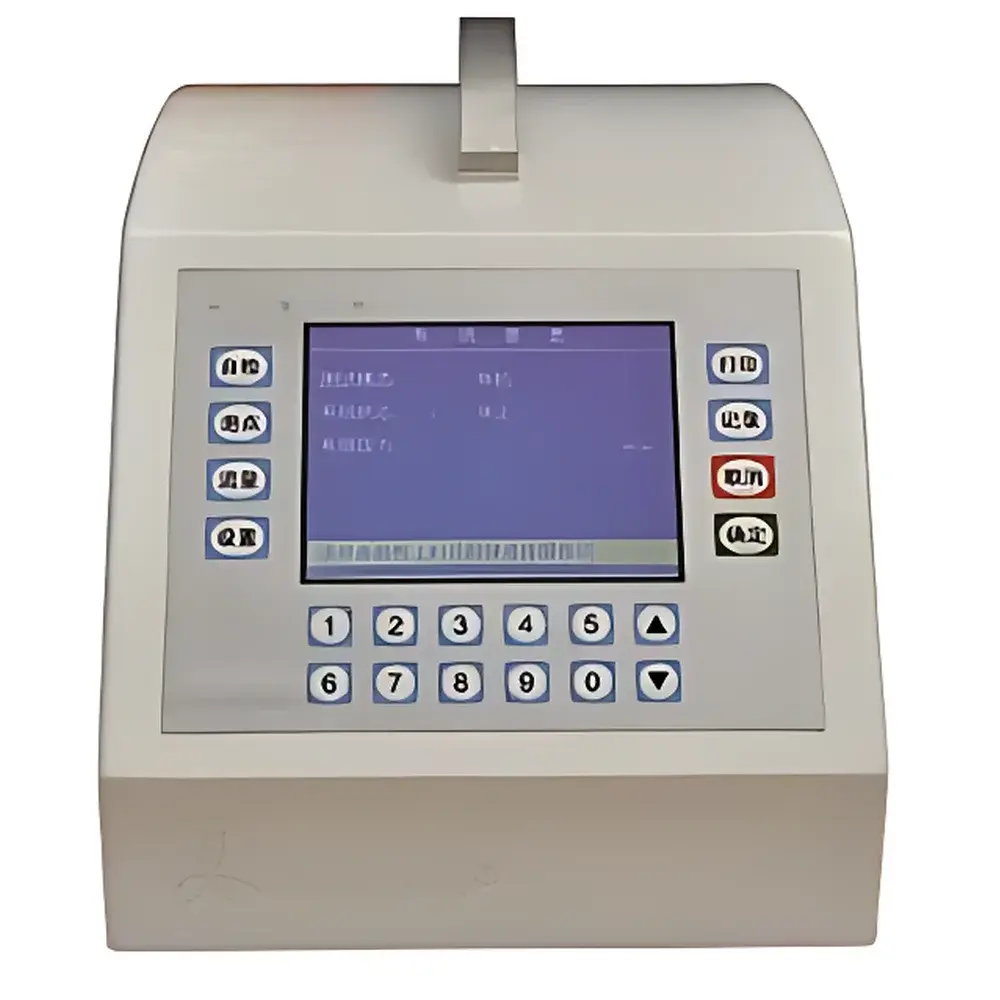
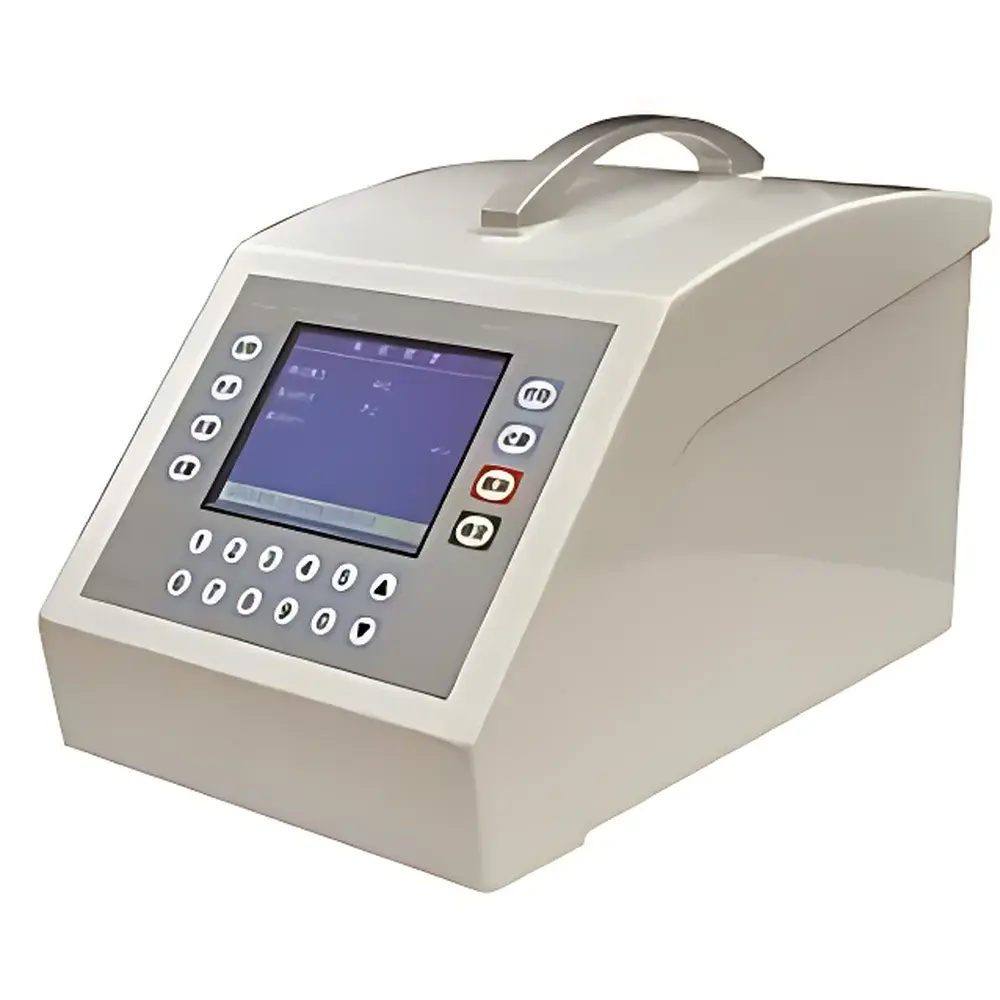
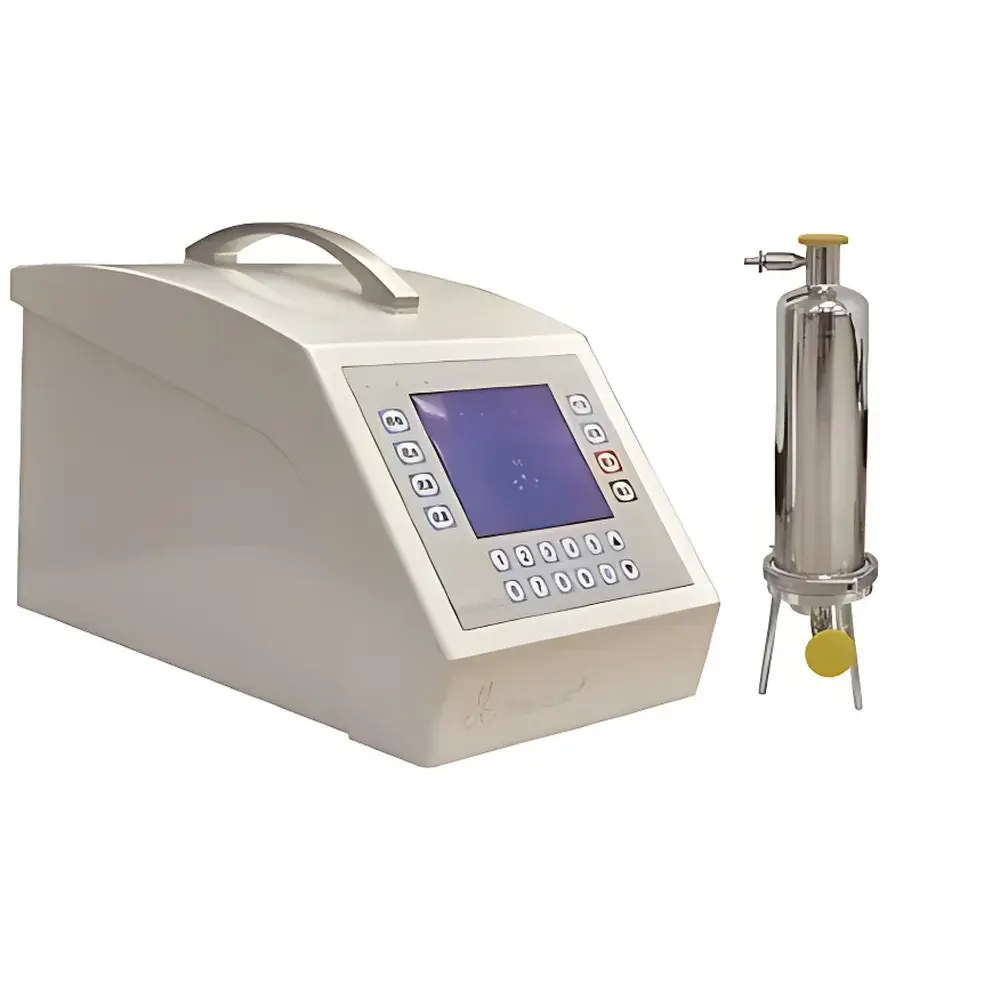
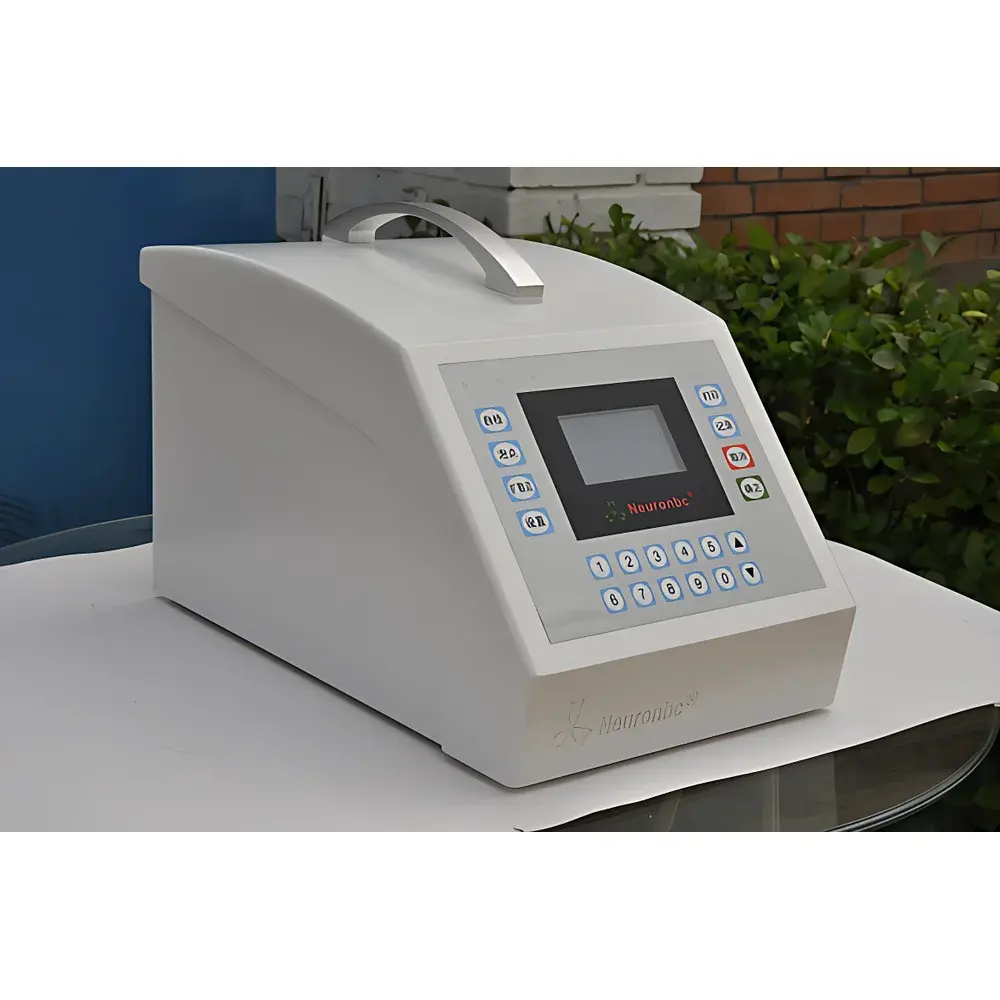
NeuronBC V4.0 Water Intrusion Integrity Tester
| Origin | Beijing, China |
|---|---|
| Manufacturer Type | Distributor |
| Origin Category | Domestic |
| Model | V4.0 |
| Price | USD 5,300 (FOB) |
| Power Supply | 100–240 VAC, 50 Hz, 120 W |
| Operating Pressure Range | 100–8000 mbar |
| Test Accuracy | Bubble Point ±50 mbar |
| Bubble Point Range | 590–6900 mbar |
| Diffusion Flow Range | 1–180 mL/min |
| Water Intrusion Range | 0.01–30 mL/min |
| Display | 5.7″ monochrome TFT LCD with backlight |
| Data Storage | 500 test records |
| Interface | RS232 serial port |
| Language Support | English & Chinese |
| Operating Modes | Online & Offline |
| Environmental Class | ISO Class B or better |
| Weight | 7.5 kg |
| Dimensions (L×W×H₁×H₂) | 400 × 240 × 270 × 220 mm |
| Relative Humidity | 10–80% RH |
| Ambient Temperature | +5 °C to +40 °C |
Overview
The NeuronBC V4.0 Water Intrusion Integrity Tester is a fully automated, regulatory-compliant instrument engineered for quantitative integrity verification of hydrophobic membrane filters used in sterile pharmaceutical manufacturing. It implements three primary ASTM- and ISO-aligned test methods—Bubble Point, Diffusion Flow (Forward Flow), and Water Intrusion—enabling comprehensive pre-use, post-use, and periodic validation per both EU Pharmacopoeia (EP) Chapter 5.6 and Annex 1 requirements, as well as current U.S. FDA and WHO GMP guidelines. Unlike conventional air-based tests, the Water Intrusion method leverages the capillary pressure principle: water is forced into hydrophobic pores only above a critical pressure threshold, allowing direct correlation between measured intrusion volume and largest pore size without wetting the membrane. This eliminates false positives from surface moisture or filter conditioning artifacts, making it especially suitable for integrity testing of vent filters, compressed gas filters, and other non-aqueous process streams where traditional aqueous bubble point testing is impractical or prohibited.
Key Features
- Automated gas dosing control with real-time upstream volume compensation—ensures consistent pressure ramp rates and eliminates operator-induced variability during bubble point and diffusion flow measurements.
- Integrated upstream volume calibration routine: measures actual system dead volume prior to each test cycle, improving reproducibility of diffusion flow results by correcting for compressibility effects in high-pressure applications.
- Dual-mode operation support: validated for both offline (benchtop) and online (in-situ) configurations via compatible process manifold interfaces—facilitating integration into SIP/CIP validation protocols.
- 5.7″ monochrome TFT LCD with adjustable backlight provides high-contrast readability under cleanroom lighting conditions; intuitive menu navigation supports rapid method selection and parameter configuration.
- Onboard thermal microprinter delivers immediate hard-copy documentation compliant with ALCOA+ principles—each printout includes timestamp, operator ID (if entered), test method, parameters, raw data, pass/fail status, and audit trail reference.
- RS232 serial interface enables bidirectional communication with LIMS or MES platforms; supports export of full test datasets—including time-stamped pressure decay curves—for 21 CFR Part 11–compliant electronic record retention.
Sample Compatibility & Compliance
The NeuronBC V4.0 accommodates a broad range of hydrophobic filter formats including disc membranes (Φ25–300 mm), standard cartridges (2.5″–40″, up to 15-core configurations), capsule filters, mini-cartridges, and flat-sheet filters. Its pressure range (100–8000 mbar) and precision flow measurement (0.01 mL/min resolution) meet the technical thresholds required for validating 0.2 µm and 0.1 µm PTFE, PVDF, and polypropylene membranes per ISO 13408-2 and ASTM F838-22. The instrument’s firmware embeds built-in logic checks aligned with EP 5.6 decision trees, automatically flagging out-of-specification trends such as excessive diffusion flow at sub-bubble-point pressures. All test reports include metadata fields necessary for GLP/GMP audits—including user login traceability, instrument ID, calibration due date, and environmental monitoring stamps.
Software & Data Management
Firmware v4.0 incorporates an embedded audit trail module compliant with FDA 21 CFR Part 11 Annex 11 expectations: all critical actions—including method edits, parameter overrides, and result approvals—are time-stamped, user-logged, and non-erasable. Historical data storage retains 500 complete test records locally, each containing raw pressure vs. time arrays, calculated flow rates, and annotated pass/fail determinations. Export functionality supports CSV and PDF formats; optional PC-based software (NeuronLink Suite) adds trend analysis, multi-instrument fleet management, and automated report generation for annual requalification dossiers. Language switching between English and Chinese is supported without firmware reload, enabling seamless deployment across multinational manufacturing sites.
Applications
- Pre-use integrity testing of sterilizing-grade air and gas filters in bioreactor and filling line ventilation systems.
- Post-use validation of final product filters in aseptic processing suites—particularly where aqueous challenge media are incompatible with product residues.
- Periodic integrity verification of HVAC terminal HEPA/ULPA housings and compressed air distribution networks.
- Water intrusion testing of hydrophobic vent filters in lyophilizer chambers and buffer preparation tanks.
- Supporting risk-based filter lifecycle management per ICH Q5D and PDA TR26 frameworks.
FAQ
Does the NeuronBC V4.0 support 21 CFR Part 11-compliant electronic signatures?
Yes—the instrument’s firmware enforces role-based access control, electronic audit trails, and immutable record storage. Optional NeuronLink Suite adds digital signature workflows for test approval and release.
Can it validate multi-core cartridge assemblies without disassembly?
Yes—its pressure control architecture and upstream volume compensation algorithm accommodate complex flow paths typical of stacked or parallel-core configurations up to 15 elements.
Is calibration traceable to national standards?
All factory calibrations are performed using NIST-traceable pressure transducers and mass flow meters; calibration certificates include uncertainty budgets and are issued per ISO/IEC 17025 requirements.
What environmental classifications does it meet for cleanroom use?
The unit is rated for ISO Class B environments per EU GMP Annex 1; its sealed enclosure and low particulate emission profile allow safe operation inside Grade C background areas.
How frequently must the internal volume calibration be repeated?
Upstream volume verification is executed automatically before every test cycle; no manual recalibration is required unless hardware modifications occur.