
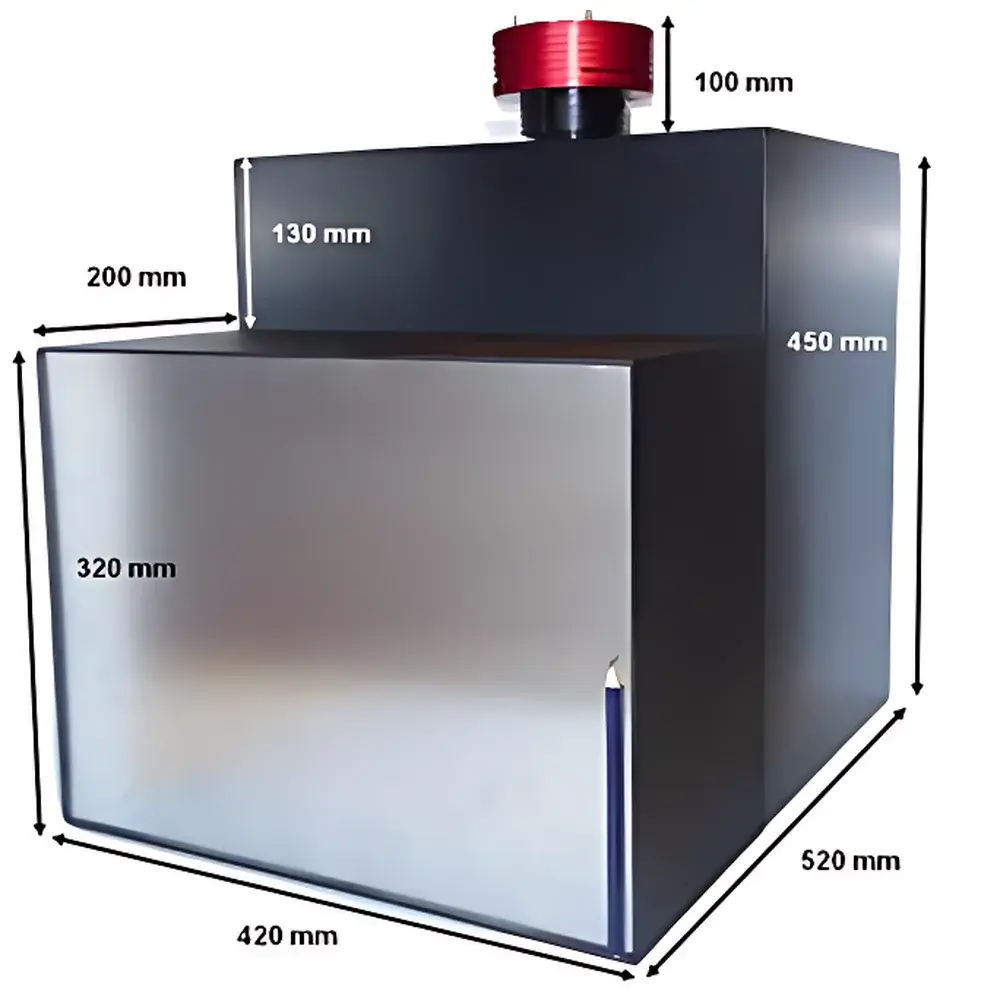
NeutronOptics Fast Neutron Imaging Camera
| Origin | France |
|---|---|
| Manufacturer Type | Distributor |
| Origin Category | Imported |
| Model | Neutronoptics |
| Pricing | Upon Request |
Overview
The NeutronOptics Fast Neutron Imaging Camera is a purpose-built, high-sensitivity scientific imaging system engineered for real-time and time-integrated radiography and tomography with fast (epithermal to MeV-range) neutrons. Unlike conventional X-ray or thermal neutron cameras, this system leverages optimized scintillator–lens–CCD coupling architecture to deliver high spatial resolution while maintaining exceptional signal-to-noise ratio under low-flux beam conditions. It operates on the principle of indirect detection: fast neutrons interact with a hydrogen-rich or gadolinium-doped scintillator screen (e.g., ZnS:Ag/LiF or plastic scintillators), generating visible photons that are relayed via a high-aperture, achromatic lens onto a deep-cooled, large-pixel CCD sensor. The camera is not based on microchannel plate (MCP) or CMOS-based direct-conversion technologies; rather, it exploits mature, low-noise astronomical-grade CCD readout techniques adapted for neutron beamline environments. Designed for integration at spallation sources, reactor-based facilities, and compact accelerator-driven neutron generators, it supports both on-axis beam monitoring and off-axis pinhole or coded-aperture imaging geometries.
Key Features
- Large-pixel, back-illuminated CCD sensor with Peltier cooling (−30 °C typical operating temperature) to suppress dark current and enable long exposure accumulation (seconds to minutes)
- High-numerical-aperture (NA > 0.8), color-corrected, neutron-beam-compatible lens assembly—free of UV-absorbing coatings or IR-blocking filters that attenuate scintillation light
- Modular scintillator interface supporting interchangeable screens (e.g., 6LiF/ZnS:Ag for thermal/epithermal neutrons; EJ-212 plastic for fast neutrons) with mechanical alignment reference points
- Real-time preview capability at reduced resolution (≥5 fps) for beam alignment, sample positioning, and optical diagnostics—compatible with standard GigE Vision or Camera Link interfaces
- Robust mechanical housing rated for vacuum proximity (10⁻³ mbar ambient tolerance) and radiation-hardened front-end electronics (tested up to 10⁴ Gy total ionizing dose)
- No proprietary firmware lock-in: native support for common scientific acquisition libraries (e.g., DCAM, Spinnaker SDK) and compatibility with EPICS IOC and Tango device servers
Sample Compatibility & Compliance
The camera is compatible with a wide range of sample geometries—from mm-scale engineering components to meter-scale cultural heritage objects—when used with appropriate collimation and source–detector geometry. It meets essential safety and operational requirements for installation in regulated neutron facilities, including compliance with IEC 61000-6-2 (immunity) and IEC 61000-6-4 (emissions). While not certified to ISO 9001 as a standalone product (as NeutronOptics functions as a specialized OEM supplier), all delivered systems include full traceable calibration reports for gain, linearity, and spatial uniformity, aligned with ISO/IEC 17025 guidelines. The design adheres to ALARA principles for operator safety and integrates seamlessly with facility-level interlock systems via TTL-compatible trigger I/O. No internal radioactive sources or hazardous materials are incorporated.
Software & Data Management
Acquisition and preprocessing are supported through open-source and vendor-neutral platforms: NeutronOptics provides native drivers for Python (via PyTango or pypylon), MATLAB Image Acquisition Toolbox, and LabVIEW. Raw frame data are saved in HDF5 or TIFF formats with embedded metadata (exposure time, lens f-number, scintillator type, timestamp, beam energy estimate). Optional software modules include real-time flat-field correction, centroid-based beam centroid tracking, and export-ready DICOM wrappers for cross-platform tomographic reconstruction pipelines (e.g., TomoPy, ASTRA Toolbox). Audit trails and user-access logs can be enabled to satisfy GLP/GMP-aligned workflows where required—though FDA 21 CFR Part 11 compliance is implemented only upon customer-specific configuration and validation protocol agreement.
Applications
- Fast neutron radiography of hydrogenous materials (e.g., explosives detection, fuel cell membrane hydration mapping, polymer composite defect analysis)
- Beamline diagnostics: real-time visualization of neutron beam profile homogeneity, shutter synchronization verification, and monochromator crystal surface inspection via pinhole projection
- Time-resolved neutron imaging for dynamic processes (e.g., water ingress in concrete, lithium diffusion in battery electrodes, combustion front propagation)
- 3D neutron tomography at resolutions down to ~50 µm (system-limited, dependent on collimation ratio and source size)
- Education and training: portable deployment at university neutron labs due to compact footprint (<350 mm × 250 mm × 180 mm) and low power consumption (<45 W)
FAQ
Is this camera suitable for thermal neutron imaging?
Yes—when paired with appropriate thermal neutron converters (e.g., 6LiF/ZnS:Ag screens) and moderated beamlines. However, its primary optimization targets epithermal and fast neutron spectra.
What is the maximum frame rate for full-resolution acquisition?
Typically 0.1–0.5 Hz at full 2048 × 2048 resolution with 16-bit depth; higher rates (up to 5 Hz) are achievable using region-of-interest (ROI) readout or binning modes.
Does the system include radiation shielding?
No—shielding must be provided by the host facility per local safety regulations. The camera housing itself is not a radiation shield but is designed for mounting behind primary collimators or within shielded enclosures.
Can I integrate this camera into an existing EPICS-based control system?
Yes—NeutronOptics supplies documented EPICS IOC source code and ADCore-compliant areaDetector drivers for seamless integration.
Is remote operation supported over WAN?
Yes—via secure SSH tunneling or TLS-encrypted HTTP API endpoints; remote diagnostics and firmware updates are supported without on-site technician presence.




