
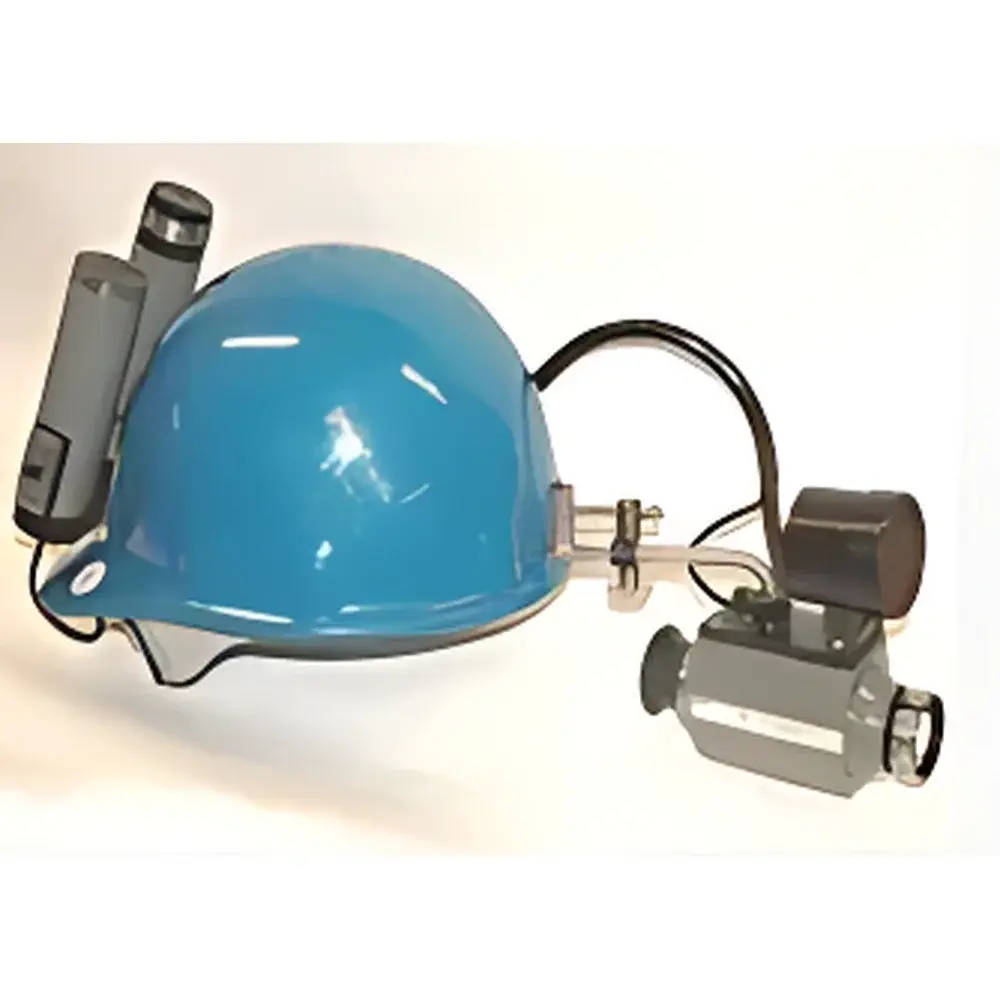
Newopto Helmet-Mounted Infrared Viewer
| Brand | FJW |
|---|---|
| Origin | USA |
| Manufacturer Type | Authorized Distributor |
| Import Status | Imported |
| Model | Newopto 85050A / 85050A-5 / 85051A / 85051A-5 |
| Spectral Sensitivity | 350–1350 nm / up to 1550 nm |
| Displayed Regions | Near-UV, Visible, Near-IR |
| Peak Spectral Sensitivity | 800 nm |
| Focal Range | 4 inches to infinity |
| Resolution | 70 line pairs per millimeter |
| Field of View | 40° |
| Magnification | ~1:1 |
| Lens | Custom Infragon 25 mm, f/1.0 |
| Optional IR Illuminator | Incandescent source with 780 nm long-pass filter |
Overview
The Newopto Helmet-Mounted Infrared Viewer is an optoelectronic imaging device engineered for real-time, hands-free visualization of near-infrared (NIR) and short-wave infrared (SWIR) radiation in the 350–1550 nm spectral band. Unlike thermal imagers operating in the mid- or long-wave IR, this viewer detects reflected or emitted NIR/SWIR light—enabling observation of laser beams (e.g., 808 nm, 980 nm, 1064 nm, 1550 nm), covert illumination, fiber optic emissions, and semiconductor inspection tasks under ambient or low-light conditions. Its core optical architecture integrates a high-transmission Infragon f/1.0 lens with a Gen II+ or Gen III image intensifier tube (depending on model variant), optimized for peak quantum efficiency at 800 nm. The system operates on the principle of photon amplification: incident photons strike a photocathode, generate photoelectrons, accelerate through a microchannel plate (MCP), and produce a visible phosphor output viewable through an eyepiece. This electro-optical conversion enables detection of low-intensity NIR sources without cryogenic cooling or digital post-processing latency.
Key Features
- Helmet-integrated ergonomic design with adjustable headband and counterbalance weight distribution for extended operational use (≥2 hours continuous wear)
- Interchangeable model configurations: 85050A series optimized for 350–1350 nm; 85050A-5 and 85051A-5 variants extend sensitivity to 1550 nm via enhanced photocathode coating and spectral filter stack
- Fixed-focus optical path calibrated from 4 inches to optical infinity—no manual focusing required during dynamic field use
- 70 lp/mm resolution at center field ensures clear discrimination of laser spot profiles, fiber end-face defects, and alignment fiducials
- 40° full field of view provides situational awareness while maintaining sufficient angular resolution for precision targeting
- Optional integrated infrared illuminator (incandescent lamp + 780 nm long-pass filter) enables active NIR imaging in total darkness without compromising eye safety or inducing visible glare
- Ruggedized aluminum housing rated IP54 for dust and water resistance; compliant with MIL-STD-810G for shock, vibration, and thermal cycling
Sample Compatibility & Compliance
The viewer is compatible with any non-coherent or coherent light source emitting within its spectral response window—including diode lasers, LED arrays, superluminescent diodes (SLDs), and broadband incandescent/NIR lamps. It supports qualitative and semi-quantitative assessment of beam presence, divergence, mode structure, and spatial uniformity. Device compliance includes RoHS 2011/65/EU, CE marking for electromagnetic compatibility (EN 61326-1), and conformity with ANSI Z87.1-2020 for impact-resistant optics. While not classified as medical or diagnostic equipment, its optical design adheres to ISO 10110-7 standards for surface quality and wavefront error control in intensifier-coupled viewing systems. No calibration certificate is supplied by default; however, optional NIST-traceable spectral responsivity verification is available upon request for GLP-aligned laboratory documentation.
Software & Data Management
This is a purely analog, real-time optical viewing instrument—no onboard digital imaging sensor, firmware, or software interface is included. Output is visual only, delivered directly to the user’s retina via phosphor screen projection. Consequently, it requires no drivers, operating system compatibility, or cybersecurity configuration. For documentation purposes, users may pair the viewer with external digital cameras (e.g., silicon-based NIR-sensitive CMOS sensors) mounted coaxially or via beam-splitter adapters. All such integration workflows fall outside the scope of factory support but are routinely implemented in laser safety audits, fiber optic network commissioning, and university optics teaching labs. Audit trails, electronic records, or 21 CFR Part 11 compliance are not applicable—consistent with its classification as a passive observation aid rather than a regulated measurement instrument.
Applications
- Laser alignment and beam profiling in industrial material processing (e.g., Nd:YAG, fiber laser, diode-pumped solid-state systems)
- Fiber optic network troubleshooting: identification of breaks, bends, connector contamination, and splice losses at 850/1310/1550 nm windows
- Defense and security: detection of NIR-illuminated surveillance targets, night vision interoperability testing, and anti-counterfeit document verification
- Academic research: undergraduate and graduate instruction in photonics, optoelectronics, and laser physics laboratories
- Semiconductor wafer inspection: visualization of IR-transparent substrates (e.g., Si, GaAs) and sub-surface defects using 1064 nm illumination
- Biomedical optics: preclinical NIR fluorescence guidance during small-animal imaging setup and surgical navigation prototype development
FAQ
Does this viewer require batteries or external power?
Yes—the intensifier tube requires a regulated 3.0 V DC supply (provided via integrated lithium-ion battery pack with ≥8-hour standby life and hot-swap capability).
Can it be used with Class 4 lasers?
No—direct exposure to collimated Class 4 laser radiation will permanently damage the photocathode and phosphor screen. Always use appropriate OD-rated laser safety filters upstream of the viewer.
Is eye relief adjustable?
Yes—eyepiece diopter adjustment range is −5 to +5 dpt to accommodate uncorrected or corrected vision without requiring additional eyewear.
What is the typical lifetime of the image intensifier tube?
Rated minimum operational life is 15,000 hours at nominal gain settings; actual longevity depends on cumulative exposure dose and storage conditions per MIL-STD-750E Test Method 1070.
Can multiple viewers be synchronized for stereo imaging?
Not natively—the system has no timing interface or synchronization port. Stereo NIR observation requires custom mechanical rigging and independent calibration of inter-pupillary distance and parallax correction.



