
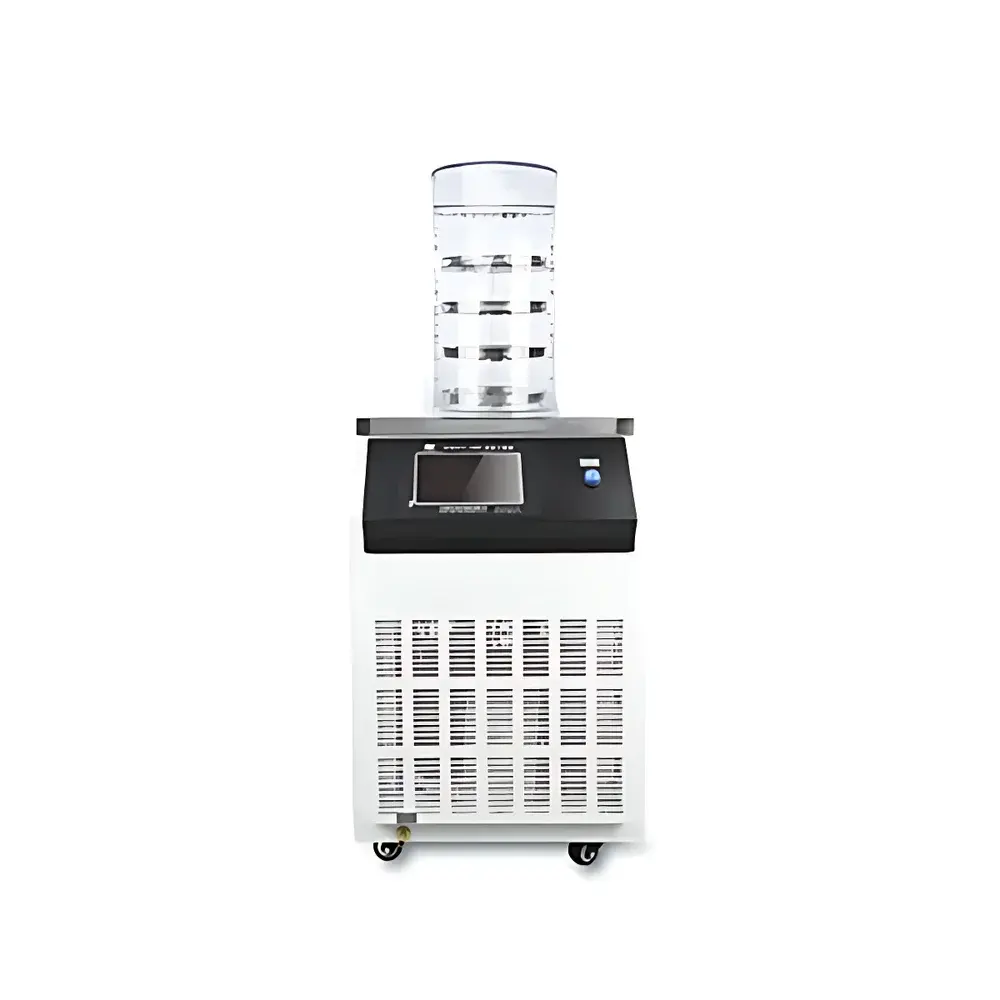
Ningbo Scientz SCIENTZ-12ND/A Benchtop Manifold Freeze Dryer with Heated Shelf and Vacuum Control
| Brand | Ningbo Scientz |
|---|---|
| Origin | Zhejiang, China |
| Manufacturer Type | OEM/ODM Producer |
| Instrument Type | Manifold-Style Freeze Dryer with Heated Shelf |
| Freeze-Drying Area | 0.12 m² |
| Ultimate Vacuum (Empty Chamber) | ≤5 Pa |
| Condensate Capacity | 3 kg/24 h |
| Cold Trap Temperature (Empty) | ≤−56 °C |
| Dimensions (L×W×H) | 590 × 460 × 400 mm + 440 mm (Chamber Height) |
| Compressor | Imported High-Efficiency Single-Stage or Optional Dual-Stage Cascade (−80 °C Capable) |
| Control System | 7-inch True-Color Touchscreen with Embedded Industrial OS |
| Heating System | 36 V Silicone Rubber Heated Shelf with PID Temperature Control |
| Chamber Material | One-Piece Molded Polycarbonate (Optically Transparent, Corrosion-Resistant, Leak-Tight) |
| Vacuum Interface | Standard KF-25 Flange |
| Data Management | Onboard Curve Storage, USB Export, PC-Compatible Software with Audit Trail Support |
Overview
The Ningbo Scientz SCIENTZ-12ND/A is a benchtop manifold freeze dryer engineered for precision, reproducibility, and operational flexibility in academic, governmental, and early-stage biopharmaceutical laboratories. It operates on the fundamental principle of lyophilization—sublimation of frozen solvent (typically water) under deep vacuum without passing through the liquid phase. This process preserves labile biological structures—including proteins, nucleic acids, enzymes, viral particles, and probiotic cultures—by minimizing thermal degradation, oxidation, and conformational collapse. The SCIENTZ-12ND/A integrates a heated shelf system with programmable ramp-hold temperature profiles, enabling controlled primary and secondary drying stages. Its −56 °C cold trap (standard) or optional −80 °C cascade configuration ensures efficient vapor capture across diverse eutectic points, while the polycarbonate drying chamber provides real-time visual monitoring of ice sublimation and cake morphology—critical for empirical process development.
Key Features
- Heated shelf system with 36 V low-voltage silicone rubber heating elements and PID-controlled temperature regulation (±0.5 °C accuracy), supporting systematic optimization of drying cycles.
- One-piece molded optical-grade polycarbonate chamber—chemically inert, shatter-resistant, and fully transparent—enabling unobstructed observation of sample state transitions during lyophilization.
- 7-inch true-color industrial touchscreen interface with embedded real-time operating system; supports multi-curve storage (≥100 protocols), USB data export, and timestamped event logging.
- Imported high-efficiency refrigeration compressor (single-stage standard; dual-stage cascade available for −80 °C operation), delivering rapid cooldown and stable cold trap performance under load.
- Intelligent vacuum management: vacuum pump activation is interlocked with cold trap temperature (pump engages only when trap reaches setpoint), extending pump service life and reducing oil contamination risk.
- Optional accessories include KF-25 vacuum oil mist filter, automatic pressure differential valve (prevents backstreaming), eutectic point tester, and wide-mouth manifold with eight standard 24/29 ground-glass ports compatible with international lyophilization vials and stopper-sealed flasks.
Sample Compatibility & Compliance
The SCIENTZ-12ND/A accommodates a broad spectrum of sample formats—including serum vials, cryotubes, petri dishes, and custom containers—via its open manifold design and adjustable shelf height. It is routinely deployed for lyophilizing aqueous-based formulations containing proteins (e.g., monoclonal antibodies, recombinant enzymes), vaccines (live-attenuated and subunit), microbial cultures (bacteria, yeast, bacteriophages), plant extracts, soil suspensions, and nanomaterial dispersions. While not certified to ISO 22000 or FDA 21 CFR Part 11 out-of-the-box, its data logging architecture supports GLP/GMP-aligned workflows when paired with validated SOPs and third-party audit trail software. All electrical components comply with IEC 61010-1 safety standards; vacuum and refrigeration systems adhere to ISO 8573-1 (compressed air purity) and EN 60335-1 (household and similar electrical appliances) requirements.
Software & Data Management
Data integrity is maintained via an onboard industrial embedded OS that records time-stamped values for chamber pressure, cold trap temperature, shelf temperature, and elapsed cycle time at user-defined intervals (1–60 sec). Each freeze-drying run generates a binary log file (.fdl) containing full parameter history, alarm events, and operator annotations. Files are exportable via USB 2.0 to Windows-based PCs running Scientz’s proprietary LyoView desktop application—capable of overlaying multiple curves, calculating drying rates, exporting CSV reports, and generating PDF summaries compliant with internal QA documentation requirements. Optional firmware upgrades support CSV metadata embedding (operator ID, batch number, material ID) and basic electronic signature functionality for regulated environments.
Applications
This system serves as a scalable platform for method development prior to pilot- or production-scale lyophilization. It is widely adopted in university life science departments for preserving viral stocks and primary cell lines; in food science labs for stabilizing probiotics and anthocyanin-rich botanicals; in environmental testing facilities for preparing soil and sludge matrices for heavy metal analysis; and in pharmaceutical R&D for screening excipient compatibility and collapse temperature (Tc) of protein formulations. Its heated shelf capability makes it especially suitable for developing secondary drying protocols for amorphous biologics requiring residual moisture control below 1.5% w/w. Regulatory researchers use it to generate stability-indicating data per ICH Q5C guidelines.
FAQ
What is the maximum batch capacity for vial-based lyophilization?
The manifold configuration supports up to eight standard 24/29 vials (e.g., 20 mL scintillation vials or 30 mm diameter serum bottles); total loaded mass should not exceed 1.2 kg to maintain uniform drying kinetics.
Can the SCIENTZ-12ND/A be used for non-aqueous solvents?
It is optimized for water-based systems; organic solvents (e.g., tert-butanol, ethanol) require custom cold trap liners and modified vacuum protocols—not recommended without engineering consultation.
Is remote monitoring supported?
No native Ethernet or Wi-Fi module is included; however, USB-exported logs can be ingested into LIMS or SCADA platforms via script-based automation.
What maintenance intervals are recommended for the vacuum pump?
Oil change every 500 operating hours; inlet filter replacement every 200 hours; annual calibration of pressure transducer and PT100 shelf sensors by authorized service technician.
Does the system meet any international quality standards?
The unit complies with CE marking directives (EMC 2014/30/EU, LVD 2014/35/EU) and RoHS 2011/65/EU; full ISO 13485 or GMP qualification requires site-specific validation per Annex 15 of EU GMP Guidelines.



