
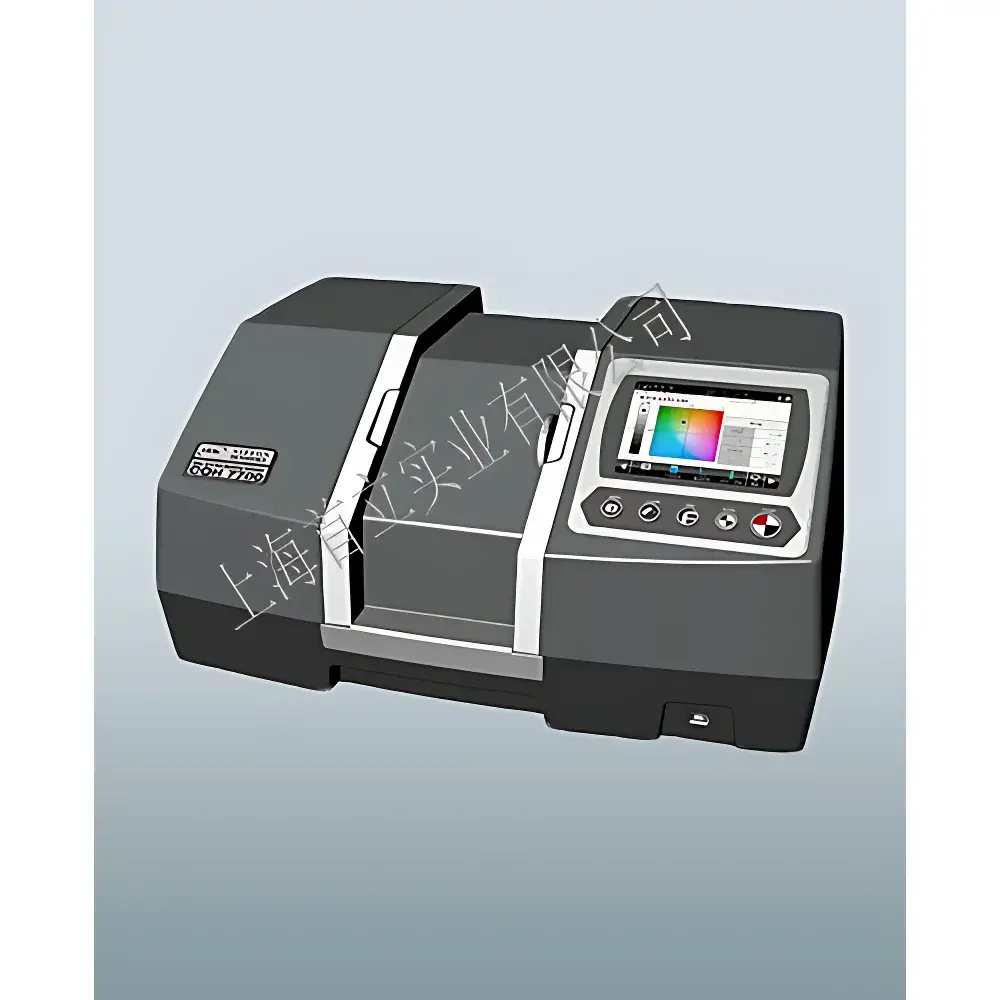
NIPPON DENSHOKU COH7700 Spectrophotometric Haze and Color Meter
| Brand | NIPPON DENSHOKU |
|---|---|
| Origin | Japan |
| Model | COH7700 |
| Product Type | Spectrophotometric Color & Haze Analyzer |
| Instrument Type | Benchtop |
| Optical Geometry | d/8° integrating sphere |
| Light Source | White LED |
| Spectral Range | 400–700 nm |
| Repeatability | ΔE*ab ≤ 0.03 |
| Integrating Sphere Diameter | Ø150 mm |
| Measurement Principle | Dual-beam, post-dispersion spectrophotometry |
| Detector | Silicon photodiode array |
| Display | 5.7-inch color TFT LCD |
| Measurement Time | ~5 s (color only), ~10 s (simultaneous color + haze) |
| Sample Compartment | Open-type sliding drawer (120 mm × 120 mm) |
| Compliance Standards | ASTM D1003, ASTM D5386, ASTM D6166, ISO 13468, ISO 14782, JIS K7136, JIS K7361-1, JIS Z8722, GB/T 2410, GB/T 6324.6 |
Overview
The NIPPON DENSHOKU COH7700 is a benchtop spectrophotometric haze and color meter engineered for high-precision, multi-parameter optical characterization of transparent and translucent materials. Utilizing dual-beam, post-dispersion spectrophotometry with a Ø150 mm integrating sphere and white LED illumination, the COH7700 simultaneously quantifies spectral transmittance (400–700 nm at 10 nm intervals), CIE colorimetric values (XYZ, L*a*b*, L*C*h*, Yxy), haze (Haze %), total transmittance (Tt), diffuse transmittance (Td), and regular transmittance (Tr). Its d/8° optical geometry complies with JIS Z 8722 (0°/diffuse) for color and JIS K 7361-1 / JIS K 7136 for haze—enabling traceable, standards-aligned evaluation of visual appearance attributes critical in quality control for polymers, films, pharmaceutical water, cosmetic bases, and petroleum derivatives.
Key Features
- Dual-function capability: Simultaneous acquisition of full-spectrum colorimetric data and ASTM/ISO-compliant haze metrics in a single measurement cycle (~10 s).
- Large open sliding sample compartment (120 mm × 120 mm) with adjustable height; accommodates standard cuvettes (up to 100 mm pathlength), flat sheets, and irregular specimens without repositioning.
- White LED light source ensures stable spectral output over time, eliminating lamp aging drift and reducing calibration frequency versus tungsten-halogen sources.
- Integrated support for multiple illuminants (A, C, D65, F6, F8, F10) and observer angles (2° and 10°), enabling cross-standard comparability and regulatory reporting per ISO/CIE conventions.
- Onboard color difference calculation using ΔE*ab, ΔE*94, ΔE00, and CMC (l:c) formulas, with user-definable tolerance limits and pass/fail判定 logic based on L*a*b* or ΔL*Δa*Δb* components.
- Optional APHA, Gardner, Saybolt, and ASTM color scale modules for petroleum and chemical product grading—fully compliant with ASTM D1209, D1500, D156, and D6166.
Sample Compatibility & Compliance
The COH7700 supports liquid, film, sheet, and molded resin samples across diverse industrial sectors. Its large sample chamber accepts 20 mm micro-cuvettes (optional), standard 10 mm–100 mm pathlength cuvettes, and free-standing plates up to 120 mm × 120 mm. The instrument’s optical design satisfies key international test methods including ASTM D1003 (haze and transmittance of transparent plastics), ISO 13468-1/-2 (plastic film haze), ISO 14782 (glass haze), JIS K 7136 (transparency/haze of plastics), and GB/T 2410 (Chinese national standard for transparency testing). For regulated environments, raw spectral data, metadata (date/time, operator ID, instrument serial number), and measurement conditions are exportable in CSV format—supporting audit-ready documentation under GLP and GMP frameworks.
Software & Data Management
All measurements are displayed in real time on a 5.7-inch color TFT LCD with customizable views: spectral curves, CIELAB vector plots, chromaticity diagrams (CIE 1931 x,y), hue-chroma-lightness (HCL) maps, and deviation overlays against reference standards. Up to 100 reference spectra and 400 sample records can be stored internally. USB port enables direct data export—including full spectral arrays, calculated indices, and test parameters—to external drives or PCs. Optional PC software provides advanced statistical analysis (mean, SD, CPK), batch reporting, SPC charting, and integration with LIMS via standardized CSV schema. No proprietary binary formats are used—ensuring long-term data accessibility and interoperability.
Applications
- Quality assurance of optical films, PET bottles, acrylic panels, and polycarbonate lenses where haze and yellowness index directly impact end-user perception.
- Pharmaceutical water testing (PW, WFI) per USP and EP 2.2.39, monitoring clarity and absence of particulate-induced scattering.
- Petroleum product grading (lubricants, solvents, fuels) using APHA, Gardner, and Saybolt scales in accordance with ASTM D1209/D1500/D156.
- Cosmetic formulation development—quantifying color stability of aqueous emulsions, toners, and serums under accelerated aging protocols.
- Regulatory submissions requiring documented compliance with ISO 9001, IATF 16949, or FDA 21 CFR Part 11 (when paired with validated software and access controls).
FAQ
Does the COH7700 meet FDA 21 CFR Part 11 requirements for electronic records?
The hardware supports audit-trail-capable data export (CSV with timestamps, operator IDs, and instrument metadata). Full Part 11 compliance requires implementation of validated PC software with electronic signatures, role-based access, and secure archive—available as an optional package.
Can the instrument measure both haze and color on opaque or semi-transparent samples?
No—it is optimized for transparent and translucent materials. Opaque samples require reflectance-mode instruments (e.g., COH400 series) with d/8° geometry and diffuse illumination.
Is calibration verification traceable to NIST or JCSS standards?
Yes. NIPPON DENSHOKU provides factory-calibrated ceramic and glass standards certified to JCSS (Japan Calibration Service System); optional NIST-traceable transmittance and color standards are available upon request.
What is the maximum sample thickness the COH7700 can accommodate?
The open sliding chamber allows vertical clearance up to 120 mm; however, optical path integrity requires samples to remain within the defined beam aperture—typically ≤50 mm for optimal signal-to-noise ratio in haze mode.
How often is recalibration recommended under routine use?
Annual recalibration is advised for ISO/IEC 17025-accredited labs. Daily verification using supplied air and white reference tiles is required to maintain measurement continuity per ASTM E308 and JIS Z 8722 protocols.




