
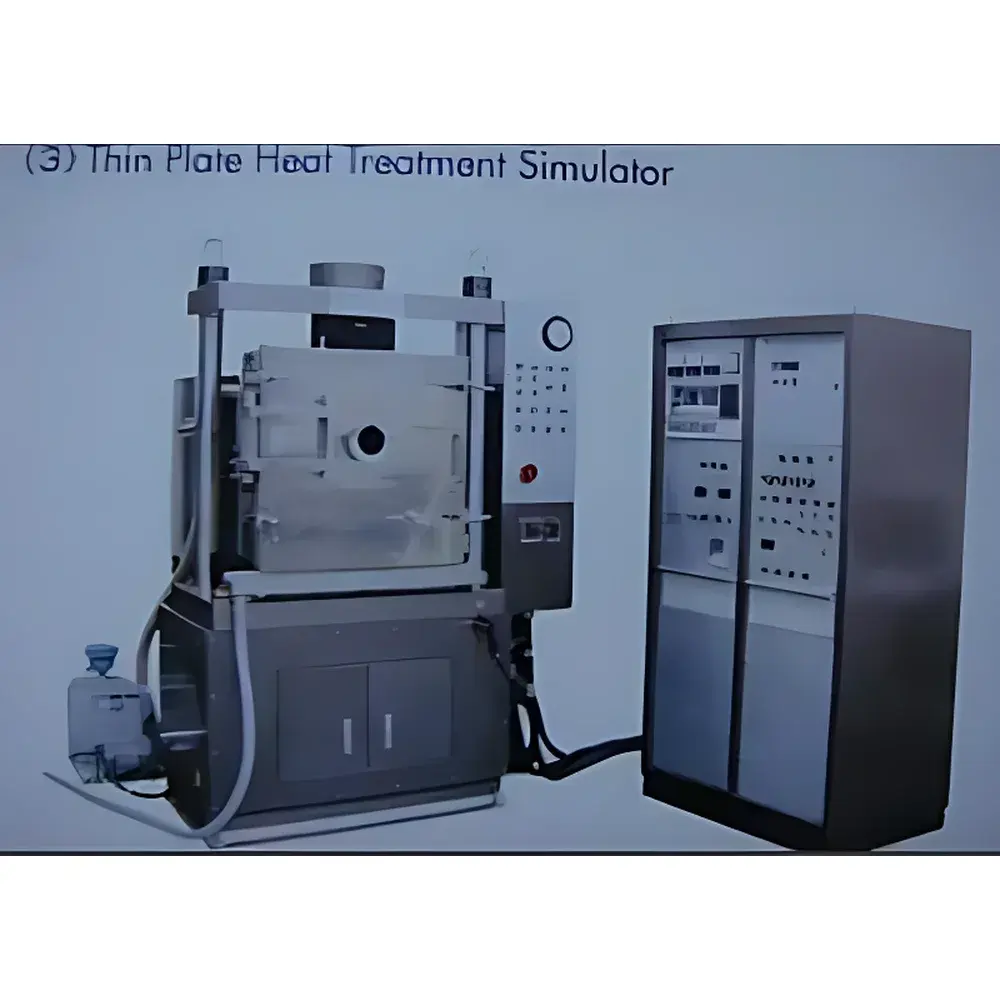
Nippon Steel HeatSimulator HS-Heat Advanced Thin-Sheet Thermal Processing Simulator
| Origin | Japan |
|---|---|
| Supplier Type | Authorized Distributor |
| Origin Category | Imported Instrument |
| Model | HS-Heat |
| Price | USD 950,000 (FOB Yokohama) |
| Specimen Thickness | 0.2–3.2 mm |
| Specimen Width | 30–200 mm |
| Specimen Length | 200–300 mm |
| Electrical Supply | 45–150 kVA, 50/60 Hz (Secondary Voltage: 6–24 V) |
| Max. Heating Temperature | 1400 °C |
| Max. Heating Rate | 500 °C/s |
| Cooling Media | Compressed Air, Nitrogen, Water Mist, Direct Spray |
| Cooling Rate Range | 0.1–1000 °C/s |
| Tensile Load Capacity | 50 kN |
| Actuator Stroke | 50 mm |
| Anti-Buckling Mechanism | Hydraulic Preload System |
Overview
The Nippon Steel HeatSimulator HS-Heat is a high-fidelity, laboratory-scale thermal-mechanical simulator engineered for the precise replication of industrial hot-rolling, continuous annealing, and galvannealing thermal cycles experienced by thin steel sheets (0.2–3.2 mm thickness). It employs direct-resistance heating (DRH) coupled with controlled convective and impingement cooling to reproduce transient temperature profiles with microsecond-level thermal response fidelity. Unlike conventional furnace-based simulators, the HS-Heat achieves rapid, spatially uniform heating via low-voltage, high-current passage through the specimen itself—eliminating thermal lag and enabling true process-relevant thermal histories. Its integrated uniaxial tensile actuation system operates synchronously with thermal cycling, permitting concurrent thermo-mechanical loading under programmable strain rates and hold conditions—critical for studying dynamic recrystallization, phase transformation kinetics (e.g., austenite → ferrite, bainite, martensite), and precipitation behavior in advanced high-strength steels (AHSS), TRIP, and TWIP alloys.
Key Features
- Direct-resistance heating architecture delivering up to 500 °C/s heating rates with ±2 °C thermal uniformity across specimen width (measured via embedded thermocouple array and IR pyrometry)
- Multi-mode cooling system supporting gas quenching (N₂, air), water mist, and high-pressure spray—enabling cooling rates from 0.1 to 1000 °C/s with reproducible heat-transfer coefficient control
- Hydraulically preloaded tensile frame with 50 kN capacity and 50 mm stroke, featuring real-time load-displacement feedback and active buckling suppression during high-temperature extension
- Modular specimen fixture design accommodating standard sheet dimensions (W: 30–200 mm × L: 200–300 mm) with interchangeable electrode clamps for varying thicknesses and electrical resistivity ranges
- Integrated data acquisition at 10 kHz sampling rate for synchronized recording of temperature (Type K thermocouples + two-color pyrometer), load, displacement, voltage, and current
- Robust stainless-steel vacuum-compatible chamber with quartz viewport, optional inert atmosphere (O₂ < 10 ppm) capability, and CE-compliant safety interlocks
Sample Compatibility & Compliance
The HS-Heat accommodates metallic sheet specimens with electrical resistivity between 1.2–35 µΩ·m—including low-carbon steels, IF steels, dual-phase (DP), complex-phase (CP), and press-hardening steels (PHS). Non-ferrous alloys (e.g., Al-Mg-Si, Ti-6Al-4V) may be tested with custom electrode adaptation. All thermal and mechanical protocols are traceable to ASTM E2847 (Standard Practice for Calibration of Thermal Analysis Instruments) and ISO 11357-1 (Plastics — Differential Scanning Calorimetry). The system supports GLP-compliant operation with audit-trail-enabled software, electronic signatures per FDA 21 CFR Part 11, and full metadata embedding (operator ID, calibration date, environmental conditions) in exported datasets.
Software & Data Management
Control and analysis are performed via HeatSim Studio v4.2—a Windows-based application built on LabVIEW RT and MATLAB Runtime. It provides graphical thermal cycle programming (including multi-step ramp/hold/quench sequences), real-time visualization of thermal gradients and stress-strain evolution, and automated calculation of transformation onset temperatures (Ac₁, Ac₃, Ms) using differential thermal analysis (DTA) algorithms. Raw data export conforms to HDF5 format with embedded SI units and time-synchronized channels. Integration with Thermo-Calc and JMatPro is supported for CALPHAD-informed simulation validation. All user actions, parameter changes, and calibration events are logged with timestamped, non-erasable entries compliant with ISO/IEC 17025 documentation requirements.
Applications
- Development and optimization of continuous annealing line (CAL) thermal schedules for automotive AHSS grades
- Quantification of critical cooling rates for martensite suppression and bainitic transformation in medium-Mn steels
- In-situ measurement of flow stress evolution during intercritical annealing of DP steels
- Correlation of thermal history with final grain size, texture, and precipitate distribution (validated via post-test EBSD and TEM)
- Validation of JMAK and Koistinen-Marburger models for phase transformation kinetics under non-isothermal conditions
- Supporting R&D for hydrogen embrittlement mitigation strategies via controlled tempering and bake-hardening simulations
FAQ
What specimen thickness range is supported without modification?
The standard configuration supports specimens from 0.2 mm to 3.2 mm thickness. Electrode contact geometry and current density distribution are automatically adjusted within this range via closed-loop voltage regulation.
Can the system simulate galvannealing thermal cycles with Zn-Fe interdiffusion modeling?
Yes—by coupling programmed heating/cooling sequences with controlled atmosphere (N₂ + 5% H₂) and optional in-chamber Zn vapor source integration (available as add-on module), the HS-Heat enables experimental validation of Fe-Zn intermetallic layer growth kinetics.
Is third-party calibration certification included?
Each unit ships with NIST-traceable calibration certificates for thermocouples, load cell, and displacement transducer, verified per ISO/IEC 17025 by an ILAC-accredited metrology lab.
How is thermal uniformity validated across the specimen width?
Uniformity is confirmed using a 5-point thermocouple array embedded in a reference Inconel 718 specimen, with IR pyrometer cross-validation at three spatial positions; typical deviation is ≤ ±1.8 °C at 900 °C.
Does the software support automated generation of CCT/TTT diagrams?
Yes—HeatSim Studio includes a dedicated Transformation Mapping module that constructs continuous-cooling transformation (CCT) diagrams from sequential single-cycle tests, with statistical uncertainty bands derived from replicate runs (n ≥ 3).



