
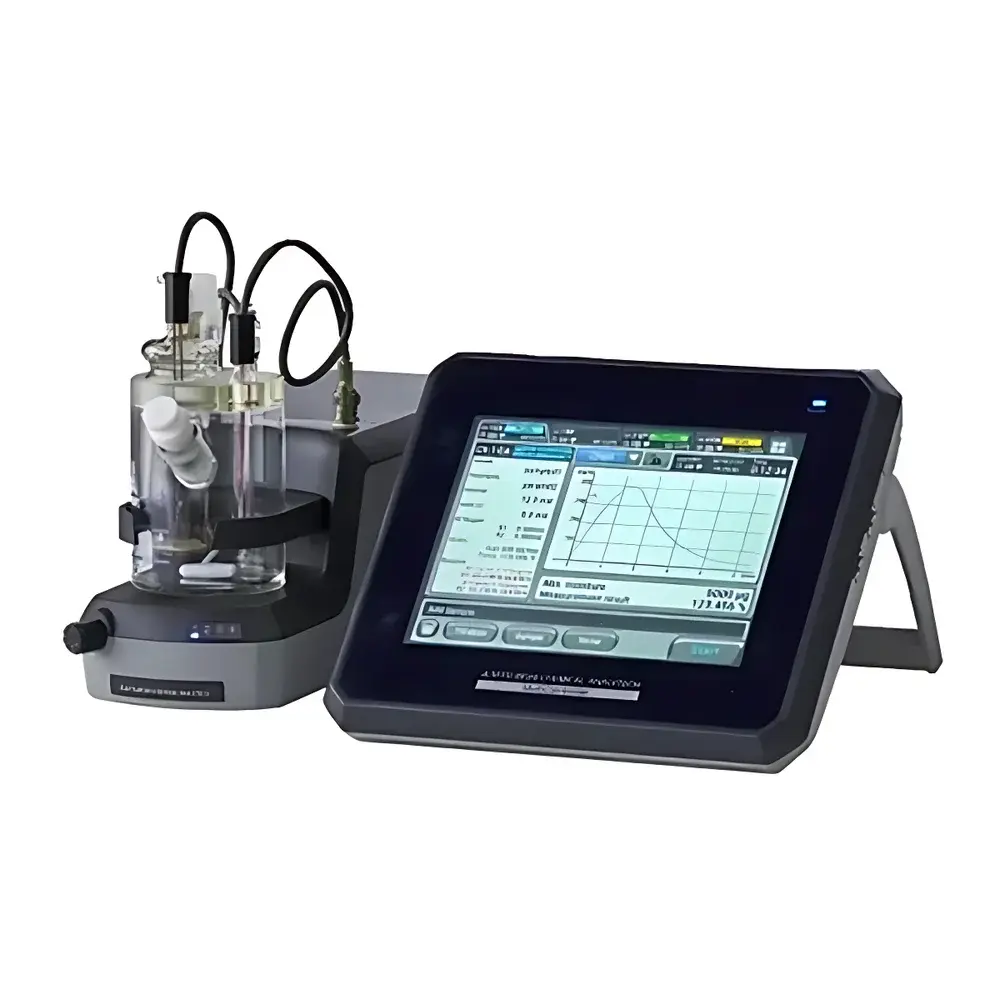
Nittoseiko Analytech CA-310CB Coulometric Bromine Number/Bromine Index Analyzer
| Brand | Nittoseiko Analytech |
|---|---|
| Origin | Japan |
| Model | CA-310CB |
| Instrument Type | Universal Coulometric Potentiometric Titrator |
| Measurement Range | 1–10,000 mg Br/100 g |
| Electrode Readout Accuracy | RSD < 0.3% |
| Resolution | 0.1 µg Br₂ |
| Titration Accuracy | ±3% |
| Compliance Standards | GB/T 1815–2019, SH/T 1551–2018, SH/T 0630–1996, ASTM D1492–13 |
Overview
The Nittoseiko Analytech CA-310CB is a fully automated coulometric titrator engineered for precise, trace-level determination of bromine number (g Br/100 g) and bromine index (mg Br/100 g) in hydrocarbon matrices—primarily aromatic and olefinic petroleum products, solvents, and synthetic intermediates. It operates on the fundamental principle of controlled-potential coulometry: bromide ions (Br⁻) in the electrolyte are electrochemically oxidized to molecular bromine (Br₂) at a constant current within a sealed titration cell; the generated Br₂ reacts quantitatively with carbon–carbon double bonds in the sample. Total charge passed (Q, in coulombs) is measured in real time and converted to bromine mass via Faraday’s law (1 mole Br₂ ≡ 2 × 96,485 C), enabling direct calculation of unsaturation without volumetric reagent standardization. This eliminates drift-related errors inherent in conventional potentiometric titration and ensures high reproducibility across extended operational cycles.
Key Features
- Modular dual-electrode architecture: configurable with either membrane-separated or membrane-free generator electrodes—optimized for matrix-specific interference mitigation (e.g., sulfur compounds, halogenated impurities)
- Dual-mode endpoint detection: selectable between biamperometric (dual platinum indicator electrodes) and bipotentiometric (voltage-sensing) modes for robust endpoint resolution under varying sample conductivity and viscosity
- Programmable pre-warmup scheduling: instrument initiates self-stabilization sequence prior to scheduled analysis—reducing operator wait time and ensuring thermal and electrochemical equilibrium before first injection
- High-speed coulometric mode: accelerated current ramping and optimized cell geometry reduce average analysis cycle time by up to 40% versus conventional coulometric systems, while maintaining stoichiometric fidelity
- Integrated SOP-driven workflow engine: users define and store complete analytical protocols—including solvent volume, sample mass, current setpoint, stirring speed, and endpoint sensitivity—enabling walk-away operation with full audit trail
- 8.4-inch capacitive touchscreen HMI: intuitive icon-based navigation with multilingual UI support (English default; Chinese optional firmware module)
- Multi-channel scalability: single master control unit supports up to four independent titration modules—enabling parallel analysis, method comparison, or statistical replication without hardware duplication
- Automated fluid handling: motor-driven syringe pumps manage electrolyte replenishment, waste evacuation, and cell rinsing—minimizing manual intervention and cross-contamination risk
Sample Compatibility & Compliance
The CA-310CB is validated for use with light distillates (e.g., BTX streams), naphthas, reformates, styrene monomer, and polymer-grade propylene—samples compliant with ASTM D1492–13, SH/T 1551–2018, and GB/T 1815–2019 test protocols. Its sealed, argon-purged titration cell prevents atmospheric moisture ingress and bromine volatilization, critical for low-level (<10 mg Br/100 g) measurements. All electronic logging—including current profiles, endpoint timestamps, and calibration history—adheres to ALCOA+ data integrity principles. Full 21 CFR Part 11 compliance is achievable via optional secure user authentication, electronic signatures, and immutable audit trails when deployed in regulated QC environments (e.g., ISO/IEC 17025-accredited labs, GMP manufacturing sites).
Software & Data Management
Embedded firmware provides real-time coulomb integration, automatic blank subtraction, and dynamic current correction based on cell resistance monitoring. Raw data (Q vs. t curves, potential transients) and processed results (bromine index, RSD, % recovery) export directly to CSV or XML. LIMS integration is supported via ASTM E1384-compliant HL7 or TCP/IP socket interface—enabling bidirectional sample ID exchange, result auto-posting, and instrument status polling. Optional PC-based software (CA-Link Suite) adds advanced reporting (ASTM-style certificates), multi-instrument fleet monitoring, and trend analysis against historical control charts.
Applications
- Quality control of benzene, toluene, and xylene (BTX) feedstocks per SH/T 0630–1996
- Monitoring bromine index in ethylene cracker feed to prevent catalyst poisoning in downstream alkylation units
- Specification testing of styrene monomer per ASTM D1492–13 for polymerization-grade release
- Research-scale screening of hydrogenation efficiency in unsaturated intermediates
- Regulatory compliance testing for halogen content in pharmaceutical excipients (USP <231> referenced methodology)
FAQ
What sample types require membrane-separated generator electrodes?
Samples containing sulfur compounds (e.g., mercaptans, sulfides) or residual metals that catalyze bromine decomposition benefit from membrane isolation to prevent generator electrode fouling and erroneous current consumption.
How does the CA-310CB handle high-viscosity samples like heavy naphthenic oils?
Viscous matrices require pre-dilution with high-purity chlorobenzene or o-xylene; the system’s programmable stirring profile (50–800 rpm) and heated cell option (up to 60 °C) ensure homogeneous dispersion and rapid Br₂ diffusion kinetics.
Is method validation documentation provided with the instrument?
Yes—Nittoseiko Analytech supplies IQ/OQ documentation templates, performance verification protocols (including repeatability, linearity, and LOD/LOQ assessment), and traceable calibration certificates for current source and electrometer modules.
Can the CA-310CB be integrated into an existing laboratory automation framework?
Absolutely—the master controller supports Modbus TCP and RS-485 interfaces for PLC-level coordination with robotic samplers, carousel loaders, and centralized MES systems.



