
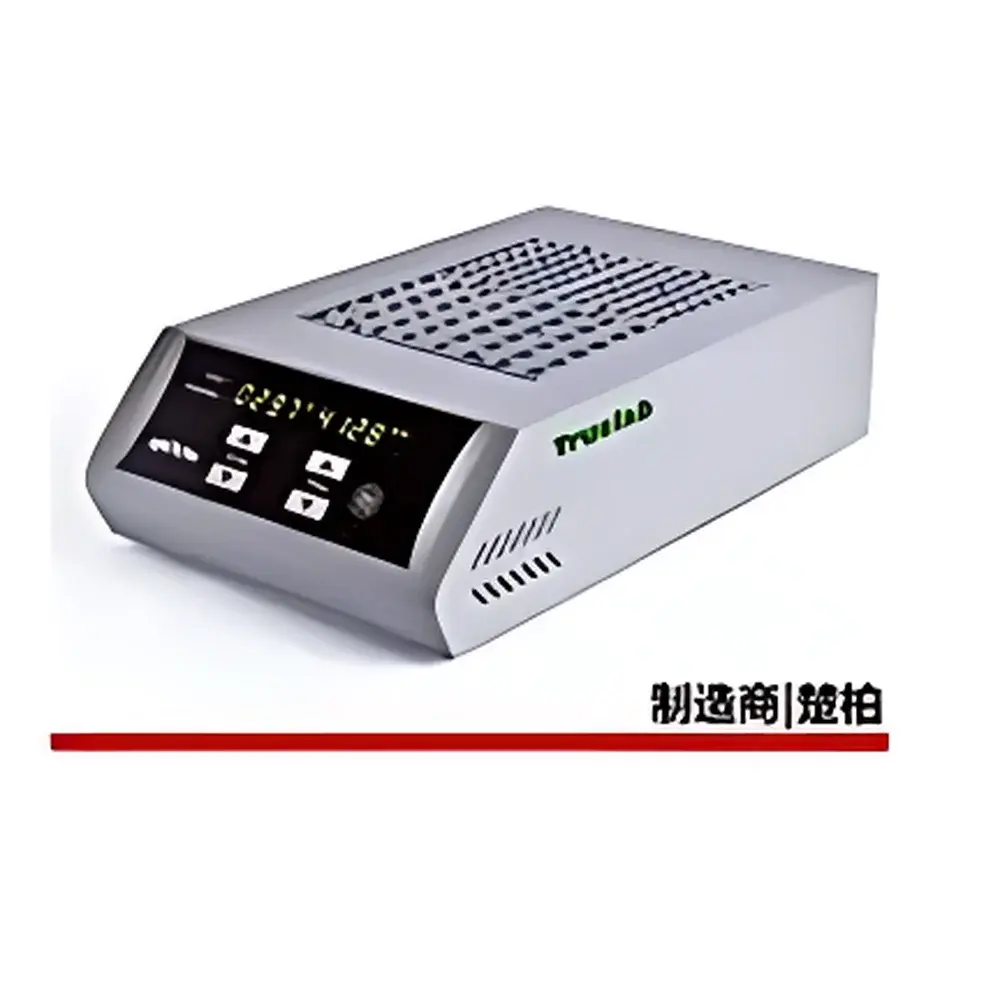
Truelab HB-150 High-Temperature Dry Block Metal Bath
| Brand | Truelab |
|---|---|
| Model | HB-150 |
| Temperature Range | 0–150 °C |
| Temperature Accuracy | ±0.1 °C |
| Temperature Stability | ≤±0.5 °C (40–100 °C), ≤±1.0 °C (100–150 °C) |
| Heating Uniformity (Module) | ≤±0.5 °C |
| Module Temperature Difference | ≤0.3 °C @ 40 °C |
| Ramp Time | ≤30 min (20 °C → 150 °C) |
| Display Resolution | 0.1 °C |
| Timer Range | 0–99 h 59 min |
| Power Rating | 200–600 W (model-dependent) |
| Dimensions (W×D×H) | 260×220×95 mm |
| Net Weight | 5 kg |
| Compliance | CE, RoHS, ISO 9001-manufactured |
Overview
The Truelab HB-150 High-Temperature Dry Block Metal Bath is an engineered alternative to conventional oil baths for precise, contamination-free thermal incubation and reaction control in modern laboratories. Unlike liquid-based heating systems, this dry block instrument utilizes solid-state aluminum alloy heating blocks with integrated high-efficiency resistive elements and PID-controlled microprocessor regulation to deliver rapid, uniform, and stable temperature environments across a broad operational range of 0–150 °C. Its design eliminates risks associated with oil degradation, evaporation, flammability, and cross-contamination—making it especially suitable for applications requiring strict sample integrity, such as nucleic acid denaturation, enzyme kinetics, immunoassay incubation, and controlled thermal digestion protocols. The HB-150 series conforms to fundamental laboratory safety and performance expectations defined in ISO/IEC 17025 for equipment used in accredited testing laboratories.
Key Features
- Microprocessor-based digital temperature control with real-time LCD display showing setpoint, actual block temperature, and countdown timer (0–99 h 59 min).
- High-precision thermistor feedback system ensuring ±0.1 °C display resolution and automatic offset calibration for long-term drift compensation.
- Dual-stage thermal protection: programmable overtemperature cutoff plus independent mechanical safety thermostat for fail-safe operation.
- Optimized aluminum block architecture delivering ≤±0.5 °C intra-block uniformity at 40–100 °C and ≤±1.0 °C at elevated temperatures (100–150 °C), with inter-module variation ≤0.3 °C under standardized load conditions.
- Modular interchangeability: supports 17 standard block configurations—including formats for 0.2 mL PCR tubes (up to 96-well), 1.5/2.0 mL microcentrifuge tubes, 10–40 mm diameter test tubes, and 96-well ELISA plates—enabling seamless adaptation to diverse assay workflows.
- Energy-efficient operation with power consumption scaling per configuration (200 W for single-block HB-1501; up to 600 W for quad-block HB-1204), minimizing standby heat loss and thermal inertia.
Sample Compatibility & Compliance
The HB-150 accommodates a wide range of vessel geometries without requiring consumable oils or external circulators. All heating modules are CNC-machined from aerospace-grade anodized aluminum to ensure corrosion resistance, dimensional repeatability, and consistent thermal conductivity. Each module is validated for compatibility with common labware materials including polypropylene, polycarbonate, borosilicate glass, and stainless steel. The instrument meets CE marking requirements for electromagnetic compatibility (EMC Directive 2014/30/EU) and low-voltage safety (LVD Directive 2014/35/EU). It is manufactured under an ISO 9001-certified quality management system and supports GLP-compliant documentation through optional timestamped audit logs when integrated with Truelab’s LabLink software suite.
Software & Data Management
While the HB-150 operates autonomously via front-panel controls, optional USB connectivity enables integration with Truelab LabLink v3.2 software for remote parameter setting, real-time temperature logging, and export of CSV-formatted time-series data. The software supports FDA 21 CFR Part 11–compliant user authentication, electronic signatures, and immutable audit trails—critical for regulated environments in pharmaceutical QC, clinical diagnostics, and food safety testing laboratories. Data retention includes date/time stamps, operator ID, temperature deviation alerts, and thermal ramp profiles for full traceability during method validation or regulatory inspections.
Applications
- Thermal denaturation and hybridization steps in molecular biology workflows (e.g., DNA/RNA extraction, RT-PCR setup, restriction digests).
- Controlled enzymatic reactions requiring tight thermal control between 37 °C and 95 °C (e.g., kinase assays, ligase incubations).
- Sample preparation for chromatographic analysis—including derivatization, hydrolysis, and solvent evaporation pre-concentration.
- Stability testing of active pharmaceutical ingredients (APIs) and excipients per ICH Q1A(R2) guidelines.
- Heavy metal digestion in environmental and food testing labs using EPA Method 3050B or ISO 11466 protocols.
- Calibration of temperature-sensitive sensors and reference standards in metrology labs.
FAQ
Is the HB-150 suitable for use with organic solvents?
Yes—unlike oil baths, the dry block design eliminates solvent immersion risk. However, direct contact between volatile solvents and hot aluminum surfaces should be avoided; use appropriate tube caps and secondary containment.
Can multiple temperature zones be programmed simultaneously?
No—the HB-150 maintains a single uniform temperature across the entire block surface. For multi-zone control, consider Truelab’s dual-independent-block models (e.g., HB-200D).
What maintenance is required?
Routine cleaning with isopropyl alcohol and lint-free cloth; no lubrication or fluid replacement needed. Annual verification of temperature accuracy using NIST-traceable calibrated probe is recommended.
Does it support external temperature probes for sample-core monitoring?
The unit does not include built-in probe input, but third-party PT100 or thermocouple interfaces can be added via optional LabLink expansion module (sold separately).
How is temperature uniformity verified during factory calibration?
Each unit undergoes 9-point thermal mapping per ASTM E2202-18 using a calibrated 9-channel data logger and reference-grade PRTs before shipment; calibration certificate available upon request.



