
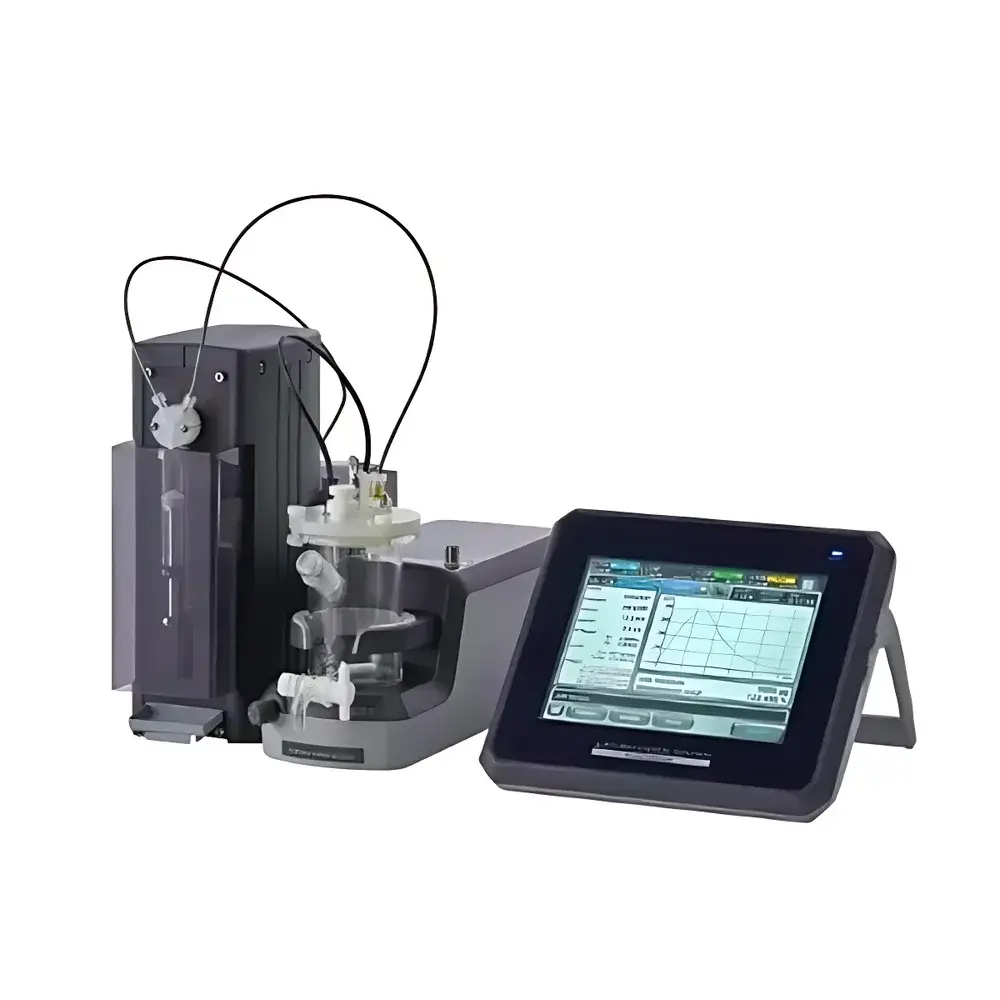
Nittoseiko Analytech CA-310KB Coulometric and Volumetric Bromine Number/Bromine Index Titrator
| Brand | Nittoseiko Analytech |
|---|---|
| Origin | Japan |
| Model | CA-310KB |
| Measurement Range | 10 mgBr/100g – 500 gBr/100g |
| Relative Standard Deviation | < 0.3% |
| Detection Resolution | 10 µg Br₂ |
| Titration Accuracy | ±5% |
| Electrolysis Current | 430 mA (516 mA in High-Speed Mode) |
| Display | 8.4-inch color TFT touchscreen |
| Max. Simultaneous Channels | 4 (optional) |
| Compliance | ASTM D1159, SH/T 1767, SH/T 1485.5, GB/T 11136 |
Overview
The Nittoseiko Analytech CA-310KB is a dual-mode electrochemical titrator engineered for precise determination of bromine number (g Br₂/100 g) and bromine index (mg Br₂/100 g) in hydrocarbon samples—primarily unsaturated aliphatic and aromatic compounds found in petroleum distillates, styrene monomers, diolefins, and industrial solvents. It operates on the principle of potentiometric volumetric titration using a standardized KBr–KBrO₃ reagent, where endpoint detection relies on a sharp, reversible potential shift induced by free bromine generation at the indicator electrode pair. Unlike coulometric systems that generate titrant electrolytically, the CA-310KB employs calibrated burette delivery with high-resolution micro-dosing (minimum dispense volume: 2 µL), enabling trace-level quantification across five orders of magnitude—from low-concentration refinery streams (10 mgBr/100g) to highly reactive olefinic feedstocks (up to 500 gBr/100g). Its architecture integrates real-time polarization potential monitoring, automatic baseline correction, and continuous current pulse control to minimize drift and suppress false endpoints caused by redox-active impurities or electrode fouling.
Key Features
- Dual operational mode support: volumetric titration (primary) with optional coulometric compatibility via shared stirrer platform—enabling method flexibility without hardware duplication.
- High-speed electrolysis mode (516 mA max current) reduces stabilization time by >40% versus conventional settings, accelerating throughput while maintaining stoichiometric fidelity per ASTM D1159 Annex A3.
- Embedded SOP manager: stores and enforces step-by-step procedural logic—including sample mass input, solvent selection, reagent blank calibration, and post-titration electrode conditioning—for auditable, operator-independent execution.
- 8.4-inch capacitive touchscreen interface with configurable bilingual display (English default; Chinese optional), supporting intuitive navigation, live titration curve visualization, and real-time residual potential tracking.
- Modular multi-channel architecture: up to four independent titration units controlled from a single master console—ideal for parallel batch analysis, method validation, or inter-laboratory reproducibility studies.
- Automated fluid handling: integrated peristaltic pumps enable hands-free reagent aspiration, waste evacuation, and cell rinsing—reducing cross-contamination risk and minimizing manual intervention during unattended runs.
- Comprehensive GLP/GMP readiness: audit-trail logging (user ID, timestamp, parameter changes, raw electrode potential values), electronic signature support, and encrypted data export compliant with FDA 21 CFR Part 11 requirements.
Sample Compatibility & Compliance
The CA-310KB is validated for use with light hydrocarbons (e.g., naphtha, cracked gasoline), aromatic fractions (BTX, xylenes), polymer-grade monomers (styrene, butadiene), and synthetic intermediates containing carbon–carbon double bonds or triple bonds. Sample matrices must be soluble in acetic acid–chloroform mixtures (standardized per SH/T 1767); water content must remain below 50 ppm to prevent side reactions with bromine. The instrument meets regulatory alignment with ASTM D1159–07(2017) for petroleum products, SH/T 1485.5–1995 for divinylbenzene, SH/T 1767–2008 for industrial aromatics, and GB/T 11136–1989 for benzene derivatives. All firmware and calibration protocols are traceable to NIST-certified reference materials, and system suitability testing includes daily blank verification, repeatability checks (n ≥ 6), and recovery assessment using certified brominated standards.
Software & Data Management
Firmware v4.2+ supports structured data capture via embedded SQLite database, storing full experimental metadata—including electrode potential vs. volume curves, derivative plots, user annotations, and calculated statistics (mean, RSD, confidence intervals). Data export options include CSV (for LIMS integration), PDF reports with digital signatures, and encrypted USB backups. Four USB 2.0 ports accommodate balance interfaces (auto-weight import), barcode scanners, and peripheral printers (thermal or impact dot-matrix). LAN connectivity enables remote monitoring, centralized configuration management, and scheduled firmware updates. Built-in diagnostics provide contextual troubleshooting guidance—including electrode impedance diagnostics, pump flow verification, and reagent depletion alerts—with event-driven notifications via email or SNMP trap.
Applications
- Quality control of petrochemical feedstocks: quantifying residual olefins in reformate or hydrotreated naphthas prior to catalytic reforming.
- Monomer purity assurance: verifying bromine index compliance (< 10 mgBr/100g) in polymerization-grade styrene per ISO 10302 specifications.
- Refinery process optimization: monitoring bromine number trends across fractionation cuts to adjust hydrogenation severity.
- R&D screening of novel catalysts: evaluating selectivity in partial hydrogenation reactions by tracking unsaturation loss kinetics.
- Regulatory reporting: generating auditable datasets for REACH substance registration dossiers requiring bromine reactivity profiling.
FAQ
What is the difference between bromine number and bromine index?
Bromine number expresses unsaturation as grams of bromine per 100 g sample (g Br₂/100 g), typically used for higher-olefin-content materials like cracked stocks. Bromine index reports the same property in milligrams per 100 g (mg Br₂/100 g), preferred for low-level unsaturation in purified aromatics or solvents.
Can the CA-310KB perform both volumetric and coulometric titrations?
It is primarily a volumetric potentiometric titrator. However, its universal stirrer platform and compatible electrode sets allow integration with external coulometric cells—though dedicated coulometric operation requires separate power supply and controller modules not included in standard CA-310KB configuration.
How does the instrument handle electrode drift during long sequences?
It applies dynamic baseline correction by continuously monitoring open-circuit potential before each titration cycle and subtracting measured background offset from active signal acquisition—ensuring consistent endpoint discrimination even after 8+ hours of continuous operation.
Is method validation documentation provided?
Yes—Nittoseiko Analytech supplies IQ/OQ documentation templates, performance qualification protocols aligned with ASTM E2500, and a complete set of system suitability test procedures covering precision, accuracy, linearity, and robustness per ICH Q2(R2).
What maintenance intervals are recommended for routine operation?
Daily: electrode cleaning with ethanol and ultrasonic bath; weekly: pump tubing inspection and replacement if cracked; quarterly: full calibration verification using certified bromine standards and volumetric pipette checks per ISO/IEC 17025 guidelines.




